. 2019 Jan 22;116(4):1136-1145.
doi: 10.1073/pnas.1804350116. Epub 2018 Dec 31.

Neoproterozoic glacial origin of the Great Unconformity

Affiliations

Neoproterozoic glacial origin of the Great Unconformity

C Brenhin Keller et al. Proc Natl Acad Sci U S A. .

Abstract

The Great Unconformity, a profound gap in Earth's stratigraphic record often evident below the base of the Cambrian system, has remained among the most enigmatic field observations in Earth science for over a century. While long associated directly or indirectly with the occurrence of the earliest complex animal fossils, a conclusive explanation for the formation and global extent of the Great Unconformity has remained elusive. Here we show that the Great Unconformity is associated with a set of large global oxygen and hafnium isotope excursions in magmatic zircon that suggest a late Neoproterozoic crustal erosion and sediment subduction event of unprecedented scale. These excursions, the Great Unconformity, preservational irregularities in the terrestrial bolide impact record, and the first-order pattern of Phanerozoic sedimentation can together be explained by spatially heterogeneous Neoproterozoic glacial erosion totaling a global average of 3-5 vertical kilometers, along with the subsequent thermal and isostatic consequences of this erosion for global continental freeboard.

Keywords: Cambrian explosion; Great Unconformity; glacial erosion; snowball Earth; zircon.


Conflict of interest statement

Conflict of interest statement: The editor, P.F.H., is an adjunct professor in the same department as J.M.H.

Figures
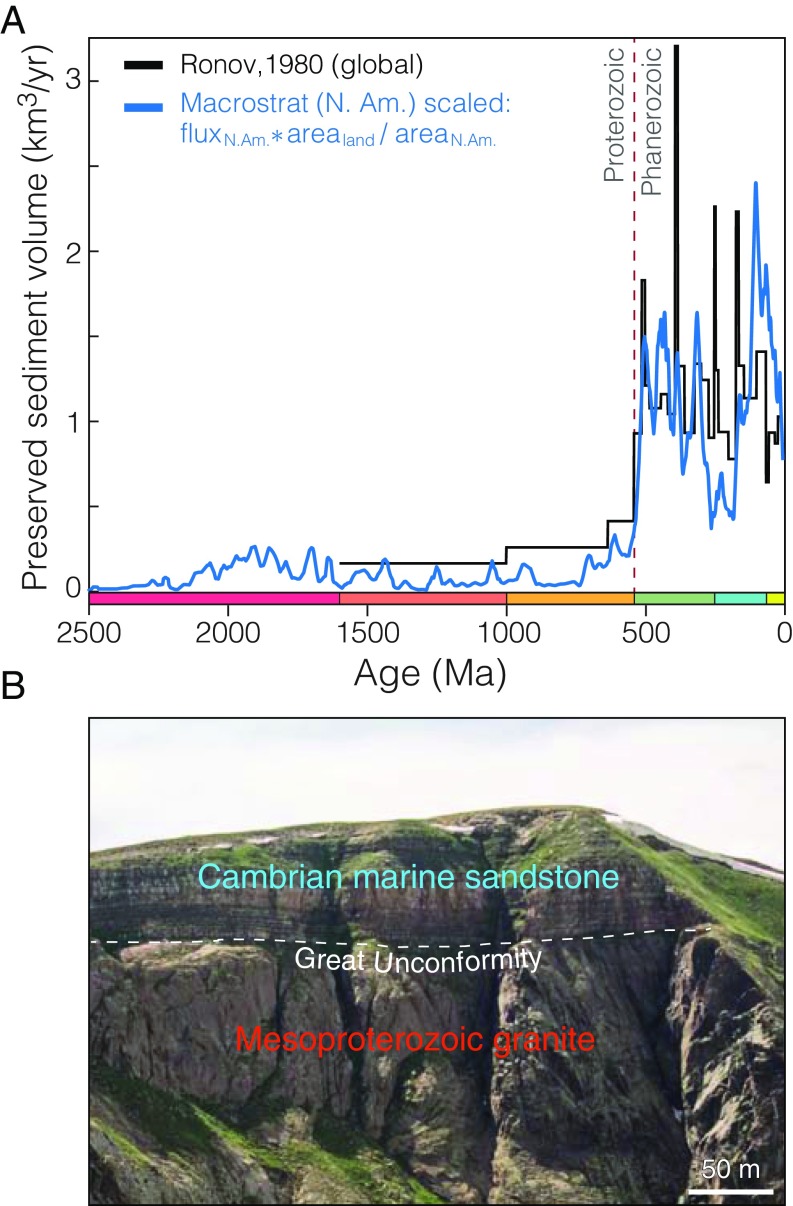
Fig. 1.
Fig. 1.
The Great Unconformity. (A) Global preserved sedimentary rock volume increases by more than a factor of 5 across the Phanerozoic–Proterozoic boundary in both the estimate of Ronov et al. (4) and a global scaling of North American units from the Macrostrat database by the area ratio of global land area to North American land area (a factor of 6.1) according to Husson and Peters (8), excluding recent alluvium. (B) The Cambrian Ignacio quartzite overlies the Mesoproterozoic (1.35 Ga) Eolus granite at a sharp peneplanar nonconformity in the Needle Mountains, CO.
Fig. 2.
Fig. 2.
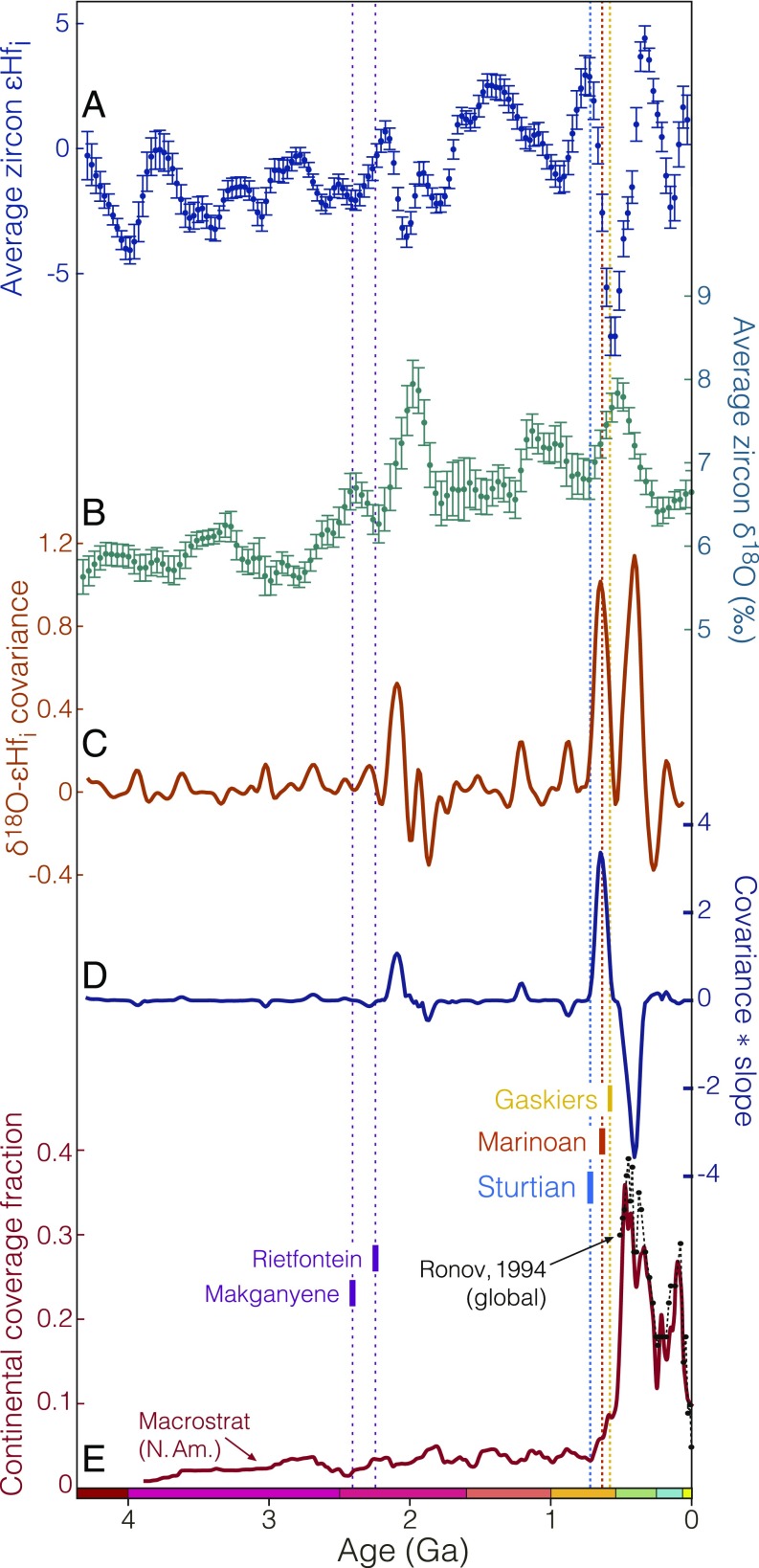
Zircon isotope variability and continental sediment coverage throughout Earth’s history. (A) Average zircon εHf. (B) Average zircon δ18O. (C) The covariance between standardized zircon εHf and δ18O. Positive covariance indicates times where average zircon oxygen and hafnium isotopes both indicate either increasing or decreasing crustal recycling in new magmas. (D) The product of standardized εHf - δ18O covariance with standardized average slope. Large positive values indicate high covariance and increasing crustal reworking. Large negative values indicate high covariance and decreasing crustal reworking. (E) Fraction of North American continental area covered by marine sediment (age uncertainty represented by σ = 10 My Gaussian kernel) from Macrostrat (–9), along with the corresponding global Phanerozoic record of Ronov (23).
Fig. 3.
Fig. 3.
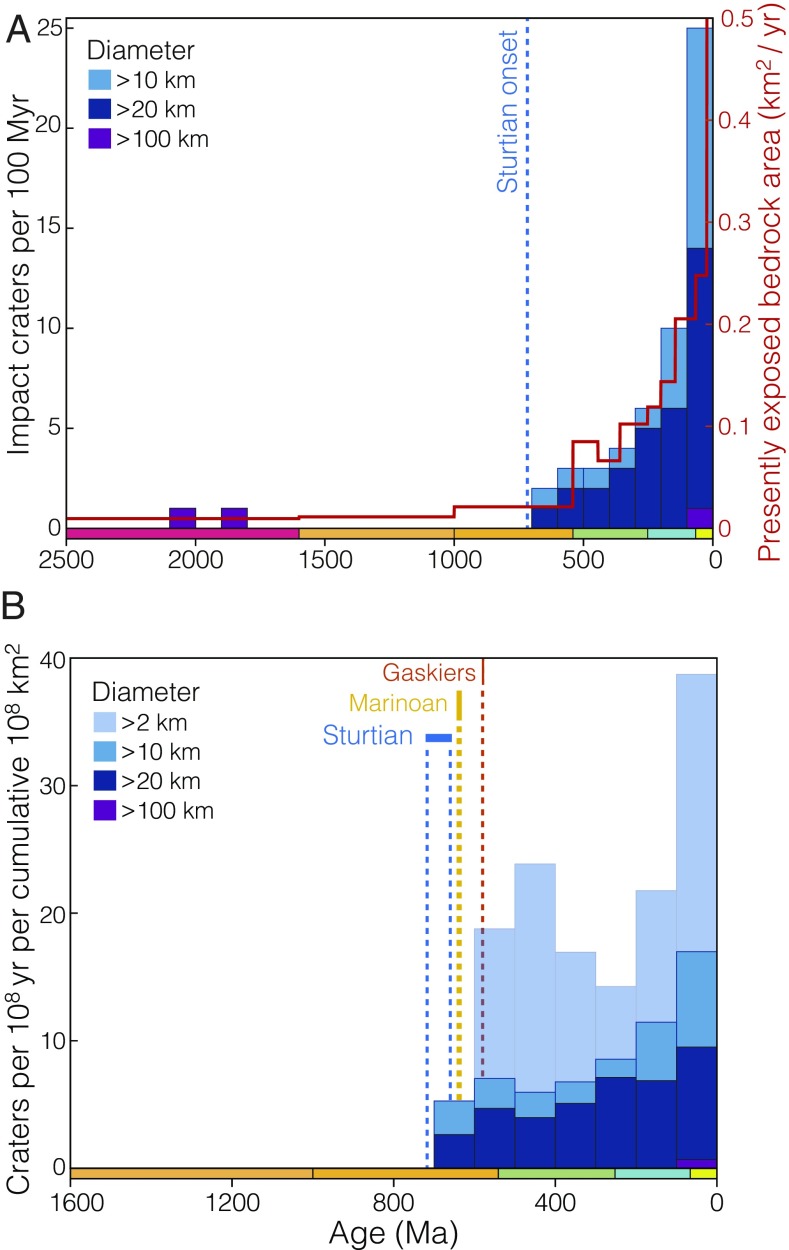
The record of impact craters preserved in Earth’s continental crust with formation ages known to within ±75 My (1-σ) from the PASSC database (42). (A) Absolute crater counts (left axis) for several size ranges tallied in 100-My bins over the past 2.5 Ga, plotted alongside global exposed bedrock area in km2/y (right axis) (43). (B) Apparent impact cratering rate per unit bedrock area area tallied in 100-My bins for crater diameters from 2 km to >100 km.
Fig. 4.
Fig. 4.
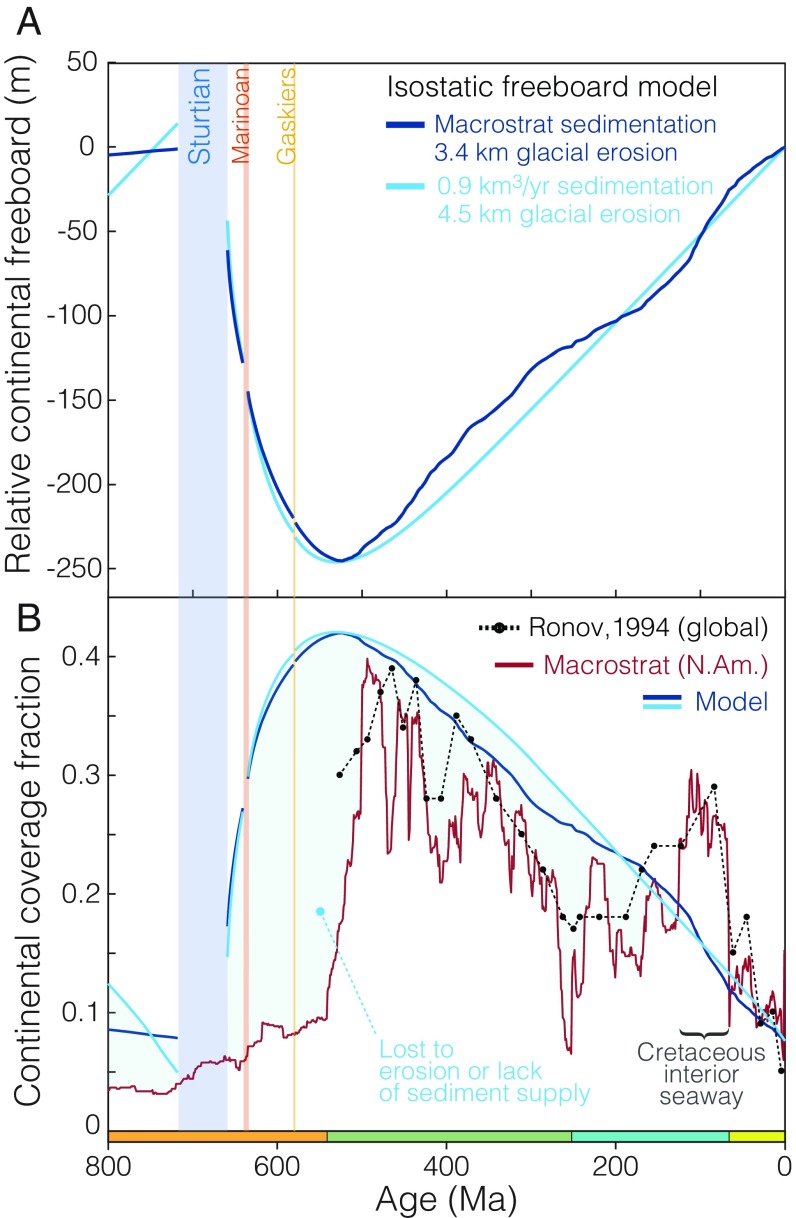
Isostatic global sea level and continental coverage model. (A) Temporal evolution in average continental freeboard driven by erosion, subsequent thermal subsidence, and sediment accumulation. Neoproterozoic glacial erosion is distributed in proportion to the duration of each glacial interval. (B) Corresponding modeled continental coverage fraction assuming a constant hypsometric profile, compared with the observed North American record from Macrostrat (–9) and Ronov’s (23) global record of Phanerozoic marine sediment coverage.
Fig. 5.
Fig. 5.
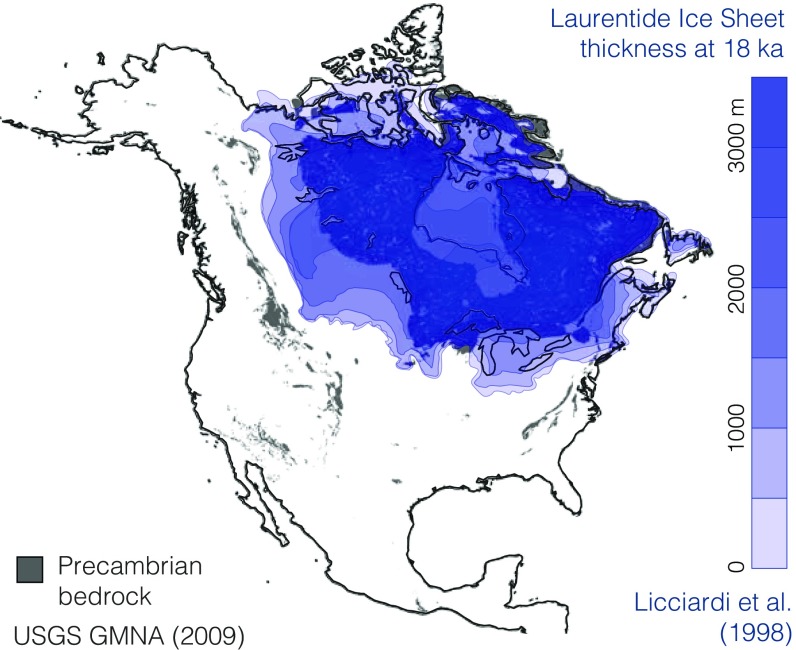
Capture of the Great Unconformity by Laurentide glacial erosion, illustrated by the correspondence (73) between Precambrian basement exposure as mapped in the Geologic Map of North America (74) and the extent of the Laurentide ice sheet at 18 ka as estimated by Licciardi et al. (75). Note the survival of Phanerozoic cover under the ice divide near Hudson’s Bay, where basal sliding velocities are low.

References

    1. Powell JW, Thompson AH, Coues E, Goode GB. Exploration of the Colorado River of the West and its Tributaries. Government Printing Office; Washington, DC: 1875.
    1. Walcott CD. 1914. Cambrian Geology and Paleontology, Smithsonian Miscellaneous Collections (The Lord Baltimore Press, Washington, DC), Vol 57.
    1. Sloss LL. Sequences in the cratonic interior of North America. Geol Soc Am Bull. 1963;74:93–114.
    1. Ronov AB, Khain VE, Balukhovsky AN, Seslavinsky KB. Quantitative analysis of Phanerozoic sedimentation. Sediment Geol. 1980;25:311–325.
    1. Peters SE, Gaines RR. Formation of the ‘Great Unconformity’ as a trigger for the Cambrian explosion. Nature. 2012;484:363–366. - PubMed

Publication types