


Lung Ultrasound and Blood Gas-Based Classification of Critically Ill Patients with Dyspnea: A Pathophysiologic Approach
- PMID: 30598565
- PMCID: PMC6259439
- DOI: 10.4103/ijccm.IJCCM_338_18
Lung Ultrasound and Blood Gas-Based Classification of Critically Ill Patients with Dyspnea: A Pathophysiologic Approach
Abstract
Introduction: The objective of this study was to classify dyspneic patients and to evaluate outcome variables on the basis of lung ultrasound (LUS) and arterial blood gas (ABG) findings.
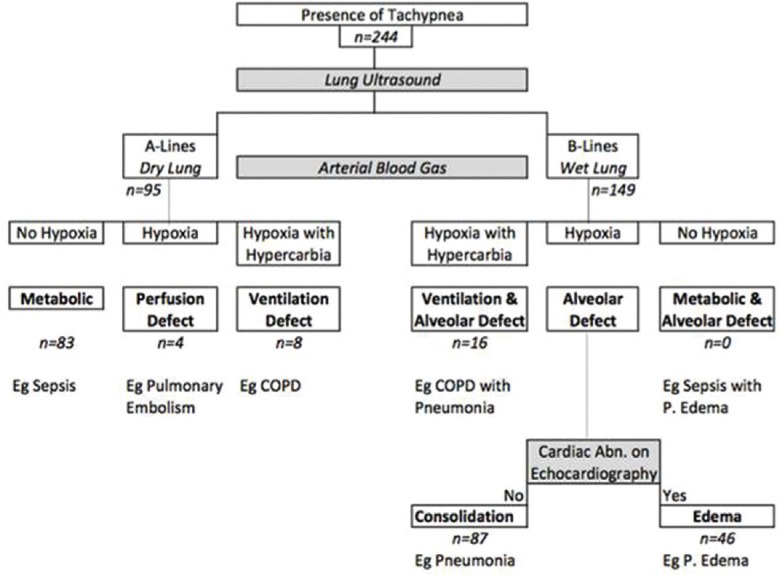
Methods: We performed a retrospective chart-based review in which we included patients with dyspnea admitted to our intensive care unit (ICU) between March 2015 and August 2016. On the basis of LUS (presence of A-lines/B-lines) and ABG (hypoxia/hypercarbia), patients were classified into six groups: (i) metabolic defect (dry lung, no hypoxia); (ii) perfusion defect (dry lung, hypoxia); (iii) ventilation defect (dry lung, hypoxia, and hypercarbia); (iv) ventilation and alveolar defect (wet lung, hypoxia, and hypercarbia); (v) alveolar defect-consolidation ([wet lung] hypoxia, no echocardiographic [ECG] abnormality); (vi) alveolar defect-pulmonary edema (wet lung [usually bilateral], hypoxia, ECG abnormality). The patient's demographic data, sequential organ failure assessment (SOFA) score, need for intubation, vasopressors, form of mechanical ventilation, ICU outcome, and length of stay were noted.
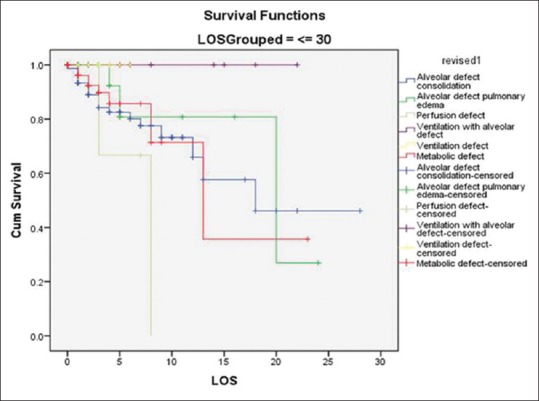
Results: A total of 244 out of 435 patients were eligible for inclusion in the study. The median age was 56 years. 132 patients (54.1%) required mechanical ventilation, and median SOFA score was 7. Noninvasive ventilation was required in 87.5% of patients with ventilation defect as compared to 9.2% with alveolar defect-consolidation (P < 0.0001). We had 21.7% mortality in patients with alveolar defect-consolidation, 10.8% mortality in patients with metabolic defect, and 8.7% mortality in patients with alveolar defect-pulmonary edema (P < 0.0001).
Conclusion: This classification gives an organized approach in managing patients with dyspnea. It predicts that patients with alveolar defect-consolidation are most sick of all the groups and need immediate intervention.
Keywords: A-lines; B-lines; arterial blood gas analysis; lung ultrasound.
Conflict of interest statement
There are no conflicts of interest.
Figures
References
-
- Collins S, Storrow AB, Kirk JD, Pang PS, Diercks DB, Gheorghiade M, et al. Beyond pulmonary edema: Diagnostic, risk stratification, and treatment challenges of acute heart failure management in the emergency department. Ann Emerg Med. 2008;51:45–57. - PubMed
-
- Ray P, Delerme S, Jourdain P, Chenevier-Gobeaux C. Differential diagnosis of acute dyspnea: The value of B natriuretic peptides in the emergency department. QJM. 2008;101:831–43. - PubMed
-
- Peacock WF. Using the emergency department clinical decision unit for acute decompensated heart failure. Cardiol Clin. 2005;23:569–88. viii. - PubMed
-
- Logeart D, Saudubray C, Beyne P, Thabut G, Ennezat PV, Chavelas C, et al. Comparative value of Doppler echocardiography and B-type natriuretic peptide assay in the etiologic diagnosis of acute dyspnea. J Am Coll Cardiol. 2002;40:1794–800. - PubMed
LinkOut - more resources
Full Text Sources