Hepatitis C: From inflammatory pathogenesis to anti-inflammatory/hepatoprotective therapy
- PMID: 30598575
- PMCID: PMC6305530
- DOI: 10.3748/wjg.v24.i47.5297
Hepatitis C: From inflammatory pathogenesis to anti-inflammatory/hepatoprotective therapy
Abstract
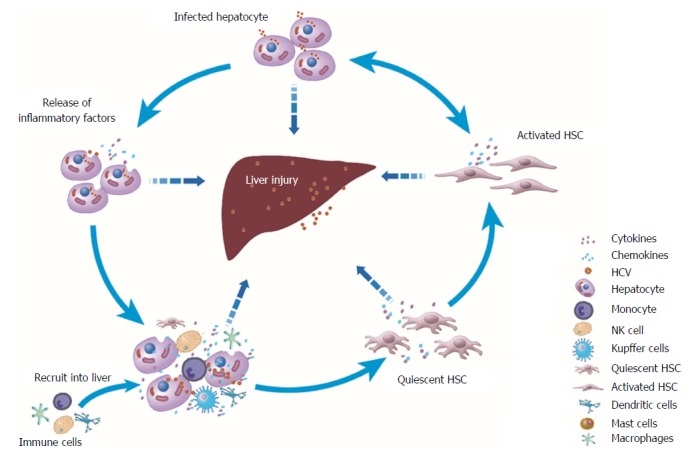
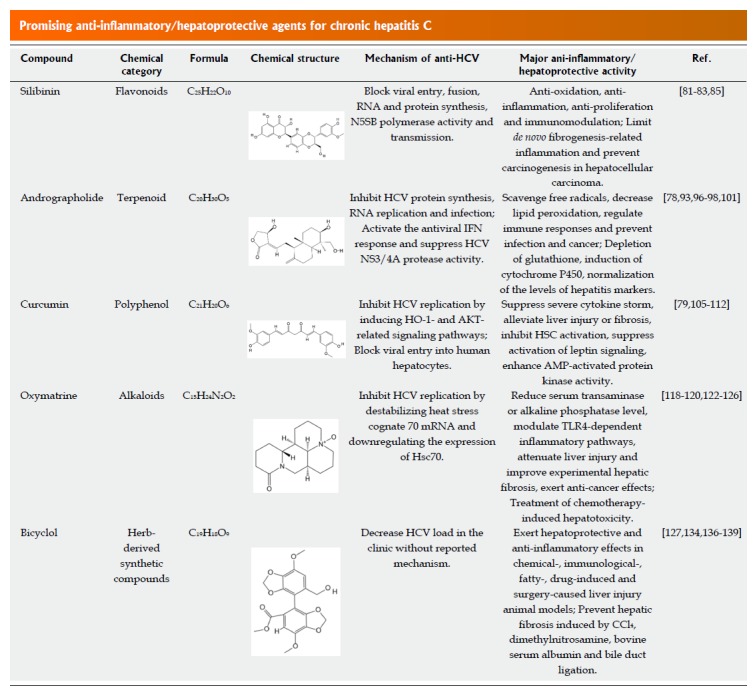
Hepatitis C virus (HCV) infection commonly causes progressive liver diseases that deteriorate from chronic inflammation to fibrosis, cirrhosis and even to hepatocellular carcinoma. A long-term, persistent and uncontrolled inflammatory response is a hallmark of these diseases and further leads to hepatic injury and more severe disease progression. The levels of inflammatory cytokines and chemokines change with the states of infection and treatment, and therefore, they may serve as candidate biomarkers for disease progression and therapeutic effects. The mechanisms of HCV-induced inflammation involve classic pathogen pattern recognition, inflammasome activation, intrahepatic inflammatory cascade response, and oxidative and endoplasmic reticulum stress. Direct-acting antivirals (DAAs) are the first-choice therapy for effectively eliminating HCV, but DAAs alone are not sufficient to block the uncontrolled inflammation and severe liver injury in HCV-infected individuals. Some patients who achieve a sustained virologic response after DAA therapy are still at a long-term risk for progression to liver cirrhosis and hepatocellular carcinoma. Therefore, coupling with anti-inflammatory/hepatoprotective agents with anti-HCV effects is a promising therapeutic regimen for these patients during or after treatment with DAAs. In this review, we discuss the relationship between inflammatory mediators and HCV infection, summarize the mechanisms of HCV-induced inflammation, and describe the potential roles of anti-inflammatory/hepatoprotective drugs with anti-HCV activity in the treatment of advanced HCV infection.
Keywords: Anti-inflammatory and hepatoprotective therapy; Hepatitis C virus infection; Inflammatory pathogenesis; Liver disease.
Conflict of interest statement
Conflict-of-interest statement: No potential conflicts of interest.
Figures
Similar articles
-
What Are the Benefits of a Sustained Virologic Response to Direct-Acting Antiviral Therapy for Hepatitis C Virus Infection?Gastroenterology. 2019 Jan;156(2):446-460.e2. doi: 10.1053/j.gastro.2018.10.033. Epub 2018 Oct 24. Gastroenterology. 2019. PMID: 30367836 Review.
-
Enhanced immune responses, PI3K/AKT and JAK/STAT signaling pathways following hepatitis C virus eradication by direct-acting antiviral therapy among Egyptian patients: a case control study.Pathog Dis. 2021 Mar 20;79(3):ftab008. doi: 10.1093/femspd/ftab008. Pathog Dis. 2021. PMID: 33524139
-
Levels of Cytokines in Serum Associate With Development of Hepatocellular Carcinoma in Patients With HCV Infection Treated With Direct-Acting Antivirals.Gastroenterology. 2018 Feb;154(3):515-517.e3. doi: 10.1053/j.gastro.2017.10.035. Epub 2017 Nov 2. Gastroenterology. 2018. PMID: 29102620
-
Rewiring Host Signaling: Hepatitis C Virus in Liver Pathogenesis.Cold Spring Harb Perspect Med. 2020 Jan 2;10(1):a037366. doi: 10.1101/cshperspect.a037366. Cold Spring Harb Perspect Med. 2020. PMID: 31501266 Free PMC article. Review.
-
The Path to Cancer and Back: Immune Modulation During Hepatitis C Virus Infection, Progression to Fibrosis and Cancer, and Unexpected Roles of New Antivirals.Transplantation. 2017 May;101(5):910-915. doi: 10.1097/TP.0000000000001623. Transplantation. 2017. PMID: 28045877 Review.
Cited by
-
Oxidative stress, immunological and cellular hypoxia biomarkers in hepatitis C treatment-naïve and cirrhotic patients.Arch Med Sci. 2020 Jan 3;17(2):368-375. doi: 10.5114/aoms.2019.91451. eCollection 2021. Arch Med Sci. 2020. PMID: 33747272 Free PMC article.
-
Combined Use of Bicyclol and Berberine Alleviates Mouse Nonalcoholic Fatty Liver Disease.Front Pharmacol. 2022 Feb 16;13:843872. doi: 10.3389/fphar.2022.843872. eCollection 2022. Front Pharmacol. 2022. PMID: 35250593 Free PMC article.
-
Chronic inflammation: key player and biomarker-set to predict and prevent cancer development and progression based on individualized patient profiles.EPMA J. 2019 Nov 20;10(4):365-381. doi: 10.1007/s13167-019-00194-x. eCollection 2019 Dec. EPMA J. 2019. PMID: 31832112 Free PMC article. Review.
-
Exploring the Microbiome in Gastric Cancer: Assessing Potential Implications and Contextualizing Microorganisms beyond H. pylori and Epstein-Barr Virus.Cancers (Basel). 2023 Oct 15;15(20):4993. doi: 10.3390/cancers15204993. Cancers (Basel). 2023. PMID: 37894360 Free PMC article. Review.
-
Sarcopenia in chronic viral hepatitis: From concept to clinical relevance.World J Hepatol. 2023 May 27;15(5):649-665. doi: 10.4254/wjh.v15.i5.649. World J Hepatol. 2023. PMID: 37305369 Free PMC article. Review.
References
Publication types
MeSH terms
Substances
LinkOut - more resources
Full Text Sources
Medical