


Impact of bariatric surgery on outcomes of patients with celiac disease: a nationwide inpatient sample analysis, 2004-2014
- PMID: 30598595
- PMCID: PMC6302198
- DOI: 10.20524/aog.2018.0323
Impact of bariatric surgery on outcomes of patients with celiac disease: a nationwide inpatient sample analysis, 2004-2014
Abstract
Background: While patients with celiac disease have increasingly developed an atypical pattern of weight gain and obesity, the role of bariatric surgery remains unclear. The primary aim of this study was to evaluate the effect of bariatric surgery on clinical outcomes among hospitalized patients with celiac disease.
Methods: The United States Nationwide Inpatient Sample database was queried for discharges with co-diagnoses of morbid obesity and celiac disease between 2004 and 2014. The primary outcome was in-hospital mortality. Secondary outcomes included renal failure, urinary tract infection, malnutrition, sepsis, pneumonia, respiratory failure, thromboembolic events, strictures, micronutrient deficiency, length of stay, and hospitalization costs. Using Poisson regression, adjusted incidence risk ratios (IRR) were derived for clinical outcomes in patients with prior bariatric surgery compared to those without bariatric surgery.
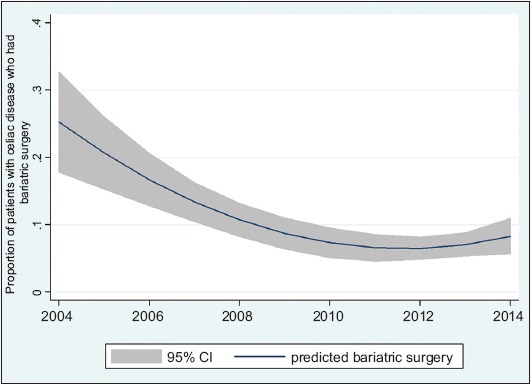
Results: Among 1499 patients with a discharge diagnosis of celiac disease and morbid obesity, 126 patients (8.4%) underwent bariatric surgery. Despite an increase in morbid obesity over the study period, the proportion of morbidly obese patients with celiac disease who had bariatric surgery declined by 18.5% (Ptrend<0.05). On multivariable analysis, bariatric surgery did not influence mortality (P=0.98), but was associated with a lower risk of renal failure, pneumonia, sepsis, urinary tract infection and respiratory failure (all P<0.05). Bariatric surgery increased the risk of vitamin D deficiency (IRR 3.5; 95% confidence interval [CI] 1.6-7.7; P=0.002) and post-operative strictures (IRR 3.3; 95%CI 1.5-7.5; P=0.004).
Conclusion: Despite the underutilization of bariatric surgery in morbidly obese celiac disease patients, the procedure is safe and appears to significantly reduce morbidity.
Keywords: Celiac disease; bariatric surgery; gluten; obesity; weight loss.
Conflict of interest statement
Conflict of Interest: None.
Figures
References
-
- Lebwohl B, Sanders DS, Green PHR. Coeliac disease. Lancet. 2018;391:70–81. - PubMed
-
- Malekzadeh R, Sachdev A, Fahid Ali A. Coeliac disease in developing countries:Middle East, India and North Africa. Best Pract Res Clin Gastroenterol. 2005;19:351–358. - PubMed
-
- Rubio-Tapia A, Ludvigsson JF, Brantner TL, Murray JA, Everhart JE. The prevalence of celiac disease in the United States. Am J Gastroenterol. 2012;107:1538–1544. - PubMed
-
- Dickey W, Kearney N. Overweight in celiac disease:prevalence, clinical characteristics, and effect of a gluten-free diet. Am J Gastroenterol. 2006;101:2356–2359. - PubMed
-
- Tucker E, Rostami K, Prabhakaran S, Al Dulaimi D. Patients with coeliac disease are increasingly overweight or obese on presentation. J Gastrointestin Liver Dis. 2012;21:11–15. - PubMed
Grants and funding
LinkOut - more resources
Full Text Sources