. 2019 Jan;53(1):1-12.
doi: 10.4132/jptm.2018.12.16. Epub 2018 Dec 28.

Artificial Intelligence in Pathology

Affiliations

Artificial Intelligence in Pathology

Hye Yoon Chang et al. J Pathol Transl Med. 2019 Jan.

Abstract

As in other domains, artificial intelligence is becoming increasingly important in medicine. In particular,deep learning-based pattern recognition methods can advance the field of pathology byincorporating clinical, radiologic, and genomic data to accurately diagnose diseases and predictpatient prognoses. In this review, we present an overview of artificial intelligence, the brief historyof artificial intelligence in the medical domain, recent advances in artificial intelligence applied topathology, and future prospects of pathology driven by artificial intelligence.

Keywords: Artificial intelligence; Deep learning; Image analysis; Pathology.


Conflict of interest statement

Conflicts of Interest

The authors declare that they have no potential conflicts of interest.

Figures
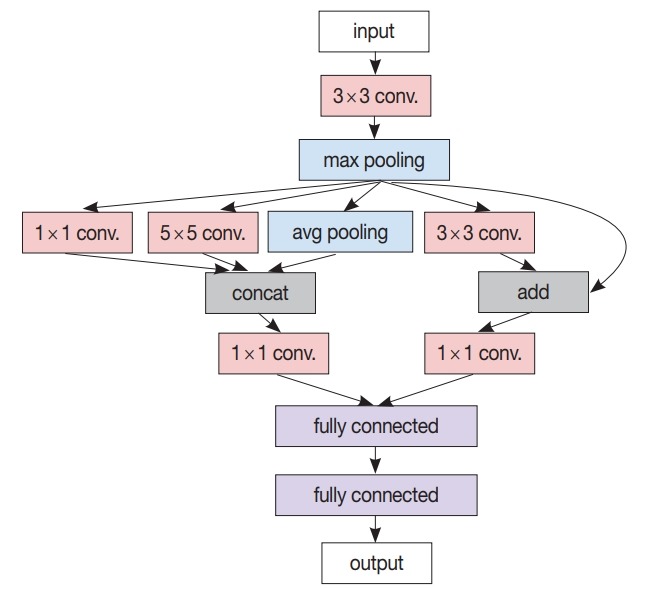
Fig. 1.
Fig. 1.
A simplified modern convolutional neural network (CNN) architecture example. In contrast to the classic CNN comprising only a cascade of convolution layers and pooling layers followed by a few fully connected layers, this example has various other concepts like branching from the max pooling layer to several (1×1, 3×3, 5 × 5) convolution layers as well as the average pooling layer, merging by concatenation from two (1×1, 5×5) convolution layers and the average pooling layer, and residual addition of max pooling layer output to the output of its succeeding (3×3) convolution layer.
Fig. 2.
Fig. 2.
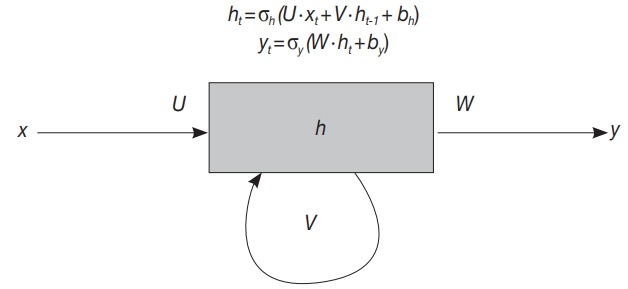
A typical recurrent layer example. In receiving a new input xt at time t, hidden state ht is updated based on xt and the previous state ht-1 first, then output yt is generated based on ht. At training time, parameters like U, V, W, bh, and by are trained to accurately generate yt for every time t.
Fig. 3.
Fig. 3.
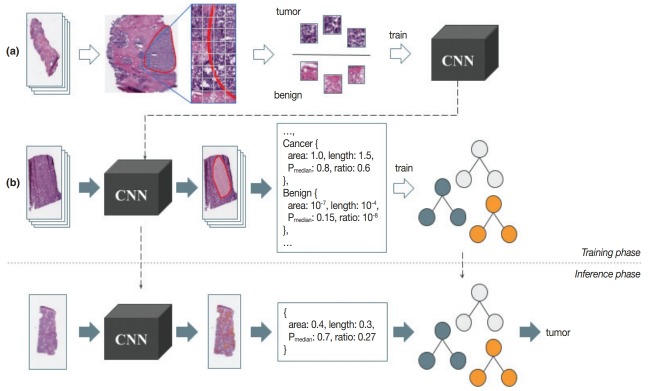
An example workflow for two-stage pathology artificial intelligence. Training phase: from the collected pathology images, a proper amount of annotation data is constructed (a). Image patch sets of balanced size are used in the training of patch-level convolutional neural network (CNN). After the patch-level CNN is trained sufficiently, heatmaps are generated for another set of pathology images using that CNN, from where the features are extracted for the decision forest like image-level machine learning (ML) model training (b). Inference phase: patch-level CNN runs on every single patch in the input pathology to generate a heatmap (first stage). Features are then extracted as in the training phase, and fed into the image-level ML model to determine the image-level result (second stage).

References

    1. McCorduck P. Machines who think: a personal inquiry into the history and prospects of artificial intelligence. Natick: A.K. Peters; 2004.
    1. Turing AM. I. Computing machinery and intelligence. Mind. 1950;59:433–60.
    1. Searle JR. Minds, brains, and programs. Behav Brain Sci. 1980;3:417–24.
    1. Russell SJ, Norvig P. Artificial intelligence: a modern approach. Upper Saddle River: Prentice Hall; 2003.
    1. Artificial intelligence [Internet] Wikipedia; 2018. [cited 2018 Dec 9]. Available from: https://en.wikipedia.org/wiki/Artificial_intelligence.