


Preoperative quadriceps weakness preferentially predicts postoperative aberrant movement patterns during high-demand mobility following total knee arthroplasty
- PMID: 30600199
- PMCID: PMC6377852
- DOI: 10.1016/j.knee.2018.12.005
Preoperative quadriceps weakness preferentially predicts postoperative aberrant movement patterns during high-demand mobility following total knee arthroplasty
Abstract
Background: Nearly all patients with total knee arthroplasty show aberrant movement patterns during tasks requiring greater joint demand compared to matched peers. Greater movement compensation leads to increased loading onto other joints, decreased functional capacity and limited reserve for independence later in life. Understanding how preoperative predictors contribute to postoperative aberrant movement patterns is needed to make better decisions for patients considering total knee arthroplasty.
Methods: Forty-seven patients were tested preoperatively and six months following primary total knee arthroplasty. Demographic (age, sex, body mass), self-reported (knee pain, perception of physical performance, physical activity level), physical performance (quadriceps strength, lower limb power and timed stair climbing) and surgical metrics were collected as predictor variables. Three-dimensional models based on joint mechanic asymmetry during a decline walking task were collected at six months postoperatively. Decline walking is a preferred means to assess the surgical knee's contribution to limb performance during high-demand tasks. Bootstrap inclusion fraction was employed to compare the stability of each predictor variable prior to the final regression model.
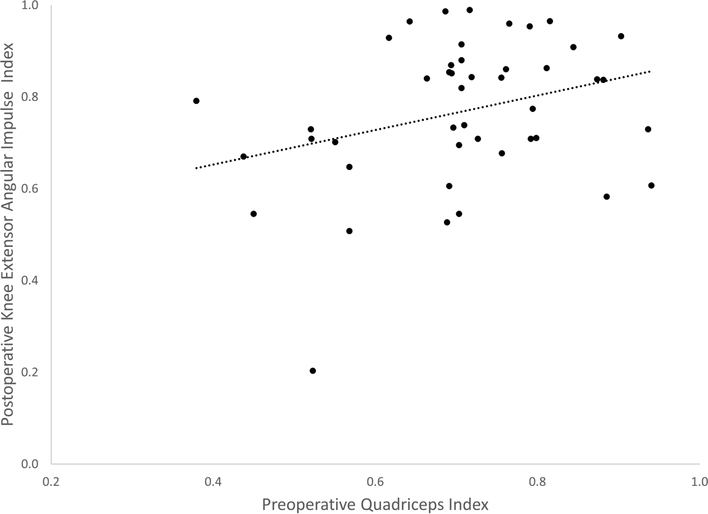
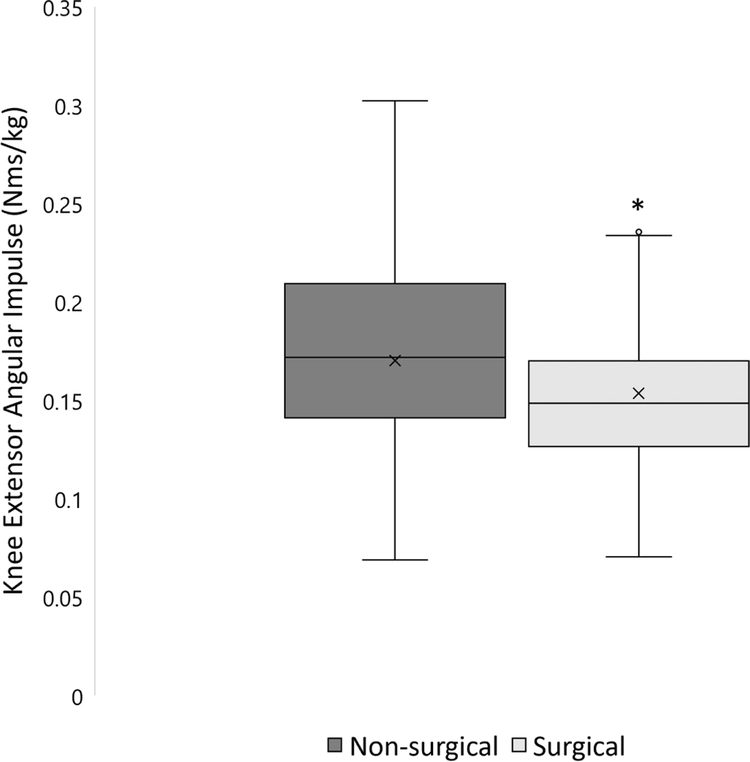
Results: Preoperative quadriceps strength (β = 0.33; p = 0.04) showed a significant relationship with knee extensor angular impulse during loading phase. No other predictor variable had any meaningful relationship with aberrant movement patterns (p > 0.05).
Conclusion: Our findings highlight patients' preoperative quadriceps strength as a meaningful predictor of postoperative performance. Preoperative quadriceps strength should be addressed when considering the knee's ability to contribute to higher demanding mobility tasks following surgery.
Keywords: Biomechanics; Decline walking; Gait analysis; Quadriceps strength; Total knee arthroplasty.
Published by Elsevier B.V.
Conflict of interest statement
Conflict of Interest Statement:
One of the authors certifies that he (CLP), or a member of his immediate family, has or may receive payments or benefits unrelated to this work, during the study period, an amount of USD 100,001 to USD 1,000,000 from Biomet, Inc (Warsaw, IN, USA).
One of the authors certifies that he (CEP), or a member of his immediate family, has or may receive payments or benefits unrelated to this work, during the study period, an amount of USD 5,000 to USD 100,000 from Biomet, Inc (Warsaw, IN, USA).
All other authors have no conflict of interest information to disclose.
Figures
References
-
- Mizner RL, Petterson SC, Stevens JE, Axe MJ, Snyder-Mackler L. Preoperative quadriceps strength predicts functional ability one year after total knee arthroplasty. J Rheumatol. 2005;32: 1533–9. - PubMed
