


US State-Level Infertility Insurance Mandates and Health Plan Expenditures on Infertility Treatments
- PMID: 30600516
- PMCID: PMC11056963
- DOI: 10.1007/s10995-018-2675-y
US State-Level Infertility Insurance Mandates and Health Plan Expenditures on Infertility Treatments
Abstract
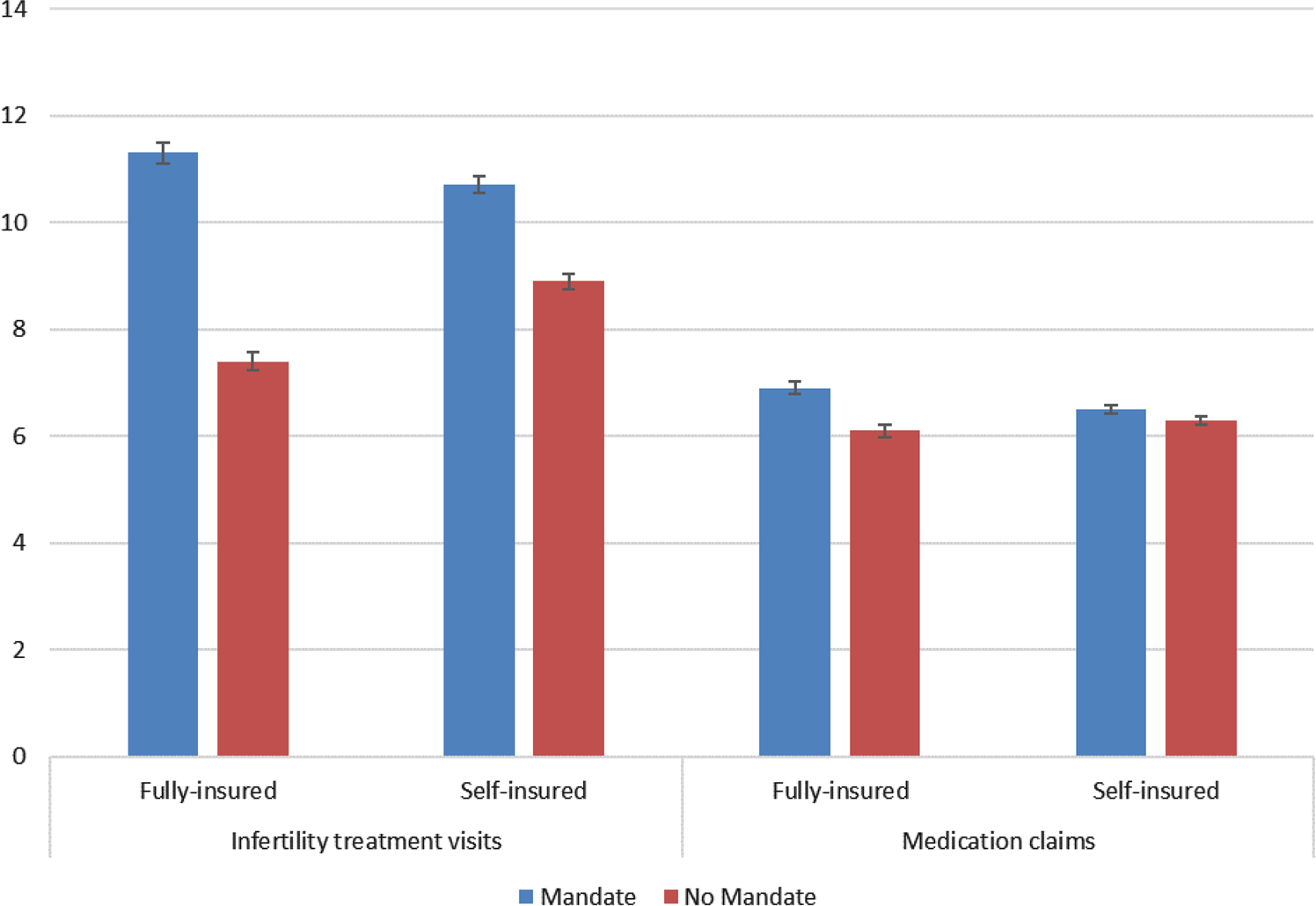
Objectives We aimed to examine the extent to which health plan expenditures for infertility services differed by whether women resided in states with mandates requiring coverage of such services and by whether coverage was provided through a self-insured plan subject to state mandates versus fully-insured health plans subject only to federal regulation. Methods This retrospective cohort study used individual-level, de-identified health insurance claims data. We included women 19-45 years of age who were continuously enrolled during 2011 and classified them into three mutually exclusive groups based on highest treatment intensity: in vitro fertilization (IVF), intrauterine insemination (IUI), or ovulation-inducing (OI) medications. Using generalized linear models, we estimated adjusted annual mean, aggregate, and per member per month (PMPM) expenditures among women in states with an infertility insurance mandate and those in states without a mandate, stratified by enrollment in a fully-insured or self-insured health plan. Results Of the 6,006,017 women continuously enrolled during 2011, 9199 (0.15%) had claims for IVF, 10,112 (0.17%) had claims for IUI, and 23,739 (0.40%) had claims for OI medications. Among women enrolled in fully insured plans, PMPM expenditures for infertility treatment were 3.1 times higher for those living in states with a mandate compared with states without a mandate. Among women enrolled in self-insured plans, PMPM infertility treatment expenditures were 1.2 times higher for mandate versus non-mandate states. Conclusions for Practice Recorded infertility treatment expenditures were higher in states with insurance reimbursement mandates versus those without mandates, with most of the difference in expenditures incurred by fully-insured plans.
Keywords: Artificial insemination; Assisted reproductive technologies; Expenditures; In vitro fertilization; Infertility; Insurance; Ovulation induction.
Figures
References
-
- Agency for Healthcare Research and Quality. (2011). Percent of private-sector enrollees that are enrolled in self-insured plans at establishments that offer health insurance by firm size and state: United States, 2011. Center for Financing, Access and Cost Trends. http://meps.ahrq.gov/mepsweb/data_stats/summ_tables/insr/state/series_2/.... Accessed 21 Dec 2018.
-
- Chambers GM, Sullivan EA, Ishihara O, Chapman MG, & Adamson GD (2009). The economic impact of assisted reproductive technology: A review of selected developed countries. Fertility and Sterility, 91(6), 2281–2294. - PubMed
-
- Chandra A, Copen CE, & Stephen EH (2013). Infertility and impaired fecundity in the United States, 1982–2010: Data from the National Survey of Family Growth. National Health Statistics Reports, 67, 1–18. - PubMed
MeSH terms
Substances
Grants and funding
LinkOut - more resources
Full Text Sources
