


Estimating the risk of PTSD in recent trauma survivors: results of the International Consortium to Predict PTSD (ICPP)
- PMID: 30600620
- PMCID: PMC6313248
- DOI: 10.1002/wps.20608
Estimating the risk of PTSD in recent trauma survivors: results of the International Consortium to Predict PTSD (ICPP)
Abstract
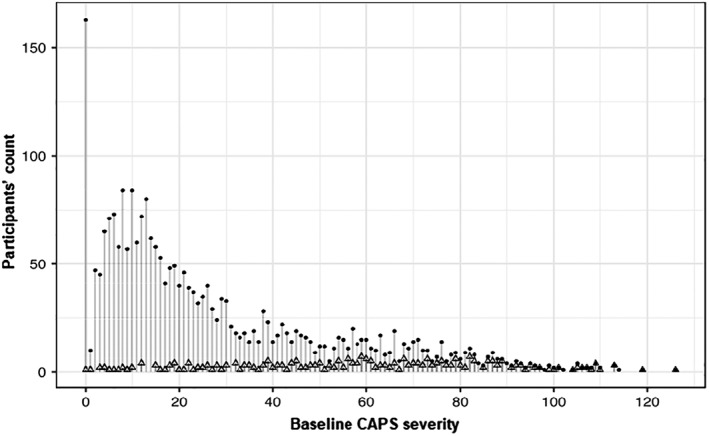
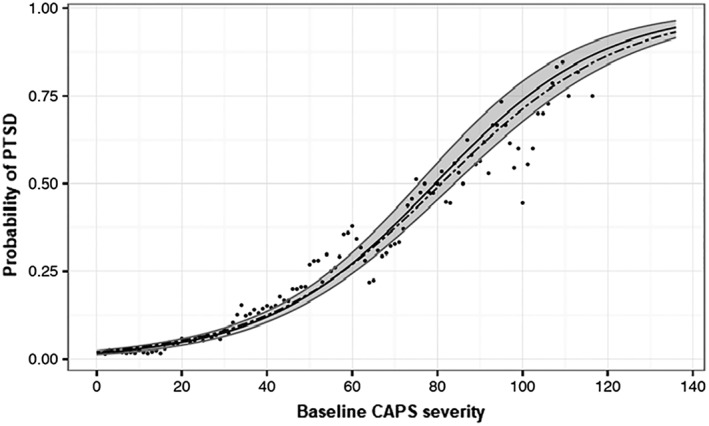
A timely determination of the risk of post-traumatic stress disorder (PTSD) is a prerequisite for efficient service delivery and prevention. We provide a risk estimate tool allowing a calculation of individuals' PTSD likelihood from early predictors. Members of the International Consortium to Predict PTSD (ICPP) shared individual participants' item-level data from ten longitudinal studies of civilian trauma survivors admitted to acute care centers in six countries. Eligible participants (N=2,473) completed an initial clinical assessment within 60 days of trauma exposure, and at least one follow-up assessment 4-15 months later. The Clinician-Administered PTSD Scale for DSM-IV (CAPS) evaluated PTSD symptom severity and diagnostic status at each assessment. Participants' education, prior lifetime trauma exposure, marital status and socio-economic status were assessed and harmonized across studies. The study's main outcome was the likelihood of a follow-up PTSD given early predictors. The prevalence of follow-up PTSD was 11.8% (9.2% for male participants and 16.4% for females). A logistic model using early PTSD symptom severity (initial CAPS total score) as a predictor produced remarkably accurate estimates of follow-up PTSD (predicted vs. raw probabilities: r=0.976). Adding respondents' female gender, lower education, and exposure to prior interpersonal trauma to the model yielded higher PTSD likelihood estimates, with similar model accuracy (predicted vs. raw probabilities: r=0.941). The current model could be adjusted for other traumatic circumstances and accommodate risk factors not captured by the ICPP (e.g., biological, social). In line with their use in general medicine, risk estimate models can inform clinical choices in psychiatry. It is hoped that quantifying individuals' PTSD risk will be a first step towards systematic prevention of the disorder.
Keywords: Post-traumatic stress disorder; clinician-administered PTSD scale for DSM-IV (CAPS); exposure to prior interpersonal trauma; female gender; lower education; prediction; prevention; risk assessment tool; trauma survivors.
© 2019 World Psychiatric Association.
Figures
References
-
- Hoge CW, Castro CA, Messer SC et al. Combat duty in Iraq and Afghanistan, mental health problems, and barriers to care. N Engl J Med 2004;351:13‐22. - PubMed
-
- Kessler RC. Posttraumatic stress disorder: the burden to the individual and to society. J Clin Psychiatry 2000;61(Suppl. 5):4‐12. - PubMed
-
- Breslau N, Peterson E, Poisson L et al. Estimating post‐traumatic stress disorder in the community: lifetime perspective and the impact of typical traumatic events. Psychol Med 2004;34:889‐98. - PubMed
-
- Committee on the Assessment of Ongoing Efforts in the Treatment of Posttraumatic Stress Disorder; Board on the Health of Select Populations; Institute of Medicine . Treatment for posttraumatic stress disorder in military and veteran populations: final assessment. Washington: Institute of Medicine National Research Council, 2014. - PubMed
Grants and funding
LinkOut - more resources
Full Text Sources
Medical
Miscellaneous
