Natural Course and Risk of Cholangiocarcinoma in Patients with Recurrent Pyogenic Cholangitis: A Retrospective Cohort Study
- PMID: 30600674
- PMCID: PMC6529165
- DOI: 10.5009/gnl18339
Natural Course and Risk of Cholangiocarcinoma in Patients with Recurrent Pyogenic Cholangitis: A Retrospective Cohort Study
Abstract
Background/aims: Recurrent pyogenic cholangitis (RPC) is a chronic progressive disease frequently accompanied by cholangiocarcinoma (CCA). This study aimed to investigate the natural course of RPC and identify factors associated with CCA.
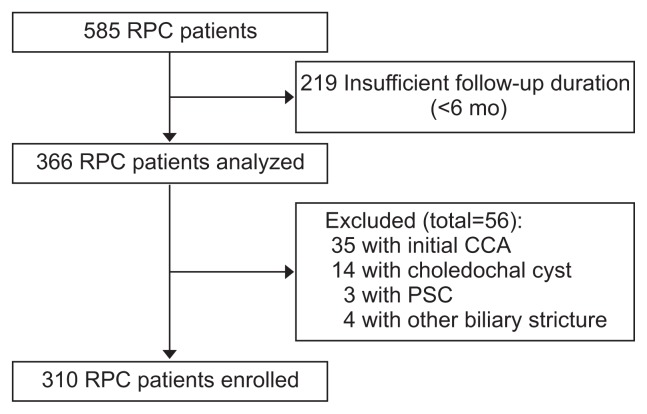
Methods: From January 2005 to December 2016, 310 patients diagnosed with RPC at Seoul National University Hospital were included. Complications and management during follow-up were recorded. CCA-free probability was estimated by Kaplan-Meier method, and risk factors associated with CCA were analyzed using log-rank test and Coxs proportional hazard regression model.
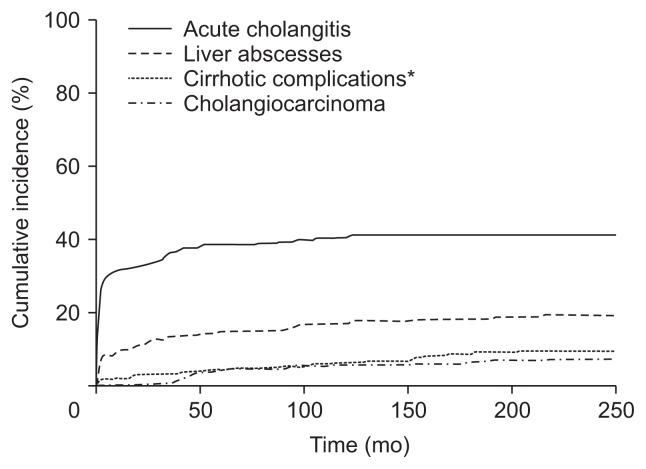
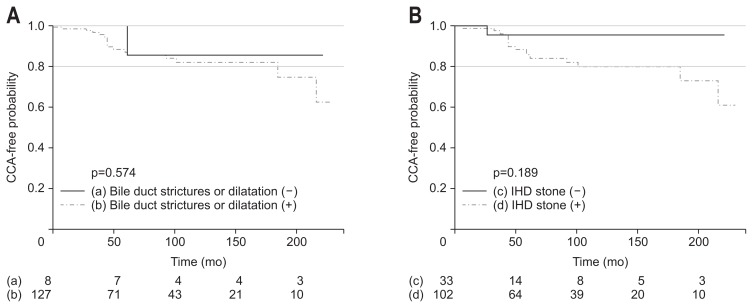
Results: Mean age at diagnosis was 59.1±10.9 years and mean follow-up duration was 84.0±64.1 months. An intrahepatic duct stone was found in 253 patients (81.6%). Liver atrophy was identified in 185 patients (59.7%) and most commonly located at the left lobe (65.4%). Acute cholangitis, liver abscesses, cirrhotic complications, and CCA developed in 41.3%, 19.4%, 9.7%, and 7.4%, respectively. During follow-up, complete resolution rate after hepatectomy, biliary bypass surgery, and choledocholithotomy with T-tube insertion reached 82.3%, 55.2%, and 42.1%, respectively. None of the patients who maintained complete resolution by the last follow-up day developed CCA. In univariate analysis, female, both-sided intrahepatic duct stones, and liver atrophy at any location were associated with increased risk of CCA. Multivariate analysis revealed that both-sided atrophy significantly increased risk of CCA (hazard ratio, 4.56; 95% confidence interval, 1.48 to 14.09; p=0.008). In 21 patients who developed intrahepatic CCA, tumor was located mostly in the atrophied lobe (p=0.023).
Conclusions: In RPC patients, acute cholangitis, liver abscess, cirrhotic complications, and CCA frequently developed. Both-sided liver atrophy was a significant risk factor for developing CCA.
Keywords: Atrophy; Cholangiocarcinoma; Cholangitis; Cirrhosis; Prognosis.
Conflict of interest statement
No potential conflict of interest relevant to this article was reported.
Figures
References
-
- Digby KH. Common-duct stone of liver origin. Br J Surg. 1930;17:578–591. doi: 10.1002/bjs.1800176804. - DOI
Publication types
MeSH terms
LinkOut - more resources
Full Text Sources
Medical