


Classifying Preoperative Opioid Use for Surgical Care
- PMID: 30601256
- PMCID: PMC7092502
- DOI: 10.1097/SLA.0000000000003109
Classifying Preoperative Opioid Use for Surgical Care
Abstract
Objective: We characterized patterns of preoperative opioid use in patients undergoing elective surgery to identify the relationship between preoperative use and subsequent opioid fill after surgery.
Background: Preoperative opioid use is common, and varies by dose, recency, duration, and continuity of fills. To date, there is little evidence to guide postoperative prescribing need based on prior opioid use.
Methods: We analyzed claims data from Clinformatics DataMart Database for patients aged 18 to 64 years undergoing major and minor surgery between 2008 and 2015. Preoperative use was defined as any opioid prescription filled in the year before surgery. We used cluster analysis to group patients by the dose, recency, duration, and continuity of use. Our primary outcome was second postoperative fill within 30 postoperative days. Our primary explanatory variable was opioid use group. We used logistic regression to examine likelihood of second fill by opioid use group.
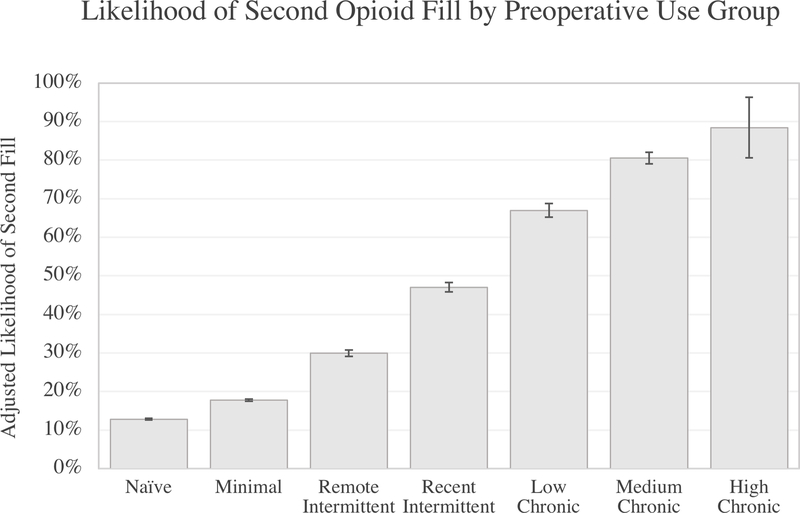
Results: Out of 267,252 patients, 102,748 (38%) filled an opioid prescription in the 12 months before surgery. Cluster analysis yielded 6 groups of preoperative opioid use, ranging from minimal (27.6%) to intermittent (7.7%) to chronic use (2.7%). Preoperative opioid use was the most influential predictor of second fill, with larger effect sizes than other factors even for patients with minimal or intermittent opioid use. Increasing preoperative use was associated with risk-adjusted likelihood of requiring a second opioid fill compared with naive patients [minimal use: odds ratio (OR) 1.49, 95% confidence interval (95% CI) 1.45-1.53; recent intermittent use: OR 6.51, 95% CI 6.16-6.88; high chronic use: OR 60.79, 95% CI 27.81-132.92, all P values <0.001).
Conclusion: Preoperative opioid use is common among patients who undergo elective surgery. Although the majority of patients infrequently fill opioids before surgery, even minimal use increases the probability of needing additional postoperative prescriptions in the 30 days after surgery when compared with opioid-naive patients. Going forward, identifying preoperative opioid use can inform surgeon prescribing and care coordination for pain management after surgery.
Figures
References
-
- Frenk SM, Porter KS, Paulozzi LJ. Prescription opioid analgesic use among adults: United States, 1999–2012. NCHS data brief 2015:1–8. - PubMed
-
- Han B, Compton WM, Blanco C, Crane E, Lee J, Jones CM. Prescription Opioid Use, Misuse, and Use Disorders in U.S. Adults: 2015 National Survey on Drug Use and Health. Ann Intern Med 2017;167:293–301. - PubMed
-
- Hina N, Fletcher D, Poindessous-Jazat F, Martinez V. Hyperalgesia induced by low-dose opioid treatment before orthopaedic surgery: An observational case-control study. European journal of anaesthesiology 2015;32:255–61. - PubMed
Publication types
MeSH terms
Substances
Grants and funding
LinkOut - more resources
Full Text Sources
Medical
