. 2019 Jan 15;116(3):944-949.
doi: 10.1073/pnas.1812548116. Epub 2019 Jan 2.

HIV peptidome-wide association study reveals patient-specific epitope repertoires associated with HIV control

Affiliations

HIV peptidome-wide association study reveals patient-specific epitope repertoires associated with HIV control

Jatin Arora et al. Proc Natl Acad Sci U S A. .

Abstract

Genetic variation in the peptide-binding groove of the highly polymorphic HLA class I molecules has repeatedly been associated with HIV-1 control and progression to AIDS, accounting for up to 12% of the variation in HIV-1 set point viral load (spVL). This suggests a key role in disease control for HLA presentation of HIV-1 epitopes to cytotoxic T cells. However, a comprehensive understanding of the relevant HLA-bound HIV epitopes is still elusive. Here we describe a peptidome-wide association study (PepWAS) approach that integrates HLA genotypes and spVL data from 6,311 HIV-infected patients to interrogate the entire HIV-1 proteome (3,252 unique peptides) for disease-relevant peptides. This PepWAS approach predicts a core set of epitopes associated with spVL, including known epitopes but also several previously uncharacterized disease-relevant peptides. More important, each patient presents only a small subset of these predicted core epitopes through their individual HLA-A and HLA-B variants. Eventually, the individual differences in these patient-specific epitope repertoires account for the variation in spVL that was previously associated with HLA genetic variation. PepWAS thus enables a comprehensive functional interpretation of the robust but little-understood association between HLA and HIV-1 control, prioritizing a short list of disease-associated epitopes for the development of targeted therapy.

Keywords: HIV-1; HLA; MHC; antigen presentation; epitope prediction.


Conflict of interest statement

The authors declare no conflict of interest.

Figures
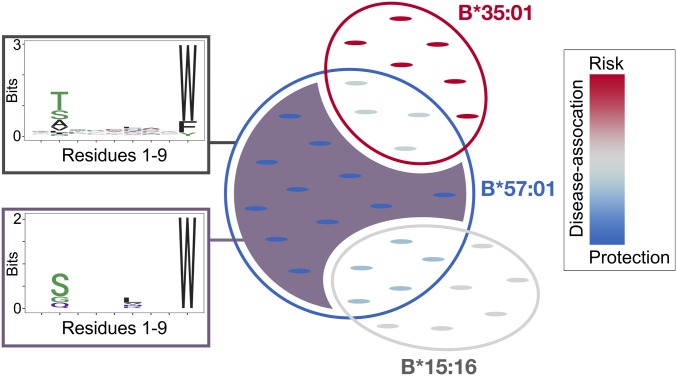
Fig. 1.
Fig. 1.
Schematic for determining peptide-specific associations through PepWAS. Disease-associated peptides are identified by integrating the different disease associations of the different HLA alleles that are predicted to bind them. Some peptides will only be bound by one HLA allele, thus drawing their disease association directly from the disease association of that allele (e.g., peptides in the purple shaded area, bound only by HLA-B*57:01). However, many peptides will be bound by several HLA alleles, which can have quite distinct, possibly even opposing, disease associations (e.g., peptides in overlap of B*57:01 and B*35:01). In this case, the disease association of the peptide derives from the disease associations of each of the binding HLA alleles, as well as their frequencies in the dataset. The PepWAS approach differentiates these distinct sets of peptides and identifies both specific peptides and epitope motifs with distinct disease association (e.g., distinct motif of purple-shaded peptides, corresponding to the dark purple cluster in Fig. 4). Circles depict repertoires of peptides (small pointed ovals) predicted to be bound by the given HLA allele. Overlap of circles defines sets of peptides bound by both HLA alleles. Color of circles and peptides depicts disease association of corresponding HLA alleles and peptides, respectively, from blue (protective) to red (risk). The number of peptides in this schematic does not correspond to the actual number of peptides observed for these HLA alleles. In reality, the overlap among HLA alleles is substantially more complex than depicted in this simplified schematic.
Fig. 2.
Fig. 2.
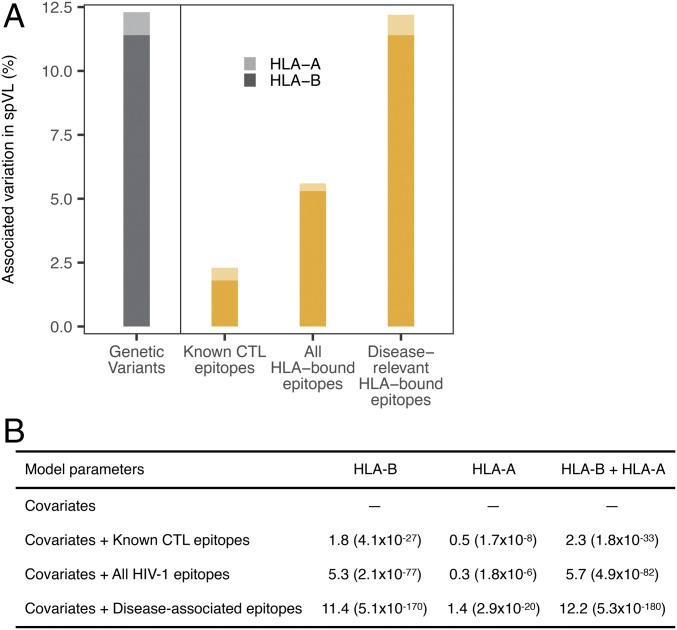
Variation in viral load associated with predicted epitope repertoires bound by HLA-B and HLA-A. Among patients with HIV (n = 6,311), the proportion of variation (estimated as adjusted ΔR2) in spVL associated with the patient-specific number of predicted HLA-bound HIV-1 epitopes is shown separately for HLA-B and HLA-A, and for different epitope sets. (A) Previously, 11.4% and 0.9% of the variation in spVL had been associated with independent genetic variants in HLA-B and HLA-A, respectively (gray bars; data from ref. 4). Here we instead calculated the variation in spVL associated with individual HLA-bound HIV epitope repertoires (yellow bars), based on known CTL epitopes from Los Alamos HIV Molecular Immunology Database, all HLA-bound HIV epitopes, and only the disease-associated HIV epitopes (the latter corresponding to 99.2% of the variation previously associated with HLA genetic variation). (B) Variation (in percent) associated with different sets of predicted epitopes. P values (in parentheses) indicate the improvement over null model (covariates only: first five PCs and the cohort group). The number of disease-associated predicted epitopes is 132 for HLA-B, and 74 for HLA-A.
Fig. 3.
Fig. 3.
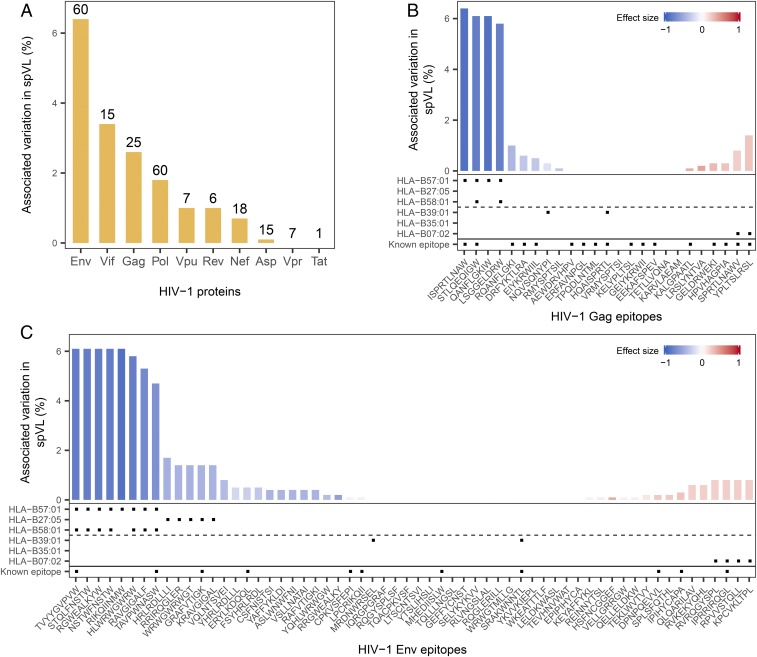
Protein- and epitope-specific association with viral load. (A) Percentage of variation in spVL associated with all predicted epitopes of a given HIV-1 protein. Absolute number of predicted HLA-B-bound epitopes per protein is shown above the bars. (B and C) Predicted HLA-B-bound epitopes accounted for varied levels of variation in spVL. Height of the bar represents the fraction of variation in spVL associated with each epitope, whereas the color reflects each epitope’s effect on spVL, ranging from protection (blue) to risk (red). Note that epitope effects are estimated separately, and are thus not independent. Gag (B) and Env (C) proteins are shown as representative examples, together with information on predicted binding for three protective and three risk HLA-B alleles highlighted in a recent review (24) and whether peptides are known epitopes in Los Alamos HIV database. All other HIV-1 proteins are shown in SI Appendix, Fig. S8.
Fig. 4.
Fig. 4.
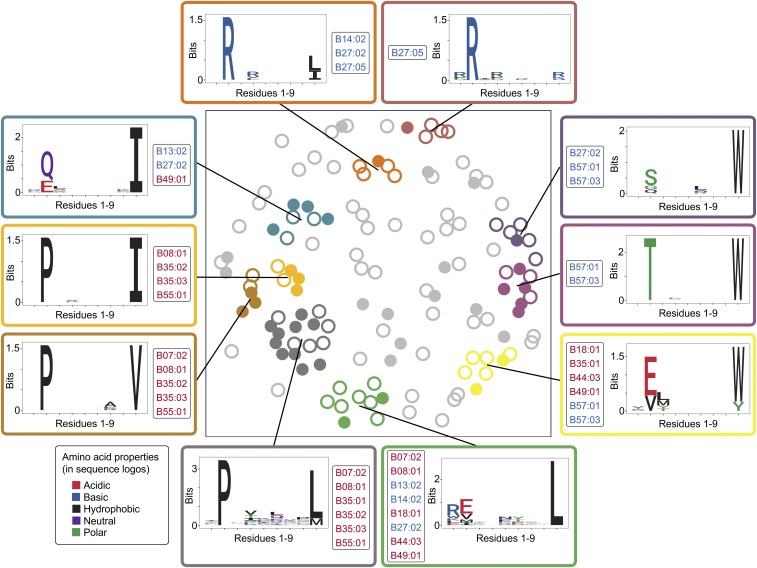
Clusters of disease-associated epitopes. Nonmetric multidimensional scaling was used to visualize the pairwise distance between predicted HLA-B-bound disease-associated epitopes, which revealed 10 dominant clusters. Each circle represents an HLA-B-bound disease-associated epitope (n = 132). Filled circles represent known CTL epitopes from the Los Alamos HIV Molecular Immunology Database (n = 45), whereas open circles represent previously uncharacterized disease-associated predicted epitopes. Cluster-specific motif and HIV-1 associated HLA-B alleles (n = 16) binding the cluster’s epitopes are shown. The coloring of the allele names indicates disease association of the specific alleles.

References

    1. Goulder PJR, Walker BD. HIV and HLA class I: An evolving relationship. Immunity. 2012;37:426–440. - PMC - PubMed
    1. Fellay J, et al. A whole-genome association study of major determinants for host control of HIV-1. Science. 2007;317:944–947. - PMC - PubMed
    1. Pereyra F, et al. The major genetic determinants of HIV-1 control affect HLA class I peptide presentation. Science. 2010;330:1551–1557. - PMC - PubMed
    1. McLaren PJ, et al. Polymorphisms of large effect explain the majority of the host genetic contribution to variation of HIV-1 virus load. Proc Natl Acad Sci USA. 2015;112:14658–14663. - PMC - PubMed
    1. Mellors JW, et al. Prognosis in HIV-1 infection predicted by the quantity of virus in plasma. Science. 1996;272:1167–1170, and erratum (1997) 275:14. - PubMed

Publication types