. 2019 Jan 2;10(1):e02495-18.
doi: 10.1128/mBio.02495-18.

The Transcriptional Cycle Is Suited to Daytime N2 Fixation in the Unicellular Cyanobacterium " Candidatus Atelocyanobacterium thalassa" (UCYN-A)

Affiliations

The Transcriptional Cycle Is Suited to Daytime N2 Fixation in the Unicellular Cyanobacterium " Candidatus Atelocyanobacterium thalassa" (UCYN-A)

María Del Carmen Muñoz-Marín et al. mBio. .

Abstract

Symbiosis between a marine alga and a N2-fixing cyanobacterium (Cyanobacterium UCYN-A) is geographically widespread in the oceans and is important in the marine N cycle. UCYN-A is uncultivated and is an unusual unicellular cyanobacterium because it lacks many metabolic functions, including oxygenic photosynthesis and carbon fixation, which are typical in cyanobacteria. It is now presumed to be an obligate symbiont of haptophytes closely related to Braarudosphaera bigelowii N2-fixing cyanobacteria use different strategies to avoid inhibition of N2 fixation by the oxygen evolved in photosynthesis. Most unicellular cyanobacteria temporally separate the two incompatible activities by fixing N2 only at night, but, surprisingly, UCYN-A appears to fix N2 during the day. The goal of this study was to determine how the unicellular UCYN-A strain coordinates N2 fixation and general metabolism compared to other marine cyanobacteria. We found that UCYN-A has distinct daily cycles of many genes despite the fact that it lacks two of the three circadian clock genes found in most cyanobacteria. We also found that the transcription patterns in UCYN-A are more similar to those in marine cyanobacteria that are capable of aerobic N2 fixation in the light, such as Trichodesmium and heterocyst-forming cyanobacteria, than to those in Crocosphaera or Cyanothece species, which are more closely related to unicellular marine cyanobacteria evolutionarily. Our findings suggest that the symbiotic interaction has resulted in a shift of transcriptional regulation to coordinate UCYN-A metabolism with that of the phototrophic eukaryotic host, thus allowing efficient coupling of N2 fixation (by the cyanobacterium) to the energy obtained from photosynthesis (by the eukaryotic unicellular alga) in the light.IMPORTANCE The symbiotic N2-fixing cyanobacterium UCYN-A, which is closely related to Braarudosphaera bigelowii, and its eukaryotic algal host have been shown to be globally distributed and important in open-ocean N2 fixation. These unique cyanobacteria have reduced metabolic capabilities, even lacking genes for oxygenic photosynthesis and carbon fixation. Cyanobacteria generally use energy from photosynthesis for nitrogen fixation but require mechanisms for avoiding inactivation of the oxygen-sensitive nitrogenase enzyme by ambient oxygen (O2) or the O2 evolved through photosynthesis. This study showed that symbiosis between the N2-fixing cyanobacterium UCYN-A and its eukaryotic algal host has led to adaptation of its daily gene expression pattern in order to enable daytime aerobic N2 fixation, which is likely more energetically efficient than fixing N2 at night, as found in other unicellular marine cyanobacteria.

Keywords: cyanobacteria; diel cycle; marine microbiology; nitrogen fixation; symbiosis; whole-genome expression.


Figures

FIG 1
FIG 1
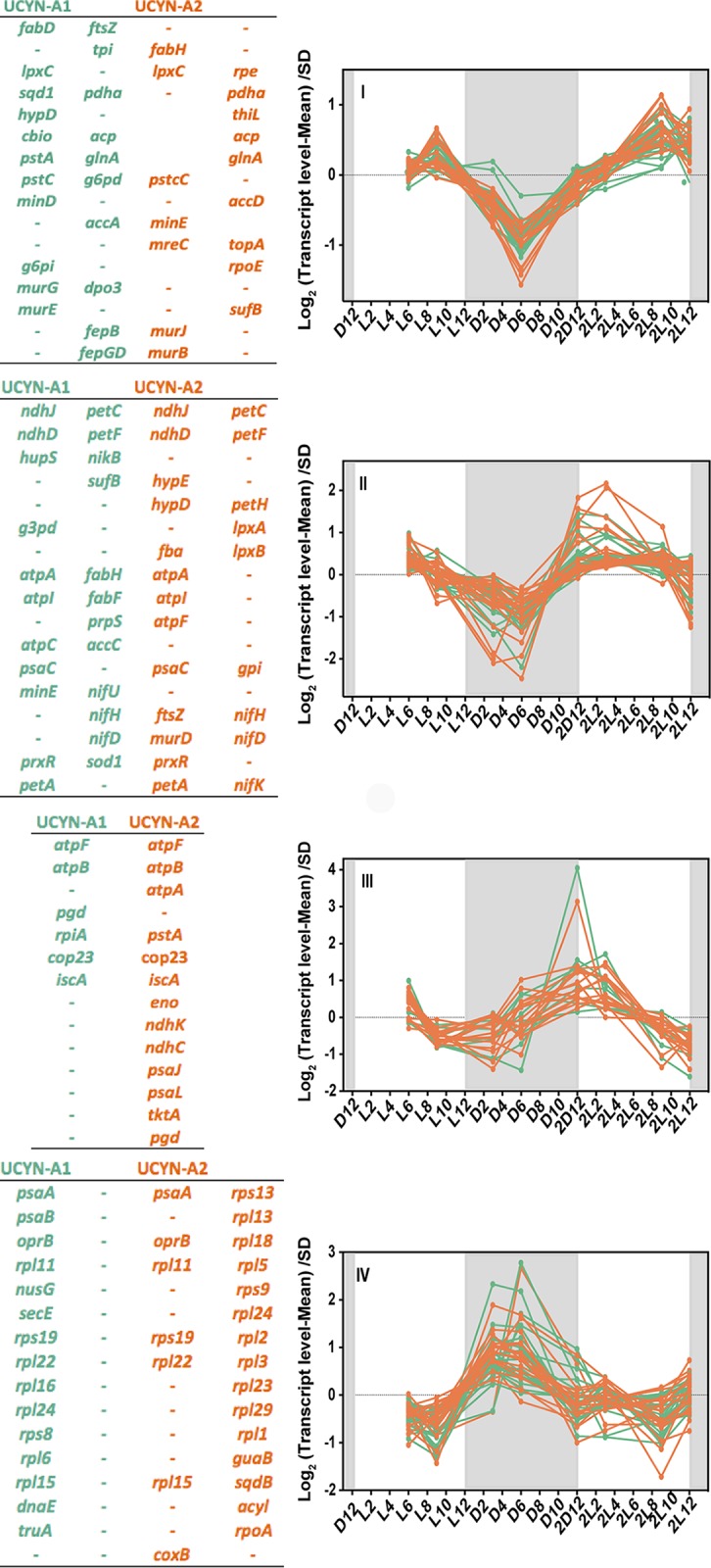
Four different clades (indicated by I-IV) based on Pearson correlation of the transcription profiles of UCYN-A1 and UCYN-A2 genes over light-dark cycles. The transcription value of each gene at each time point was normalized to the mean at all time points and divided by the standard deviation (SD) (y axis, log 2 scale). The x axis represents time points where “D” and “L” stand for dark and light, respectively, followed by a number corresponding to the hour of entry into the light or dark period. The second light-dark cycle is indicated as “2D” followed by a number corresponding to the hour of entry into the light or dark period. The shaded area represents the dark period. In each cluster, the most representative genes are listed in the table attached to the plot. UCYN-A1 genes are coded in green and UCYN-A2 genes are coded in orange.
FIG 2
FIG 2
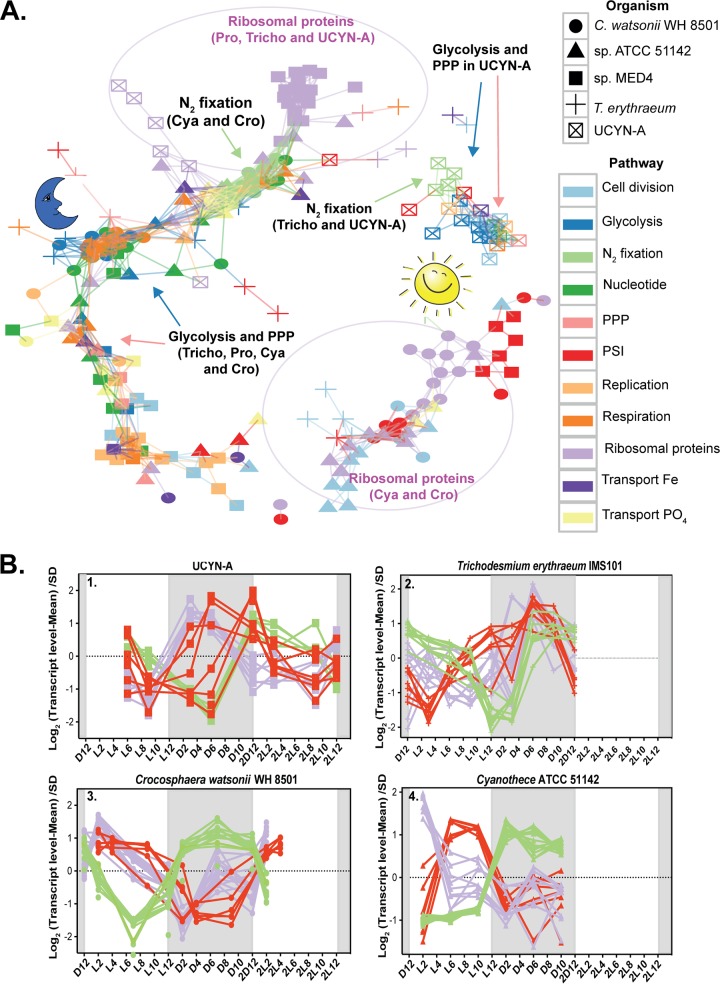
(A) Transcriptional network based on Pearson correlation of gene transcription over the diel cycle in all studied cyanobacteria. The genes are connected if correlation coefficient for their transcription patterns is higher than 0.5. The genes shown are diel genes with variable transcription patterns among the studied cyanobacteria. The arrows point to genes for glycolysis, the pentose phosphate pathway, and N2 fixation in the studied diazotrophs. The purple circles demarcate genes for ribosomal proteins included in the analysis. Abbreviations: Prochlorococcus sp. MED4 (Pro), Cyanothece sp. ATCC 51142 (Cya), C. watsonii WH 8501 (Cro), T. erythraeum (Tricho), pentose phosphate pathway (PPP), photosystem I (PSI). (B) Four time course plots for the N2-fixing cyanobacteria, showing the diel transcription patterns of photosystem I genes, N2 fixation genes, and genes for ribosomal proteins.
FIG 3
FIG 3
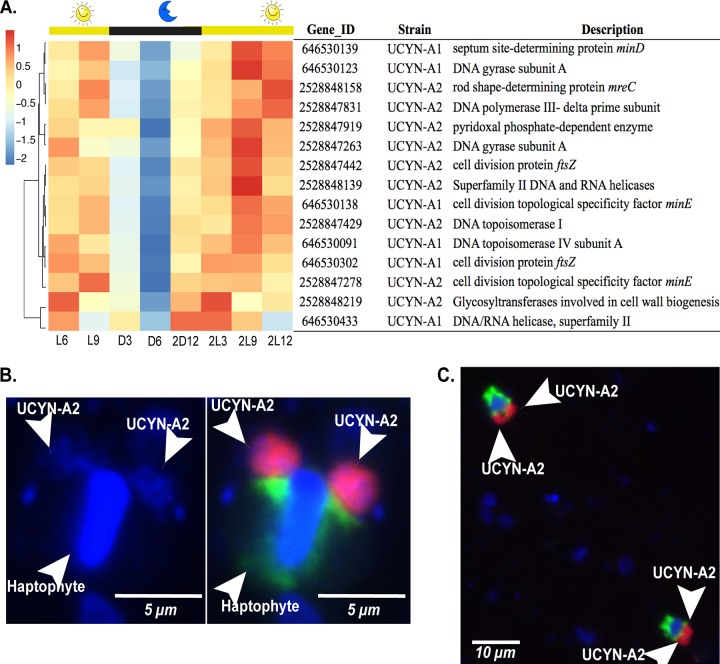
Transcription of genes for replication and cell division in UCYN-A. (A) (Upper panel) Diel transcription patterns for cell division and replication genes in UCYN-A1 and UCYN-A2 over the light-dark cycle. Hierarchical clustering of genes was based on Pearson correlations between their transcription profiles. The transcription values of the genes were standardized at each time point, and the blue-red scale shows by how many standard deviations a transcription value was lower (blue) or higher (red) than the mean transcription values over the diel cycle (Z score). The Gene ID and the gene product corresponding to each gene for UCYN-A1 and UCYN-A2 are shown. Time periods are indicated on the x axis as “L” (light) and “D” (dark) followed by a number corresponding to the hour after the sunrise and sunset periods started. The second light-dark cycle is indicated as “2D” followed by a number corresponding to the hour of entry into the light or dark period. (Lower panel) Epifluorescence micrographs of dividing UCYN-A2 detected with CARD-FISH (19). (B) Two big clusters of UCYN-A2 cells and the attached haptophyte host. (Left panel) The nucleus of the host and the UCYN-A2 cells were visualized with DAPI stain (blue). (Right panel) The UCYN-A2 strain (red) and its haptophyte host (green). (C) Two different associations of UCYN-A2 with its haptophyte dividing in samples from Scripps Pier.
FIG 4
FIG 4
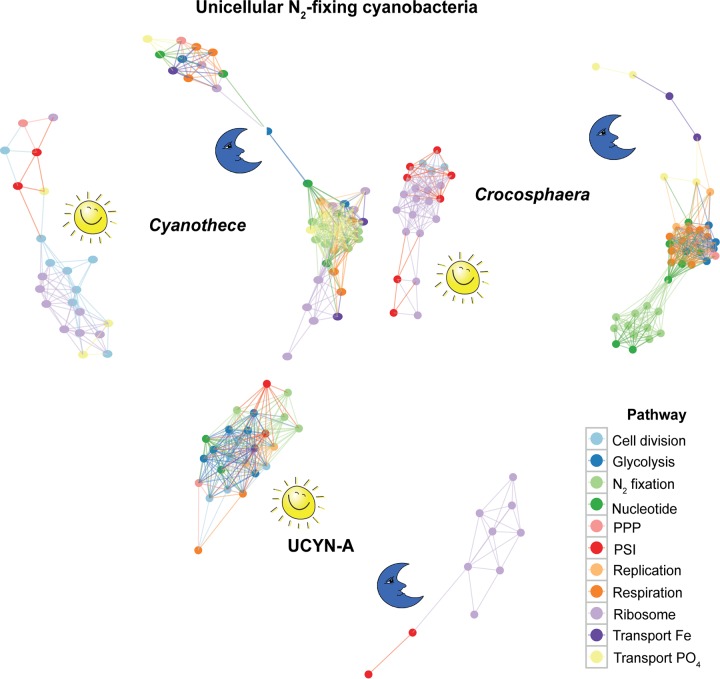
Network showing the Pearson correlation for gene transcriptions in the unicellular N2-fixing cyanobacteria Cyanothece sp. ATCC 51142 (Cyanothece), C. watsonii WH 8501 (Crocosphaera), and UCYN-A. Shown here are key genes in major metabolic pathways with distinct diel transcription patterns. The genes are shown as connected if their correlation coefficient for transcription patterns is higher than 0.2. PPP, pentose phosphate pathway; PSI, photosystem I.
FIG 5
FIG 5
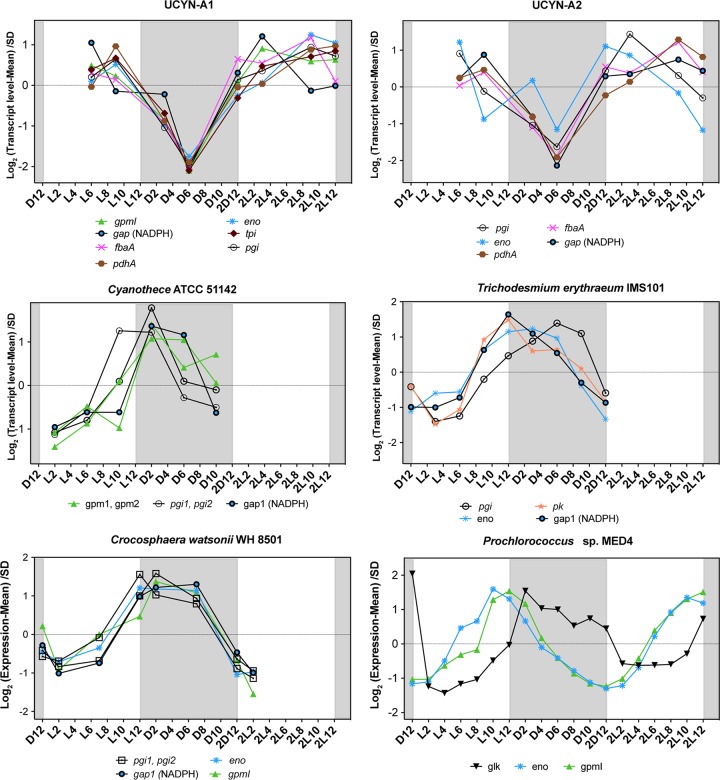
Transcriptional profiles of the genes for glycolysis over light-dark cycles in the cyanobacteria studied here. The transcription value of each gene at each time point was normalized to the mean at all time points and divided by the standard deviation (SD) (y axis, log scale). The x axis represents time points where “D” and “L” stand for dark and light, respectively, followed by a number corresponding to the hour of entry into the light or dark period. The second light-dark cycle is indicated as “2D” followed by a number corresponding to the hour of entry into the light or dark period. The shaded area represents the dark period.
FIG 6
FIG 6
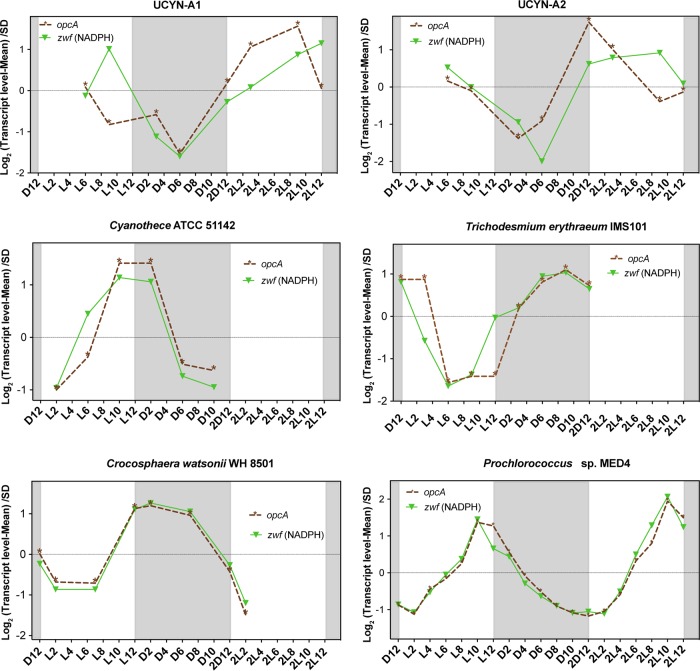
Transcriptional profiles of opcA (allosteric effector) and zwf (glucose-6-P dehydrogenase) over light-dark cycles in the cyanobacteria studied here. The transcription value of each gene at each time point was normalized to the mean at all time points and divided by the standard deviation (SD) (y axis, log scale). The x axis represents time points where “D” and “L” stand for dark and light, respectively, followed by a number corresponding to the hour of entry into the light or dark period. The second light-dark cycle is indicated as “2D” followed by a number corresponding to the hour of entry into the light or dark period. The shaded area represents the dark period.
FIG 7
FIG 7
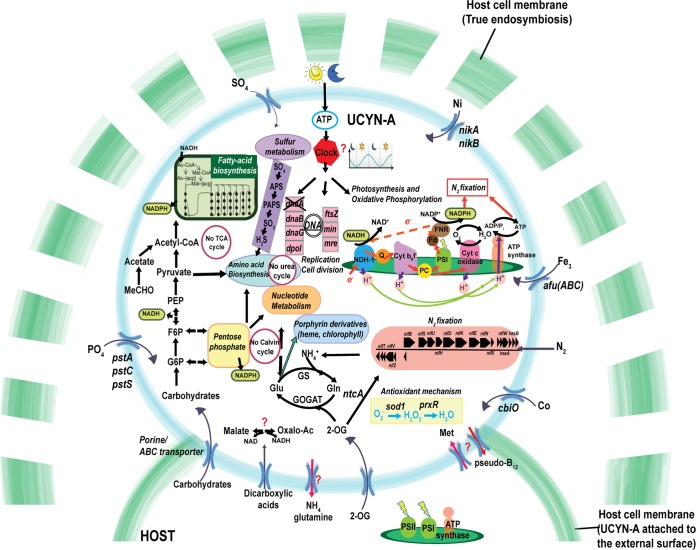
Schematic model of UCYN-A showing the possible main cellular functions, metabolic pathways, and transporters.

References

    1. Postgate JR. 1982. The fundamentals of nitrogen fixation. Cambridge University Press, London, United Kingdom.
    1. Montoya JP, Holl CM, Zehr JP, Hansen A, Villareal TA, Capone DG. 2004. High rates of N2 fixation by unicellular diazotrophs in the oligotrophic Pacific Ocean. Nature 430:1027–1031. doi:10.1038/nature02824. - DOI - PubMed
    1. Cabello AM, Cornejo-Castillo FM, Raho N, Blasco D, Vidal M, Audic S, de Vargas C, Latasa M, Acinas SG, Massana R. 2016. Global distribution and vertical patterns of a prymnesiophyte-cyanobacteria obligate symbiosis. ISME J 10:693–706. doi:10.1038/ismej.2015.147. - DOI - PMC - PubMed
    1. Martínez-Pérez C, Mohr W, Löscher C, Dekaezemacker J, Littmann S, Yilmaz P, Lehnen N, Fuchs BM, Lavik G, Schmitz R, LaRoche J, Kuypers MM. 2016. The small unicellular diazotrophic symbiont, UCYN-A, is a key player in the marine nitrogen cycle. Nat Microbiol 1:16163. doi:10.1038/NMICROBIOL.2016.163. - DOI - PubMed
    1. Farnelid H, Turk-Kubo K, Muñoz-Marín MC, Zehr JP. 2016. New insights into the ecology of the globally significant uncultured nitrogen-fixing symbiont UCYN-A. Aquat Microb Ecol 77:125–138. doi:10.3354/ame01794. - DOI