


An Unprecedented Medium-Chain Diunsaturated N-acylhomoserine Lactone from Marine Roseobacter Group Bacteria
- PMID: 30602652
- PMCID: PMC6356624
- DOI: 10.3390/md17010020
An Unprecedented Medium-Chain Diunsaturated N-acylhomoserine Lactone from Marine Roseobacter Group Bacteria
Abstract
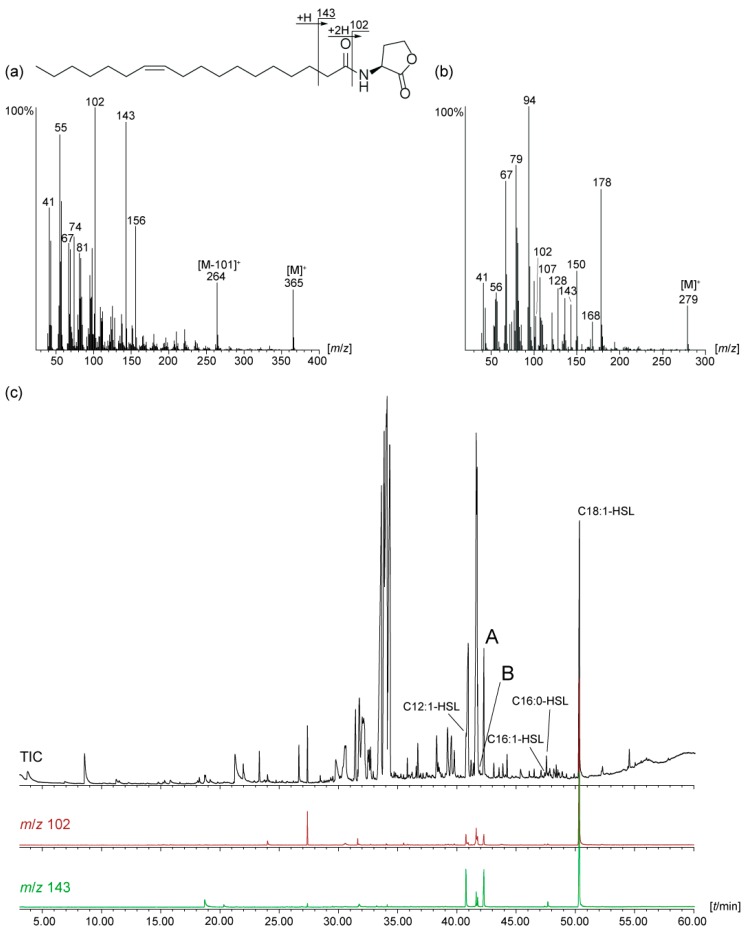
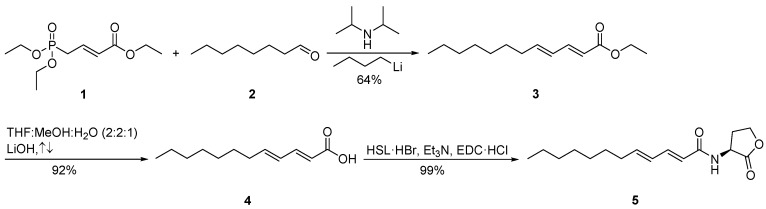
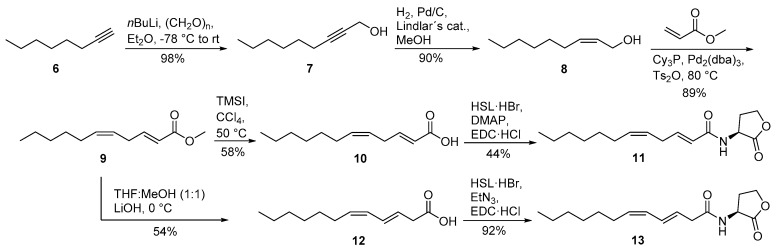
N-acylhomoserine lactones (AHLs), bacterial signaling compounds involved in quorum-sensing, are a structurally diverse group of compounds. We describe here the identification, synthesis, occurrence and biological activity of a new AHL, N-((2E,5Z)-2,5-dodecadienoyl)homoserine lactone (11) and its isomer N-((3E,5Z)-3,5-dodecadienoyl)homoserine lactone (13), occurring in several Roseobacter group bacteria (Rhodobacteraceae). The analysis of 26 strains revealed the presence of 11 and 13 in six of them originating from the surface of the macroalgae Fucus spiralis or sediments from the North Sea. In addition, 18 other AHLs were detected in 12 strains. Compound identification was performed by GC/MS. Mass spectral analysis revealed a diunsaturated C12 homoserine lactone as structural element of the new AHL. Synthesis of three likely candidate compounds, 11, 13 and N-((2E,4E)-2,4-dodecadienoyl)homoserine lactone (5), revealed the former to be the natural AHLs. Bioactivity test with quorum-sensing reporter strains showed high activity of all three compounds. Therefore, the configuration and stereochemistry of the double bonds in the acyl chain seemed to be unimportant for the activity, although the chains have largely different shapes, solely the chain length determining activity. In combination with previous results with other Roseobacter group bacteria, we could show that there is wide variance between AHL composition within the strains. Furthermore, no association of certain AHLs with different habitats like macroalgal surfaces or sediment could be detected.
Keywords: AHL; Heck coupling; Rhodobacteraceae; autoinducers; bacterial signaling; gas chromatography; mass spectrometry; quorum-sensing; sediment; structure elucidation.
Conflict of interest statement
The authors declare no conflict of interest. The funders had no role in the design of the study; in the collection, analyses, or interpretation of data; in the writing of the manuscript, and in the decision to publish the results.
Figures

References
-
- Buchan A., Mitchell A., Nathan Cude N.W., Campagna S. Acyl-homoserine Lactone-Based Quorum Sensing in Members of the Marine Bacterial Roseobacter Clade: Complex Cell-to-Cell Communication Controls Multiple Physiologies. In: de Bruijn F.J., editor. Stress and Environmental Regulation of Gene Expression and Adaptation in Bacteria. Wiley Blackwell; Hoboken, NJ, USA: pp. 225–233.
-
- Patzelt D., Wang H., Buchholz I., Rohde M., Gröbe L., Pradella S., Neumann A., Schulz S., Heyber S., Münch K., et al. You are what you talk: Quorum sensing induces individual morphologies and cell division modes in Dinoroseobacter shibae. ISME J. 2013;7:2274–2286. doi: 10.1038/ismej.2013.107. - DOI - PMC - PubMed
MeSH terms
Substances
Grants and funding
LinkOut - more resources
Full Text Sources
Other Literature Sources
Miscellaneous
