


Review
doi: 10.1038/s41556-018-0206-0.
Epub 2019 Jan 2.
Turning back time with emerging rejuvenation strategies
Affiliations
- PMID: 30602763
- PMCID: PMC7653017
- DOI: 10.1038/s41556-018-0206-0
Item in Clipboard
Review
Turning back time with emerging rejuvenation strategies
Nat Cell Biol.
2019 Jan.
Abstract
Ageing is associated with the functional decline of all tissues and a striking increase in many diseases. Although ageing has long been considered a one-way street, strategies to delay and potentially even reverse the ageing process have recently been developed. Here, we review four emerging rejuvenation strategies-systemic factors, metabolic manipulations, senescent cell ablation and cellular reprogramming-and discuss their mechanisms of action, cellular targets, potential trade-offs and application to human ageing.
Figures
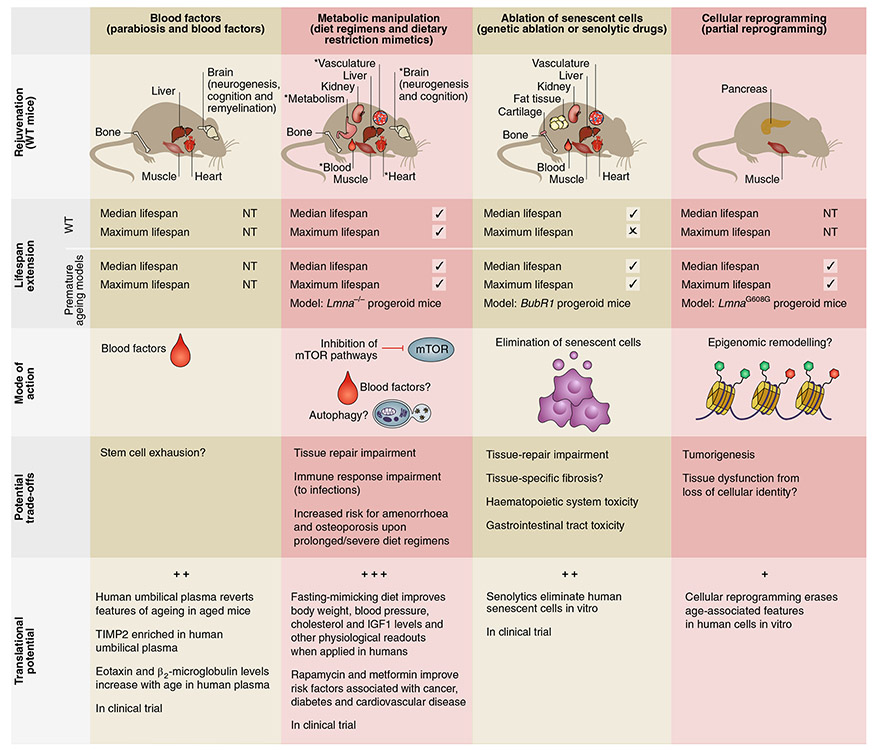
A comparison of the four emerging rejuvenation strategies: blood factors, metabolic manipulation, ablation of senescent cells and cellular reprogramming. The figure depicts the features that improve when treatment in mice is initiated at midlife or later. The top panel shows organs or tissues that exhibit a rejuvenated phenotype in wild-type (WT) mice. For rapamycin, features that have been shown to improve also in young mice following treatment are indicated with an asterisk (*). The effect on lifespan, proposed primary mode (or modes) of action and possible trade-offs of these strategies are also presented. Finally, the translational potential in humans is indicated by the increasing number of plus signs (+) based on present evidence in human ageing and current feasibility. NT, not tested. Question marks indicate possible modes of action and trade-offs. Figure adapted from ref. .
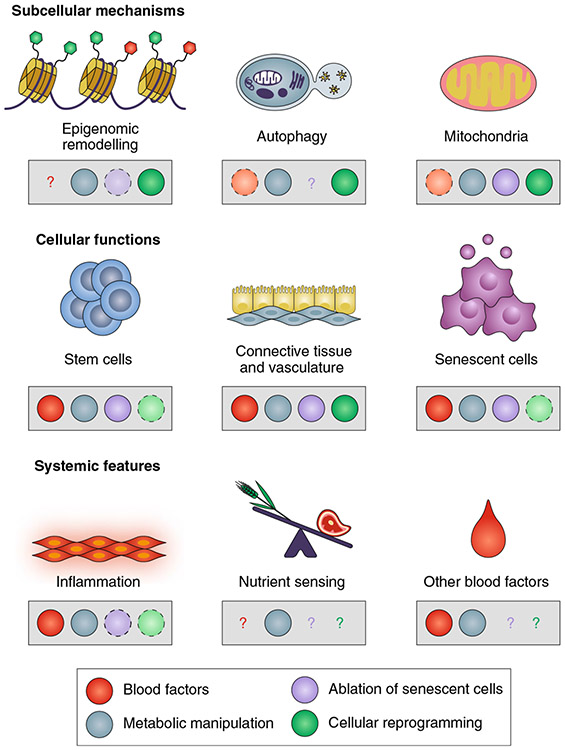
A comparison of the proposed underlying mechanisms of action and target cell types influenced by each of the rejuvenation strategies. These include subcellular mechanisms (for example, chromatin changes, induction of autophagy pathways and alteration in mitochondrial function), cellular functions (such as revival of stem cell populations, attenuation of the deleterious effects of senescent cells and changes in connective tissue cells (for example, endothelial cells, fibroblasts and adipocytes)) and intercellular features (for example, decrease in inflammation, perturbation of nutrient-sensing pathways and changes in blood factors). The circles below each feature are colour-coded for each rejuvenation strategy and represent the current level of evidence for the effect of the corresponding strategy on the feature. Solid/dark circles, strong evidence. Dotted/light circles, mostly indirect evidence. Question marks, no evidence as of now.
References
Publication types
MeSH terms
Grants and funding
LinkOut - more resources
Full Text Sources
Other Literature Sources
Medical
