


Incidence of infections due to third generation cephalosporin-resistant Enterobacteriaceae - a prospective multicentre cohort study in six German university hospitals
- PMID: 30603083
- PMCID: PMC6307128
- DOI: 10.1186/s13756-018-0452-8
Incidence of infections due to third generation cephalosporin-resistant Enterobacteriaceae - a prospective multicentre cohort study in six German university hospitals
Abstract
Background: Infections caused by third generation cephalosporin-resistant Enterobacteriaceae (3GCREB) are an increasing healthcare problem. We aim to describe the 3GCREB infection incidence and compare it to prevalence upon admission. In addition, we aim to describe infections caused by 3GCREB, which are also carbapenem resistant (CRE).
Methods: In 2014-2015, we performed prospective 3GCREB surveillance in clinically relevant patient specimens (screening specimens excluded). Infections counted as hospital-acquired (HAI) when the 3GCREB was detected after the third day following admission, otherwise as community-acquired infection (CAI).
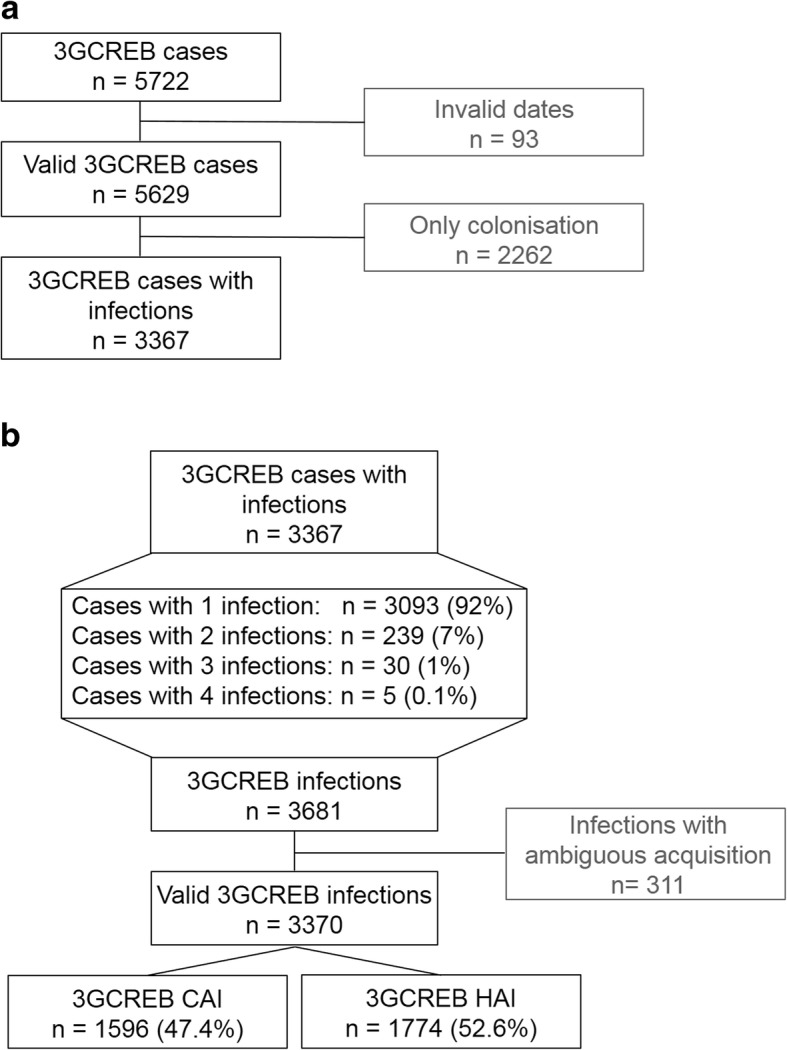
Results: Of 578,420 hospitalized patients under surveillance, 3367 had a 3GCREB infection (0.58%). We observed a similar 3GCREB CAI and HAI incidence (0.28 and 0.31 per 100 patients, respectively). The most frequent pathogen was 3GCR E. coli, in CAI and HAI (0.15 and 0.12 per 100 patients). We observed a CRE CAI incidence of 0.006 and a HAI incidence of 0.008 per 100 patients (0.014 per 1000 patient days).
Conclusions: Comparing the known 3GCREB admission prevalence of the participating hospitals (9.5%) with the percentage of patients with a 3GCREB infection (0.58%), we conclude the prevalence of 3GCREB in university hospitals to be about 16 times higher than suggested when only patients with 3GCREB infections are considered. Moreover, we find the HAI and CAI incidence caused by CRE in Germany to be relatively low.
Keywords: CRE; Carbapenem; Community-acquired infections; E. coli; ESBL; Enterobacter spp.; Fluoroquinolone; Gram-negative; Hospital-acquired infections; Klebsiella spp..
Conflict of interest statement
The ethics committee at Charité, University Medicine Berlin, Germany, approved this study (EA/018/14). Surveillance was performed in accordance with the German Infection Protection Act and did not require patient consent.(9).Not applicable.No competing interests unless stated. MJGTV is a consultant to: Alb Fils Kliniken, Astellas Pharma, MaaT Pharma, MSD/Merck; has served with the speakers’ bureau of: Astellas Pharma, Basilea, Gilead Sciences, Merck/MSD, Organobalance and Pfizer; received research funding from: 3 M, Astellas Pharma, DaVolterra, Gilead Sciences, Merck/MSD, Morphochem, Organobalance, and Seres Therapeutics. HS reports grants from Bundesministerium für Bildung und Forschung (BMBF), the German Center for Infection Research (DZIF), Cubist, and Novartis, and personal fees from Astellas-Basilea, Cubist, Durata, Genentech, Gilead, MSD, Roche Pharma, and Tetraphase. JKMK received research and travel grants from Novartis, bioMérieux, Bayer Vital, and Alere and served as consultant or speaker for bioMérieux, Novartis,and Pfizer. JZ received a speaker’s honorarium from Pfizer.Springer Nature remains neutral with regard to jurisdictional claims in published maps and institutional affiliations.
Figures

References
-
- World Health Organization: Antimicrobial resistance: global report on surveillance. In. WHO Library Cataloguing-in-Publication Data: World Health Organisation 2014.
-
- Rottier WC, Ammerlaan HS, Bonten MJ. Effects of confounders and intermediates on the association of bacteraemia caused by extended-spectrum beta-lactamase-producing Enterobacteriaceae and patient outcome: a meta-analysis. J Antimicrob Chemother. 2012;67(6):1311–1320. doi: 10.1093/jac/dks065. - DOI - PubMed
-
- European Centre for Disease Prevention and Control: Antimicrobial resistance surveillance in Europe 2015. Annual Report of the European Antimicrobial Resistance Surveillance Network (EARS-Net). In. Stockholm: ECDC; 2017.
-
- Leistner R, Schroder C, Geffers C, Breier AC, Gastmeier P, Behnke M. Regional distribution of nosocomial infections due to ESBL-positive Enterobacteriaceae in Germany: data from the German National Reference Center for the surveillance of nosocomial infections (KISS) Clin Microbiol Infect. 2015;21(3):255 e251–255 e255. doi: 10.1016/j.cmi.2014.07.015. - DOI - PubMed
Publication types
MeSH terms
Substances
LinkOut - more resources
Full Text Sources
Miscellaneous
