


Health-related quality of life in liver cirrhosis patients using SF-36 and CLDQ questionnaires
- PMID: 30603670
- PMCID: PMC6311749
- DOI: 10.5114/ceh.2018.80124
Health-related quality of life in liver cirrhosis patients using SF-36 and CLDQ questionnaires
Abstract
Aim of the study: To determine the factors that are likely to influence the domains of health-related quality of life (HRQOL) using SF-36 and CLDQ questionnaires in patients with liver cirrhosis.
Material and methods: Patients with liver cirrhosis were compared with age- and gender-matched healthy controls for physical and mental components of the SF-36 score. Effects of age, co-morbidity, namely diabetes, severity of liver disease and complications of liver cirrhosis on HRQOL using self-administered or by direct interview SF-36 and CLDQ questionnaires were studied. Statistical analysis: chi square test, ANOVA, Kruskal-Wallis test and stepwise linear regression analysis. A p value of < 0.05 was considered significant.
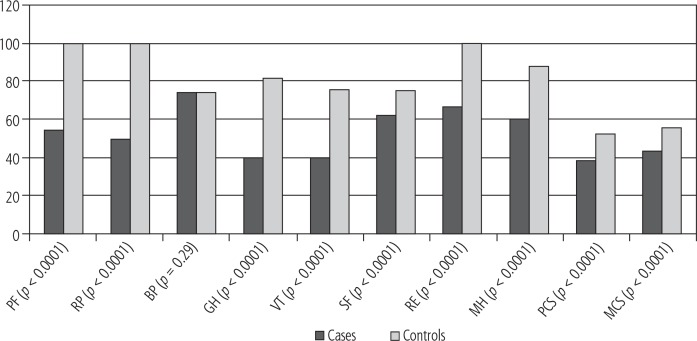
Results: Regarding SF-36 score, except for bodily pain, 149 patients had significantly low individual and composite domain scores (p value < 0.0001) compared to age/gender-matched controls. Patients below 45 years, the majority of whom belonged to Child-Turcotte-Pugh (CTP) class C with a high Model of End-Stage Liver Disease (MELD) and higher rates of complication had low SF-36 for bodily pain (KW p < 0.005) and those above 55 years for physical function (p < 0.05). Both the physical components had a major impact on mental composite score (MCS) (KW p < 0.05). The overall CLDQ score was also low in patients below 45 years old (p < 0.05). Diabetes with or without other co-morbid conditions had no effect on SF-36 or CLDQ scores, while non-diabetic co-morbid conditions did on physical domains (physical function, bodily pain and role physical) and the physical component score of SF-36 (KW p < 0.01 to < 0.0001). In linear regression, MELD had a direct and significant association with overall PCS, MCS and CLDQ.
Conclusions: Age below 45 years, higher MELD and CTP score with the presence of ascites and hepatic encephalopathy affect the overall CLDQ scores.
Keywords: cirrhosis liver; quality of life.
Figures
References
-
- Younossi ZM, Boparai N, McCormick M, et al. Assessment of utilities and health-related quality of life in patients with chronic liver disease. Am J Gastroenterol. 2001;96:579–583. - PubMed
-
- Marchesini G, Bianchi G, Amodio P, et al. Factors associated with poor health-related quality of life of patients with cirrhosis. Gastroenterology. 2001;120:170–178. - PubMed
-
- Younossi ZM, Boparai N, Price LL, et al. Health-related quality of life of patients in chronic liver disease :the impact of type and severity of liver disease. Am J Gastroenterol. 2001;96:2199–2205. - PubMed
-
- Ray I, Dutta D, Basu P, de BK. Quality of life assessment of patients with chronic liver disease in eastern India using a Bengali translation chronic liver disease questionnaire. Indian J Gastroenterol. 2010;29:187–195. - PubMed
LinkOut - more resources
Full Text Sources
Molecular Biology Databases
