


Laparoscopic-assisted cyst excision and ductoplasty plus widened portoenterostomy for choledochal cysts with a narrow portal bile duct
- PMID: 30604269
- PMCID: PMC6505504
- DOI: 10.1007/s00464-018-06635-4
Laparoscopic-assisted cyst excision and ductoplasty plus widened portoenterostomy for choledochal cysts with a narrow portal bile duct
Abstract
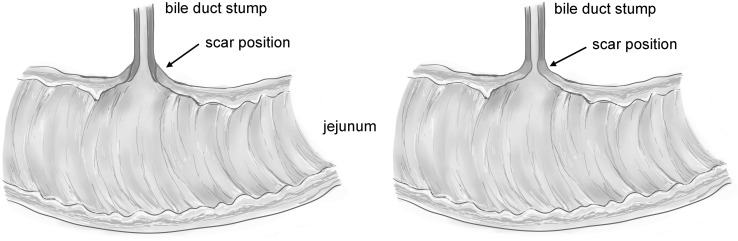
Background: Complete cyst excision with Roux-en-Y hepaticojejunostomy is the standard procedure for choledochal cysts (CCs). In recent years, neonates have been increasingly diagnosed with CCs prenatally. Earlier treatment has been recommended to avoid complications. For type IVa malformation without extensive intrahepatic bile duct dilatation, laparoscopic hepaticojejunostomy is technically challenging, and anastomotic stricture is a concern. Therefore, we propose laparoscopic synthetical techniques-laparoscopic excision of cyst and ductoplasty plus widened portoenterostomy to avoid stricture in CCs with a narrow hilar duct.
Methods: An anastomosis was created around the transected end of the common bile duct in 12 minipigs (Group A), and another 12 minipigs (Group B) received conventional cholangiojejunostomy. Anastomotic diameter measurements and cholangiography were conducted at different times. Histological findings of inflammation and scarring were compared. The expression levels of TGF-β1 and type I collagen were detected by real-time quantitative PCR. Between January 2012 and January 2016, laparoscopic excision of cyst and ductoplasty plus widened portoenterostomy were performed on 29 children with confirmed CCs with a narrow portal bile duct who were followed up for 12-48 months.
Results: Group A survived well without obstruction. Slight inflammation and fibrotic tissue were confined to the bile duct periphery. In Group B, five pigs developed stricture. Severe inflammation and diffuse fibrosis affected the whole layer of the anastomosis. Fibrotic biomarkers were significantly higher postoperatively in Group B. Clinically, 29 patients exhibited satisfactory outcomes. No anastomotic stricture has been observed to date.
Conclusions: Laparoscopic synthetical techniques may be a superior option to prevent anastomotic stricture in treating CCs with a narrow portal bile duct.
Keywords: Anastomotic stricture; Choledochal cyst; Laparoscopy; Wide hepaticojejunostomy.
Conflict of interest statement
Xiaopan Chang, Xi Zhang, Meng Xiong, Li Yang, Shuai Li, Guoqing Cao, Ying Zhou, Dehua Yang, and Shao-tao Tang have no conflicts of interest or financial ties to disclose.
Figures


References
-
- Yeung F, Chung PH, Wong KK, Tam PK. Biliary-enteric reconstruction with hepaticoduodenostomy following laparoscopic excision of choledochal cyst is associated with better postoperative outcomes: a single-centre experience. Pediatr Surg Int. 2015;31(2):149–153. doi: 10.1007/s00383-014-3648-x. - DOI - PubMed
Publication types
MeSH terms
LinkOut - more resources
Full Text Sources
Research Materials
