. 2019 Mar;597(6):1691-1704.
doi: 10.1113/JP277292. Epub 2019 Jan 30.

Functional assessment of triheteromeric NMDA receptors containing a human variant associated with epilepsy

Affiliations

Functional assessment of triheteromeric NMDA receptors containing a human variant associated with epilepsy

Katie F M Marwick et al. J Physiol. 2019 Mar.

Abstract

Key points: NMDA receptors are neurotransmitter-gated ion channels that are critically involved in brain cell communication Variations in genes encoding NMDA receptor subunits have been found in a range of neurodevelopmental disorders. We investigated a de novo genetic variant found in patients with epileptic encephalopathy that changes a residue located in the ion channel pore of the GluN2A NMDA receptor subunit. We found that this variant (GluN2AN615K ) impairs physiologically important receptor properties: it markedly reduces Mg2+ blockade and channel conductance, even for receptors in which one GluN2AN615K is co-assembled with one wild-type GluN2A subunit. Our findings are consistent with the GluN2AN615K mutation being the primary cause of the severe neurodevelopmental disorder in carriers.

Abstract: NMDA receptors are ionotropic calcium-permeable glutamate receptors with a voltage-dependence mediated by blockade by Mg2+ . Their activation is important in signal transduction, as well as synapse formation and maintenance. Two unrelated individuals with epileptic encephalopathy carry a de novo variant in the gene encoding the GluN2A NMDA receptor subunit: a N615K missense variant in the M2 pore helix (GRIN2AC1845A ). We hypothesized that this variant underlies the neurodevelopmental disorders in carriers and explored its functional consequences by electrophysiological analysis in heterologous systems. We focused on GluN2AN615K co-expressed with wild-type GluN2 subunits in physiologically relevant triheteromeric NMDA receptors containing two GluN1 and two distinct GluN2 subunits, whereas previous studies have investigated the impact of the variant in diheteromeric NMDA receptors with two GluN1 and two identical GluN2 subunits. We found that GluN2AN615K -containing triheteromers showed markedly reduced Mg2+ blockade, with a value intermediate between GluN2AN615K diheteromers and wild-type NMDA receptors. Single-channel conductance was reduced by four-fold in GluN2AN615K diheteromers, again with an intermediate value in GluN2AN615K -containing triheteromers. Glutamate deactivation rates were unaffected. Furthermore, we expressed GluN2AN615K in cultured primary mouse cortical neurons, observing a decrease in Mg2+ blockade and reduction in current density, confirming that the variant continues to have significant functional impact in neuronal systems. Our results demonstrate that the GluN2AN615K variant has substantial effects on NMDA receptor properties fundamental to the roles of the receptor in synaptic plasticity, even when expressed alongside wild-type subunits. This work strengthens the evidence indicating that the GluN2AN615K variant underlies the disabling neurodevelopmental phenotype in carriers.

Keywords: Epilepsy; Genetics; Human; electrophysiology; intellectual disability.


Figures

Figure 1
Figure 1
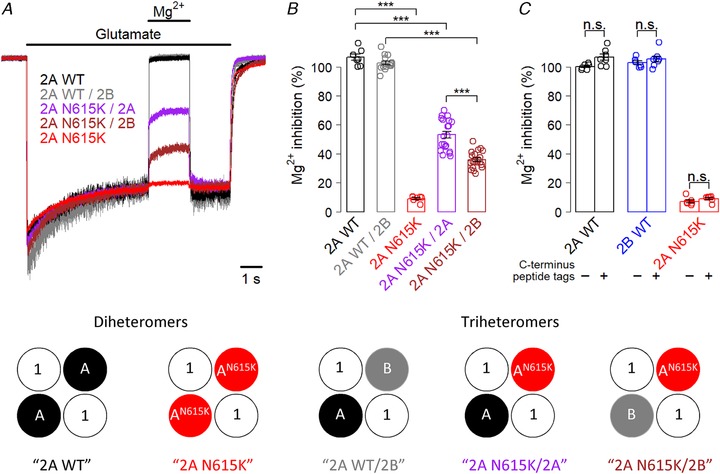
GluN2AN615K reduces Mg2+ blockade in triheteromeric NMDA receptors A, representative whole‐cell, voltage clamp recordings from HEK293T cells expressing NMDA receptors containing wild‐type GluN2A diheteromers, GluN2A/2B triheteromers and GluN2AN615K‐containing diheteromers and triheteromers, partnered with either GluN2AWT or GluN2BWT. All subunits, including wild‐type, had modified endoplasmic reticulum signals. The traces show responses to glutamate (1 mm) and blockade by Mg2+ (1 mm) in the continuous presence of glycine (100 μm), held at –60 mV. B, summary data showing percentage blockade by Mg2+ for each receptor composition. A one‐way ANOVA showed a significant effect of receptor subunit composition (F 4,64 = 346, P < 2 × 10–16). Post hoc Bonferroni corrected t tests showed that GluN2AN615K diheteromeric receptors had a significantly reduced Mg2+ blockade (9 ± 1%, n = 7) compared to GluN2AWT diheteromers (107 ± 2%, n = 7, t 7.3 = 42, P = 5 × 10–10). Triheteromeric receptors containing only one GluN2AN615K subunit also showed a marked reduction in Mg2+ blockade, whether partnered with one GluN2AWT subunit (53 ± 2%, n = 20), compared with GluN2AWT diheteromers (t 19.9 = 16.5, P = 2 × 10–12) or partnered with one GluN2BWT subunit (36 ± 1%, n = 20), compared with GluN2AWT/2BWT (103 ± 1%, n = 15, t 32.6 = 36.9, P = 9 × 10–16). The reduction in Mg2+ blockade was greater in GluN2AN615K subunits partnered with GluN2BWT than with GluN2AWT (t 29.4 = 6.3, P = 3 × 10–6). Some traces show greater than 100% blockade by Mg2+, reflecting a small contamination of the bath fluid (baseline exposure) by glutamate. C, summary data showing percentage blockade by Mg2+ for NMDA receptors with and without modified C‐termini. A two‐way ANOVA showed a significant influence of C‐terminus tag (F 1,35 = 8.0, P = 0.00785) and a significant effect of receptor subunit composition (F 2,35 = 2635, P < 2 × 10–16), although there was no significant interaction (F 2,35 = 1.3, P = 0.28). However, post hoc Bonferroni corrected t tests showed no significant effect of modifying C‐termini with engineered tags for any subunit.
Figure 2
Figure 2
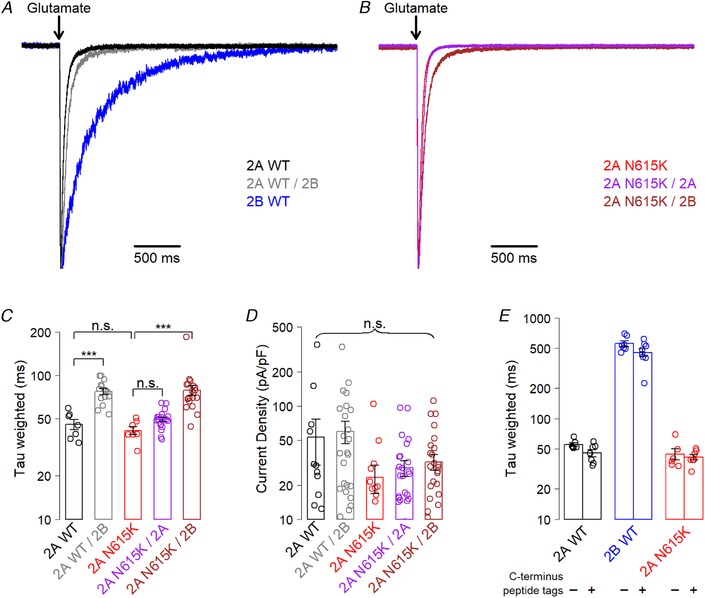
GluN2AN615K does not alter glutamate deactivation A and B, representative whole‐cell, voltage clamp recordings from HEK293T cells expressing NMDA receptors containing wild‐type GluN2A diheteromers, GluN2A/2B triheteromers and GluN2AN615K containing diheteromers and triheteromers, partnered with either GluN2AWT or GluN2BWT. All subunits, including wild‐type, had modified endoplasmic reticulum signals. The traces show deactivation following 5 ms exposure to glutamate (1 mm) and glycine (100 μm) in the absence of Mg2+ when held at –60 mV. Responses are normalized to their peak amplitudes. C, summary data showing weighted time constants fitted to the glutamate deactivation curves. A one‐way ANOVA showed a significant effect of receptor subunit composition (F 4,64 = 14, P = 3 × 10–8). Post hoc Bonferroni corrected t tests showed that GluN2AWT/2B triheteromers had a slower deactivation time constant (77 ± 4 ms; n = 15), than GluN2AWT diheteromers (45 ± 4 ms; n = 7; t 17 = 6.2, P = 4 × 10–5). GluN2AWT diheteromers were indistinguishable from GluN2AN615K diheteromers (41 ± 3; n = 7; t 11 = 0.9, P ≥ 0.4), with GluN2AN615K and GluN2AN615K/2A (49 ± 2 ms, n = 20) also showing no difference (t 10.9 = 2.6, P = 0.1). GluN2AN615K/2B triheteromers (79 ± 6, n = 20) showed a slower deactivation rate than GluN2AN615K diheteromers (t 10.9 = 2.6, P = 5 × 10–5)). D, summary data showing current density (peak amplitude/capacitance) for cells expressing diheteromeric and triheteromeric receptor combinations (for other experiments, only cells with a current response of between 100 and 1000 pA were used to allow accuracy without escape of unwanted subunit combinations but, here, all traces are included). A one‐way ANOVA showed no effect of receptor subunit composition (F 4,104 = 2.1, P = 0.08). E, summary data showing weighted time constants fitted to glutamate deactivation curves. Modifying the C‐terminus with engineered peptide tags designed to vary retention in the endoplasmic reticulum had no effect on glutamate deactivation in diheteromeric wild‐type receptors containing GluN2AWT or GluN2BWT, or in those containing GluN2AN615K. A two‐way ANOVA showed no significant influence of C terminus tag (F 1,35 = 4.0, P = 0.054), a significant effect of NMDAR subunit composition (F 2,35 = 226, P < 2 × 10–16) and no significant interaction (F 2,35 = 2.5, P = 0.1).
Figure 3
Figure 3
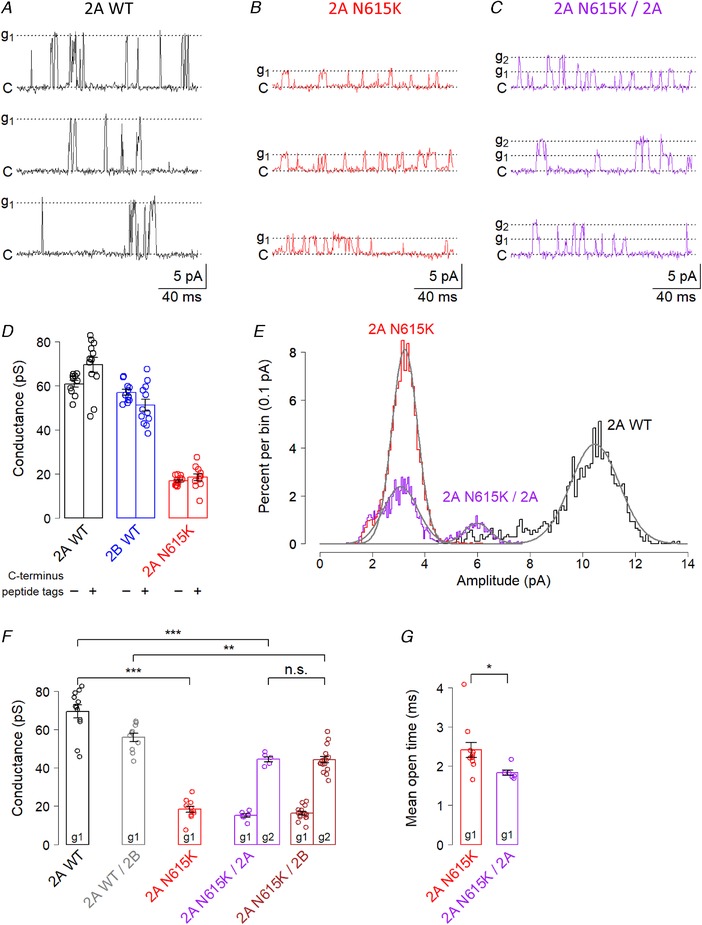
GluN2AN615K reduces single‐channel conductance in triheteromeric NMDA receptors AC, representative voltage clamp recordings made from cell‐attached patches from HEK293T cells expressing NMDA receptors containing wild‐type GluN2A diheteromers, GluN2A/2B triheteromers and GluN2AN615K‐containing diheteromers and triheteromers, partnered with either GluN2AWT or GluN2BWT. All subunits, including wild‐type, had modified endoplasmic reticulum signals. The traces show single‐channel currents in the presence of glutamate (1 mm) and glycine (100 μm). The pipette potentials used for the traces illustrated in (A) to (C) were +120, +140 and +140 mV, respectively. ‘C’ = closed; ‘g1’ = first conductance fitted; ‘g2’ = second conductance fitted. A number of transitions between the two conductance states can be seen in (C). D, summary data showing single channel conductance for receptors with and without modified C‐termini. A two‐way ANOVA showed no significant influence of C‐terminus tag (F 1,62 = 0.6, P = 0.42), a significant effect of receptor subunit composition (F 2,62 = 278, P < 2 × 10–16) and a significant interaction (F 2,62 = 5.7, P = 0.006). E, representative amplitude histograms showing fitted normal distributions, superimposed from three different patches. The means of the fitted distributions were used to calculate conductance. For the patch expressing a GluN2AN615K‐containing triheteromer, two peaks can be seen: the prominent subconductance and the less frequent intermediate conductance. F, summary data showing conductances, calculated by plotting current amplitudes against pipette potential (at least three potentials within range + 40 to + 180 mV). A two‐way ANOVA showed a main effect of subunit (F 4,70 = 121, P < 2 × 10–16) and of conductance level (g1 vs. g2; F 1,70 = 196, P < 2 × 10–16), with no significant interaction. Post hoc Bonferroni corrected t tests showed that GluN2AN615K diheteromeric receptors had a significantly lower conductance (18 ± 2 pS; n = 11) than GluN2AWT diheteromers (69 ± 3 pS; n = 12; t 15.4 = 13.7, P = 2 × 10–9). Triheteromeric receptors containing only one GluN2AN615K subunit also showed a marked reduction in intermediate conductance (g2), whether partnered with one GluN2AWT subunit (44 ± 1 pS; n = 6), compared with GluN2AWT diheteromers (t 13.5 = 7.0, P = 3 × 10–5) or with one GluN2BWT subunit (44 ± 1 pS; n = 16), compared with GluN2AWT/2BWT (56 ± 2 pS; n = 10; t 18.4 = 4.2, P = 0.003). The reduction in conductance was no greater in GluN2AN615K subunits partnered with GluN2BWT than with GluN2AWT (t 19.1 = 0.06, P > 0.9). G, summary data showing receptor mean open times calculated by fitting single exponentials to open time distributions from individual patches. Only the lower conductance openings were fitted for GluN2AN615K/2A triheteromers, which showed briefer open times than GluN2AN615K diheteromers (2A N615K/2A: 1.83 ± 0.07 ms; n = 6 vs. 2A N615K 2.42 ± 0.19 ms, n = 11; t 12.5 = 2.9, P = 0.014).
Figure 4
Figure 4
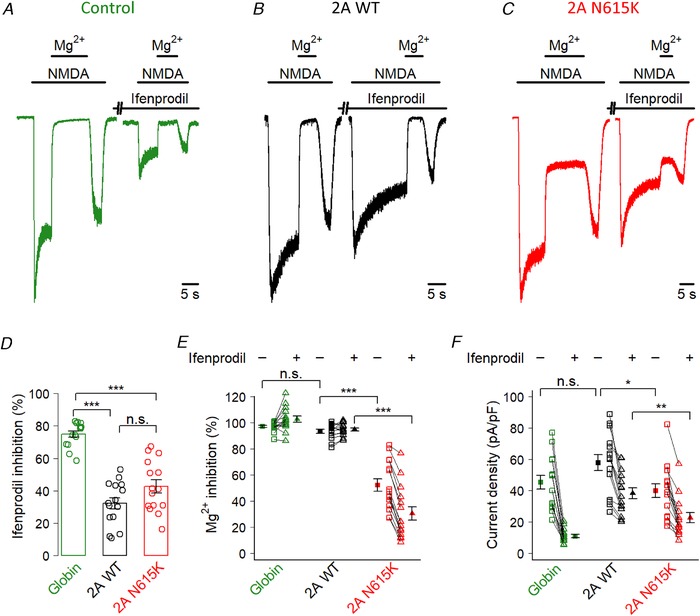
GluN2AN615K reduces Mg2+ blockade and current density in cultured neurons AC, representative whole‐cell, voltage clamp recordings made from DIV 9 primary mouse cortical neurons transiently transfected with an inert control: β globin (A), GluN2AWT (B) or GluN2AN615K (C). Traces show the response to saturating NMDA (150 μm) and inhibition by Mg2+ (1 mm), before and after a 1 min application of ifenprodil (3 μm) (a selective GluN2B negative allosteric modulator). D, summary data showing percentage inhibition by ifenprodil. A one‐way ANOVA showed a significant effect of transfected subunit (F 2,42 = 46, P = 2.8 × 10–11), with post hoc Bonferroni corrected t tests indicating that neurons transfected with GluN2AWT showed lower ifenprodil sensitivity than control transfection cells (WT: 32 ± 3; n = 15; globin 75 ± 2; n = 15; t 21.9 = 10.7, P = 1.0 × 10–9), as did neurons transfected with GluN2AN615K (43 ± 4; n = 15; t 20.0 = 7.2, P = 1.9 × 10–6) and with no difference between GluN2A and GluN2AN615K (t 27.3 = 1.9, P = 0.19). These results confirm that the GluN2AN615K subunits have been successfully trafficked to the surface in neurons. E, summary data showing Mg2+ blockade in the presence and absence of ifenprodil. Squares show blockade without ifenprodil; triangles show blockade with ifenprodil. Solid shapes represent means; hollow shapes are individual cells. A two‐way ANOVA showed a significant effect of transfected subunit (F 2,42 = 111, P = 2 × 10–16) and the presence of ifenprodil (F 1,42 = 31, P = 1.9 × 10–6), with a significant interaction (F 2,42 = 90, P = 6.7 × 10–16). Post hoc Bonferroni corrected t tests showed lower Mg2+ blockade in the absence of ifenprodil in neurons transfected with GluN2AN615K compared to GluN2AWT (WT: 93 ± 1%; n = 15; N615K 52 ± 5%; n = 15; t 16.7 = 8.2, P = 9.7 × 10–7), although there was no difference between GluN2AWT and control (globin: 97 ± 1%; n = 15; t 23.3 = 2.2, P = 0.13). In the presence of ifenprodil, the reduction in Mg2+ blockade associated with GluN2AN615K vs. wild‐type was even more marked (WT: 95 ± 1%; n = 15; N615K 31 ± 5%; n = 15; t 15.4 = 12.1, P = 8.4 × 10–9). F, summary data showing current density in the presence and absence of ifenprodil. As with Mg2+ blockade, we found that current density was reduced in neurons transfected with GluN2AN615K, and this effect was more pronounced in the presence of ifenprodil. A two‐way ANOVA showed a significant effect of transfected subunit (F 2,42 = 9.4, P = 0.0004) and the presence of ifenprodil (F 1,42 = 178, P = 2 × 10–16), with a significant interaction (F 2,42 = 9.2, P = 0.0005). Post hoc Bonferroni corrected t tests showed lower current density in the absence of ifenprodil in neurons transfected with GluN2AN615K compared to GluN2AWT (WT: 58 ± 5 pA pF–1; n = 15; N615K 40 ± 4 pA pF–1; n = 15; t 27.3 = 2.7, P = 0.037), although there was no difference between GluN2AWT and control (globin: 45 ± 4 pA pF–1; n = 15; t 27.4 = 1.9, P = 0.22). In the presence of ifenprodil, the reduction in current density associated with GluN2AN615K vs. wild‐type was even more marked (WT: 38 ± 4 pA pF–1; n = 15; N615K 23 ± 3 pA pF–1; n = 15) (t 27.8 = 3.3, P = 0.009).

References

    1. Allen NM, Conroy J, Shahwan A, Lynch B, Correa RG, Pena SDJ, McCreary D, Magalhães TR, Ennis S, Lynch SA & King MD (2016). Unexplained early onset epileptic encephalopathy: exome screening and phenotype expansion. Epilepsia 57, e12–e17. - PubMed
    1. Bading H, Ginty DD & Greenberg ME (1993). Regulation of gene expression in hippocampal neurons by distinct calcium signaling pathways. Science 260, 181–186. - PubMed
    1. Bar‐Shira O, Maor R & Chechik G (2015). Gene expression switching of receptor subunits in human brain development. PLoS Comput Biol 11, 1–21. - PMC - PubMed
    1. Behe P, Stern P, Wyllie DJA, Nassar M, Schoepfer R & Colquhoun D (1995). Determination of NMDA NR1 subunit copy number in recombinant NMDA receptors. Proc R Soc B Biol Sci 262, 205–213. - PubMed
    1. Endele S, Rosenberger G, Geider K, Popp B, Tamer C, Stefanova I, Milh M, Kortüm F, Fritsch A, Pientka FK, Hellenbroich Y, Kalscheuer VM, Kohlhase J, Moog U, Rappold G, Rauch A, Ropers HH, von Spiczak S, Tönnies H, Villeneuve N, Villard L, Zabel B, Zenker M, Laube B, Reis A, Wieczorek D, Van Maldergem L & Kutsche K (2010). Mutations in GRIN2A and GRIN2B encoding regulatory subunits of NMDA receptors cause variable neurodevelopmental phenotypes. Nat Genet 42, 1–22. - PubMed

Publication types