. 2018 Jan 4;67(5152):1419-1427.
doi: 10.15585/mmwr.mm675152e1.

Drug and Opioid-Involved Overdose Deaths - United States, 2013-2017

Affiliations

Drug and Opioid-Involved Overdose Deaths - United States, 2013-2017

Lawrence Scholl et al. MMWR Morb Mortal Wkly Rep. .

Abstract

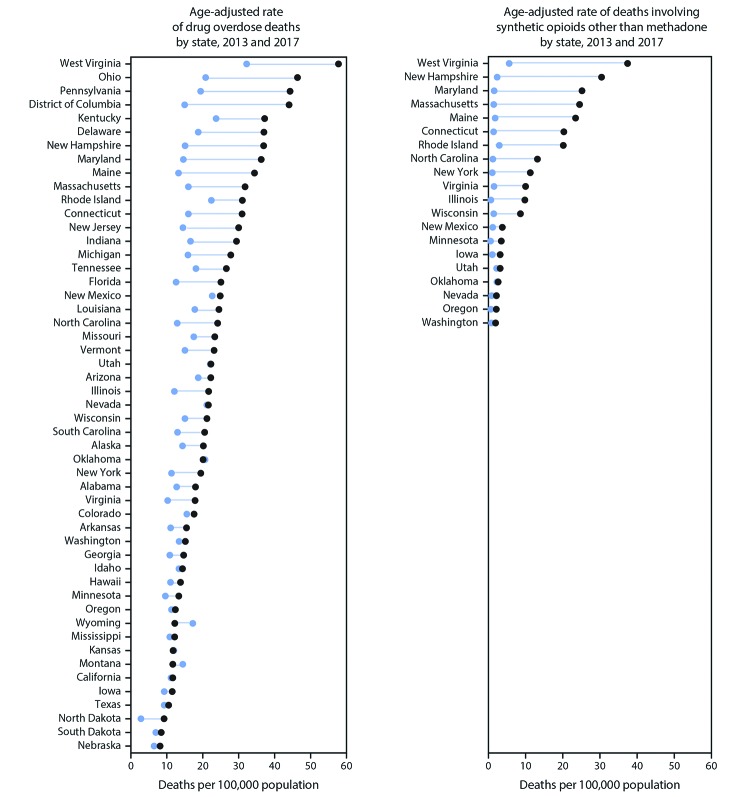
The 63,632 drug overdose deaths in the United States in 2016 represented a 21.4% increase from 2015; two thirds of these deaths involved an opioid (1). From 2015 to 2016, drug overdose deaths increased in all drug categories examined; the largest increase occurred among deaths involving synthetic opioids other than methadone (synthetic opioids), which includes illicitly manufactured fentanyl (IMF) (1). Since 2013, driven largely by IMF, including fentanyl analogs (2-4), the current wave of the opioid overdose epidemic has been marked by increases in deaths involving synthetic opioids. IMF has contributed to increases in overdose deaths, with geographic differences reported (1). CDC examined state-level changes in death rates involving all drug overdoses in 50 states and the District of Columbia (DC) and those involving synthetic opioids in 20 states, during 2013-2017. In addition, changes in death rates from 2016 to 2017 involving all opioids and opioid subcategories,* were examined by demographics, county urbanization levels, and by 34 states and DC. Among 70,237 drug overdose deaths in 2017, 47,600 (67.8%) involved an opioid. From 2013 to 2017, drug overdose death rates increased in 35 of 50 states and DC, and significant increases in death rates involving synthetic opioids occurred in 15 of 20 states, likely driven by IMF (2,3). From 2016 to 2017, overdose deaths involving all opioids and synthetic opioids increased, but deaths involving prescription opioids and heroin remained stable. The opioid overdose epidemic continues to worsen and evolve because of the continuing increase in deaths involving synthetic opioids. Provisional data from 2018 indicate potential improvements in some drug overdose indicators;§ however, analysis of final data from 2018 is necessary for confirmation. More timely and comprehensive surveillance data are essential to inform efforts to prevent and respond to opioid overdoses; intensified prevention and response measures are urgently needed to curb deaths involving prescription and illicit opioids, specifically IMF.


Conflict of interest statement

All authors have completed and submitted the ICMJE form for disclosure of potential conflicts of interest. No potential conflicts of interest were disclosed.

Figures
FIGURE
FIGURE
Age-adjusted rates of drug overdose deaths and deaths involving synthetic opioids other than methadone, by state — United States, 2013 and 2017 * Rates shown are the number of deaths per 100,000 population. Age-adjusted death rates were calculated by applying age-specific death rates to the 2000 U.S. standard population age distribution. Deaths are classified using the International Classification of Diseases, Tenth Revision (ICD–10). Left panel includes drug overdose deaths identified using underlying cause-of-death codes X40–X44, X60–X64, X85, and Y10–Y14. Right panel includes drug overdose deaths, as defined, that have synthetic opioids other than methadone (T40.4) as a contributing cause. § State-level analyses of overdose rates for deaths involving synthetic opioids other than methadone included 20 states that met the following criteria: 1) >80% of drug overdose death certificates named at least one specific drug in 2013–2017; 2) change from 2013 to 2017 in the percentage of death certificates reporting at least one specific drug was <10 percentage points; and 3) ≥20 deaths involving synthetic opioids other than methadone occurred each year during 2013–2017. States whose reporting of any specific drug or drugs involved in an overdose changed by ≥10 percentage points from 2013 to 2017 were excluded because drug-specific overdose numbers and rates might have changed substantially from 2013 to 2017 as a result of changes in reporting. Left panel: Joinpoint regression examining changes in trends from 2013 to 2017 indicated that 35 states and the District of Columbia had significant increases in drug overdose death rates from 2013 to 2017 (Alabama, Alaska, Arizona, Arkansas, Connecticut, Delaware, District of Columbia, Florida, Georgia, Hawaii, Illinois, Indiana, Iowa, Kentucky, Louisiana, Maine, Maryland, Massachusetts, Michigan, Minnesota, Missouri, New Jersey, New York, North Carolina, Ohio, Pennsylvania, Rhode Island, South Carolina, South Dakota, Tennessee, Texas, Vermont, Virginia, Washington, West Virginia, and Wisconsin). All remaining states had nonsignificant trends during this period. Right panel: Joinpoint regression examining changes in trends from 2013 to 2017 indicated that 15 states had significant increases in death rates for overdoses involving synthetic opioids other than methadone from 2013 to 2017 (Connecticut, Illinois, Iowa, Maine, Maryland, Minnesota, Nevada, New York, North Carolina, Oregon, Rhode Island, Virginia, Washington, West Virginia, and Wisconsin). The five remaining states analyzed had nonsignificant trends during this period. Significant increases in trends were not detected in some states with large absolute increases in death rates from 2013 to 2017 because of limited power to detect significant effects.

References

    1. Seth P, Scholl L, Rudd RA, Bacon S. Overdose deaths involving opioids, cocaine, and psychostimulants—United States, 2015–2016. MMWR Morb Mortal Wkly Rep 2018;67:349–58. 10.15585/mmwr.mm6712a1 - DOI - PMC - PubMed
    1. Gladden RM, Martinez P, Seth P. Fentanyl law enforcement submissions and increases in synthetic opioid-involved overdose deaths—27 states, 2013–2014. MMWR Morb Mortal Wkly Rep 2016;65:837–43. PubMed 10.15585/mmwr.mm6533a2 - DOI - PubMed
    1. O’Donnell JK, Gladden RM, Seth P. Trends in deaths involving heroin and synthetic opioids excluding methadone, and law enforcement drug product reports, by census region—United States, 2006–2015. MMWR Morb Mortal Wkly Rep 2017;66:897–903 10.15585/mmwr.mm6634a2. 10.15585/mmwr.mm6634a2 - DOI - PMC - PubMed
    1. O’Donnell JK, Halpin J, Mattson CL, Goldberger BA, Gladden RM. Deaths involving fentanyl, fentanyl analogs, and U-47700—10 states, July–December 2016. MMWR Morb Mortal Wkly Rep 2017;66:1197–202. 10.15585/mmwr.mm6643e1 - DOI - PMC - PubMed
    1. Seth P, Rudd RA, Noonan RK, Haegerich TM. Quantifying the epidemic of prescription opioid overdose deaths. Am J Public Health 2018;108:500–2. 10.2105/AJPH.2017.304265 - DOI - PMC - PubMed

Substances