


Higher Risks of Toxicity and Incomplete Recovery in 13- to 17-Year-Old Females after Marrow Donation: RDSafe Peds Results
- PMID: 30605731
- PMCID: PMC6511296
- DOI: 10.1016/j.bbmt.2018.12.765
Higher Risks of Toxicity and Incomplete Recovery in 13- to 17-Year-Old Females after Marrow Donation: RDSafe Peds Results
Abstract
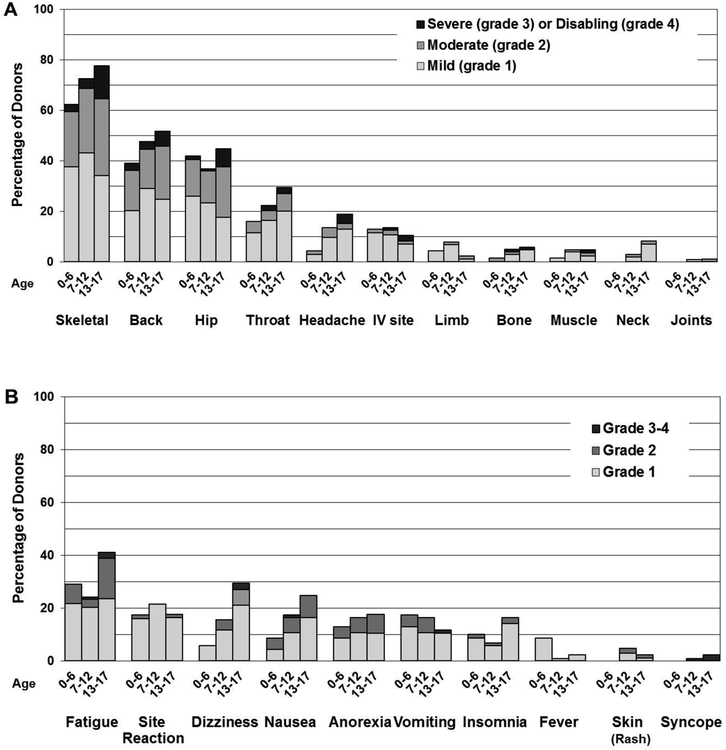
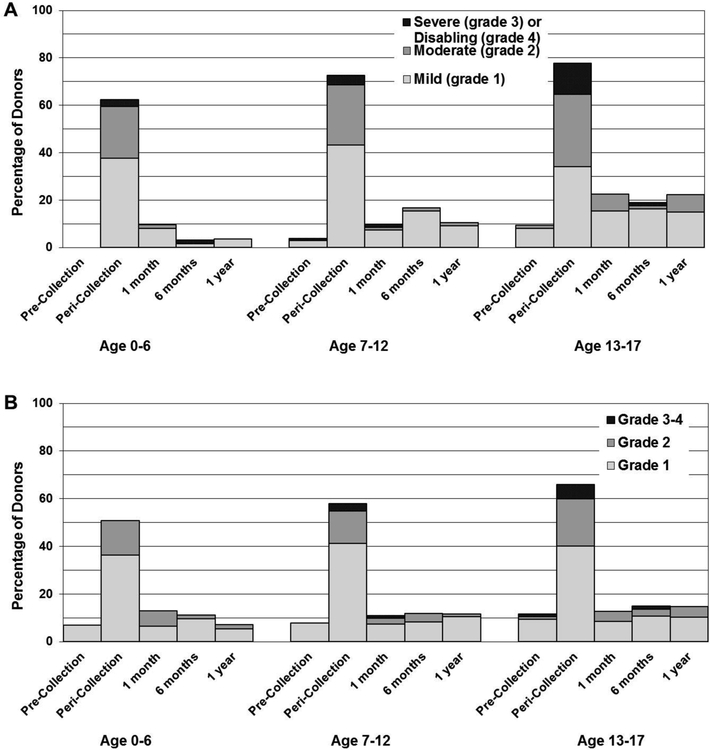
Although donation of bone marrow (BM) or peripheral blood stem cells (PBSCs) from children to family members undergoing allogeneic transplantation are well-established procedures, studies detailing levels of pain, symptoms, and long-term recovery are lacking. To address this lack, we prospectively enrolled 294 donors age <18 years at 25 pediatric transplantation centers in North America, assessing them predonation, peridonation, and at 1 month, 6 months, and 1 year postdonation. We noted that 71% of children reported pain and 59% reported other symptoms peridonation, with resolution to 14% and 12% at 1 month postdonation. Both older age (age 13 to 17 years versus younger) and female sex were associated with higher levels of pain peridonation, with the highest rates in older females (57% with grade 2-4 pain and 17% with grade 3-4 pain). Multivariate analyses showed a 4-fold increase in risk for older females compared with males age <13 years (P <.001). At 1 year, 11% of 13- to 17-year-old females reported grade 2-4 pain, compared with 3% of males age 13 to 17 years, 0% of females age <13 years, and 1% of males age <13 years (P = .01). Males and females age 13 to 17 years failed to return to predonation pain levels at 1 year 22% and 23% of the time, respectively, compared with 3% and 10% in males and females age <13 years (P = .002). Our data show that females age 13 to 17 years are at increased risk of grade 2-4 pain at 1 year and >20% of females and males age 13 to 17 years do not return to baseline pain levels by 1 year after BM donation. Studies aimed at decreasing symptoms and improving recovery in older children are warranted.
Keywords: BM collection toxicities; Donor safety; PBSC collection toxicities; Stem cell transplantation.
Copyright © 2019. Published by Elsevier Inc.
Conflict of interest statement
DISCLOSURES OF CONFLICT OF INTEREST
None of the authors have any conflict of interest to declare.
Figures
Comment in
-
Protecting the Selfless: Toward More Comprehensive Care for Pediatric Related Stem Cell Donors.Biol Blood Marrow Transplant. 2019 May;25(5):e143-e144. doi: 10.1016/j.bbmt.2019.03.010. Epub 2019 Mar 14. Biol Blood Marrow Transplant. 2019. PMID: 30878606 No abstract available.
References
-
- Pulsipher MA, Nagler A, Iannone R, et al. Weighing the risks of G-CSF administration, leukopheresis, and standard marrow harvest: ethical and safety considerations for normal pediatric hematopoietic cell donors. Pediatr Blood Cancer. 2006;46:422–33. - PubMed
-
- Pulsipher MA, Levine JE, Hayashi RJ, et al. Safety and efficacy of allogeneic PBSC collection in normal pediatric donors: the pediatric blood and marrow transplant consortium experience (PBMTC) 1996–2003. Bone Marrow Transplant. 2005;35:361–7. - PubMed
-
- Styczynski J, Balduzzi A, Gil L, et al. Risk of complications during hematopoietic stem cell collection in pediatric sibling donors: a prospective European Group for Blood and Marrow Transplantation Pediatric Diseases Working Party study. Blood. 2012;119:2935–42. - PubMed
-
- Frangoul H, Nemecek ER, Billheimer D, et al. A prospective study of G-CSF primed bone marrow as a stem-cell source for allogeneic bone marrow transplantation in children: a Pediatric Blood and Marrow Transplant Consortium (PBMTC) study. Blood. 2007;110:4584–7. - PubMed
Publication types
MeSH terms
Grants and funding
LinkOut - more resources
Full Text Sources
Medical
