


Client-tailored maternity care to increase maternal empowerment: cluster randomized controlled trial protocol; the healthy pregnancy 4 All-2 program
- PMID: 30606140
- PMCID: PMC6318875
- DOI: 10.1186/s12884-018-2155-9
Client-tailored maternity care to increase maternal empowerment: cluster randomized controlled trial protocol; the healthy pregnancy 4 All-2 program
Abstract
Background: The postpartum period is an important period for preventive strategies as common maternal and child health risks may become manifest. Women with a lower socioeconomic status tend to have lower maternal empowerment. Increasing their risks of adverse maternal and child health outcomes. This study aims to assess the effectiveness of a primary care level intervention. Delivered to maternity care assistants, aiming to increase maternal empowerment postpartum.
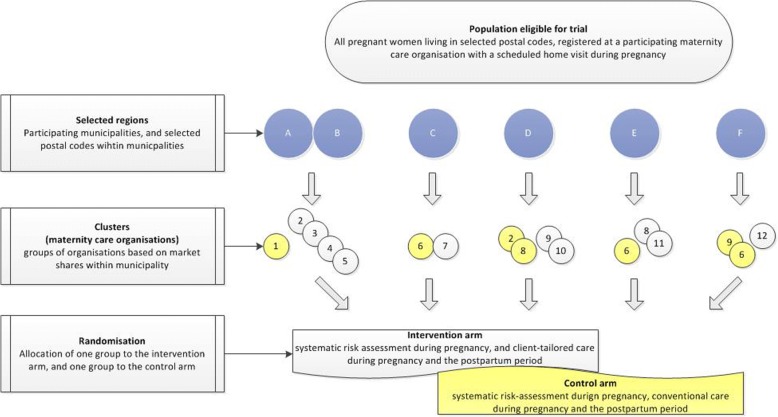
Methods: This study is part of the Dutch nationwide "Healthy Pregnancy 4 All-2" (HP4All-2) program, which aims to identify vulnerable mothers and young children at risk of adverse health outcomes, and subsequently improve their care. This program targets women from deprived neighborhoods. A pragmatic cluster randomized controlled trial will be undertaken in 12 maternity care organizations. Maternity care organizations in urban municipalities (i.e. the clusters) will be randomized to either a systematic risk assessment during pregnancy with emphasis on identification of non-medical risk factors for adverse maternal and neonatal health outcomes, and subsequent adaptation of care towards a client-tailored approach during pregnancy and the postpartum period, or solely the systematic risk assessment. The primary outcome is the prevalence of a low maternal empowerment score postpartum. Secondary maternal outcomes cover health-related quality of life, postnatal depression, smoking, alcohol consumption, illicit drug use. Finally, maternal and neonatal health care utilization postpartum are recorded. All outcomes will be analyzed according to the intention-to-treat principle, using multi-level mixed effects models.
Discussion: The study will contribute to evidence regarding the effectiveness of client-tailored, risk-based maternity care to increase maternal empowerment postpartum.
Trial registration: Netherlands Trial Registry (NTR) 6311 , registered 03-27-2017.
Keywords: Empowerment; Health inequalities; Maternity care; Risk factors.
Conflict of interest statement
Ethics approval and consent to participate
We have obtained multi-site approval from the Daily Board of the Medical Ethics Committee Erasmus MC (METC 2015–156). Ethical approval to collaborate with the board of each municipality and with the board of maternity care organizations was provided. In addition we obtained written informed consent from all three levels of participants. Written informed consent was obtained from every participant prior to inclusion. In addition, we obtained written informed consent from the board of every participating municipality (Rotterdam, Schiedam, Groningen, Utrecht, Almere, and Arnhem), and from the board of every participating maternity care organization (Kraamzorg Rotterdam, Careyn Kraamzorg, Kraamzorg Sara, Kraamzorg de Eilanden, Kraamzorg de Bakermand, Kraamzorg het Groene Kruis, Kraamvogel, Zin kraamzorg, Yunio, KraamInzicht, de Waarden, and Liemerscare).
Consent for publication
Not applicable.
Competing interests
The authors declare that they have no competing interests.
Publisher’s Note
Springer Nature remains neutral with regard to jurisdictional claims in published maps and institutional affiliations.
References
-
- Data WLC-i-P: WHO recommendations on postnatal care of the mother and newborn. 2013. - PubMed
-
- T.A. W Adjusting to motherhood maternity care assistance during the postpartum period: how to help new mothers cope. J Neonatal Nurs. 2006;12(5):163–171. doi: 10.1016/j.jnn.2006.07.003. - DOI
-
- Steegers EA, Been JV. Health inequalities: congenital or preventable? Ned Tijdschr Geneeskd. 2015;160(0):D83. - PubMed
-
- Timmermans S, Bonsel GJ, Steegers-Theunissen RP, Mackenbach JP, Steyerberg EW, Raat H, Verbrugh HA, Tiemeier HW, Hofman A, Birnie E, et al. Individual accumulation of heterogeneous risks explains perinatal inequalities within deprived neighbourhoods. Eur J Epidemiol. 2011;26(2):165–180. doi: 10.1007/s10654-010-9542-5. - DOI - PMC - PubMed
Publication types
MeSH terms
Grants and funding
LinkOut - more resources
Full Text Sources
Medical
Molecular Biology Databases
