Review
. 2019 Jan;39(1):107-116.
doi: 10.1016/j.semnephrol.2018.10.009.

Gut Microbiota-Kidney Cross-Talk in Acute Kidney Injury

Affiliations
Review

Gut Microbiota-Kidney Cross-Talk in Acute Kidney Injury

Jing Gong et al. Semin Nephrol. 2019 Jan.

Abstract

The recent surge in research on the intestinal microbiota has greatly changed our understanding of human biology. Significant technical advances in DNA sequencing analysis and its application to metagenomics and metatranscriptomics has profoundly enhanced our ability to quantify and track complex microbial communities and to begin understanding their impact on human health and disease. This has led to a better understanding of the relationships between the intestinal microbiome and renal physiology/pathophysiology. In this review, we discuss the interactions between intestinal microbiota and kidney. We focus on select aspects including the intestinal barrier, immunologic and soluble mediators of microbiome effects, and effects of dysbiosis on acute kidney injury. Relevant studies on microbiome changes in other renal diseases are highlighted. We also introduce potential mechanisms of intervention with regard to gut microbiota in renal diseases.

Keywords: AKI; Acute kidney injury; dysbiosis; gut microbiota; intestinal microbiota.


Figures

Fig.1.
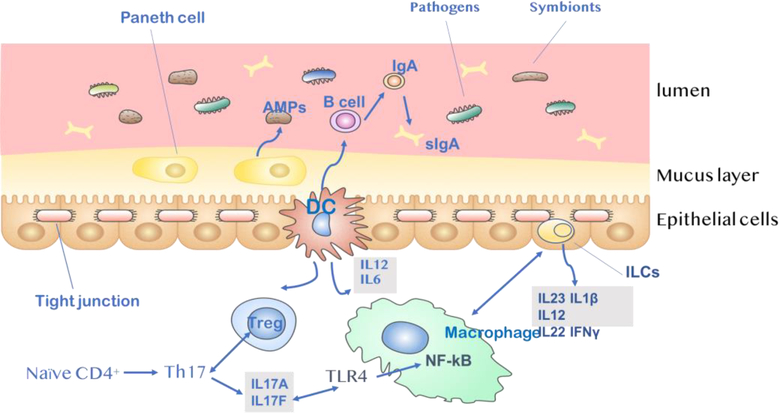
Fig.1.. Intestinal barrier to bacteria.
A) Gut microbiota plays a direct protective role as a biological barrier. They are closely attached to the surface of the intestinal mucosa and compete with pathogenic bacteria and thus can inhibit the colonization and excessive growth of pathogens. B) The intestinal epithelial layer acts as a physical barrier. Tight junction proteins play an important role in the establishment and maintenance of cell polarity within tissues. They function as a fence that restricts the intermixing of lipid and protein components of apical and basolateral membrane domains, regulate the permeability of solutes and ions through the paracellular space and prevent pathogens from reaching the subepithelial tissue. C) Microbiota and epithelial cells interact with each other and regulate subsequent immune response. Translocation of bacterial products across the leaky intestinal barrier activates the immune system, resulting in systemic inflammation. IgA released from Paneth cells plays a fundamental role in mucosal immunity, mainly in response to colonization by specific commensal bacteria. Activation of DCs activated by intestinal microbes results in the secretion of proinflammatory cytokines such as IL-12, IL-6. These DCs promote the differentiation of naïve CD4+ T cells into regulatory T (Treg) cells and the maturation of B cells into IgA-secreting plasma cells. Th17-inducing bacteria may promote Th17 immunity via IL-17A/IL-17F induction, which may involve signaling mediated by the TLR ligands. Finnally, innate lymphoid cells(ILCs) function by limiting macrophage production of the pro-inflammatory cytokines IL-1β, IL-12, IL-23, IL22 and IFNγ.
Fig.2.
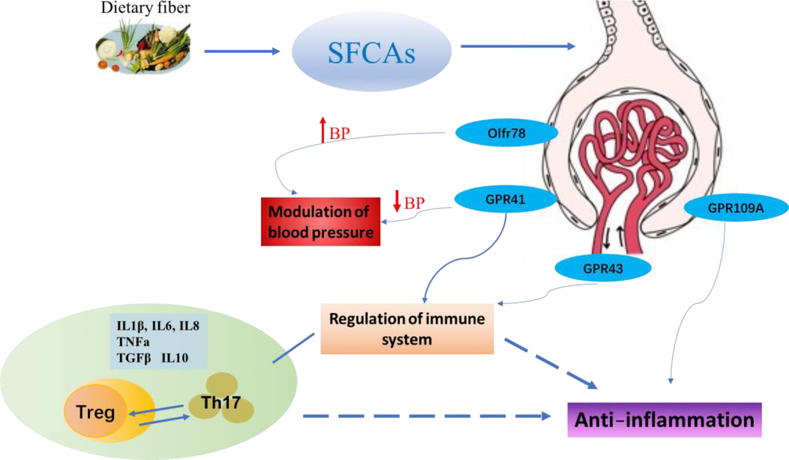
Fig.2.. SCFAs and the receptors in kidney.
GPR41, GPR43, GPR109A and Olfr78 are four SCFA receptors identified in kidney. GPR41and GPR43 are activated by acetate, propionate, butyrate, and isobutyrate and function as regulators of the immune system. Luminal butyrate exerts anti-inflammatory effects via GPR109A and HDAC inhibition. SCFAs also regulate cytokine expression in T cells and generation of Tregs through HDAC inhibition. Effector Th17 cells have enhanced aerobic glycolysis, and inhibition of glycolysis promotes Treg cell generation. The activation of GPR41 can reduce blood pressure, whereas Olfr78, upon stimulation by acetate and propionate, increases blood pressure. SCFAs-mediated cytokines include IL-8, IL-6, IL-1β, TNFα, TGFβ, and IL-10.
Fig.3.
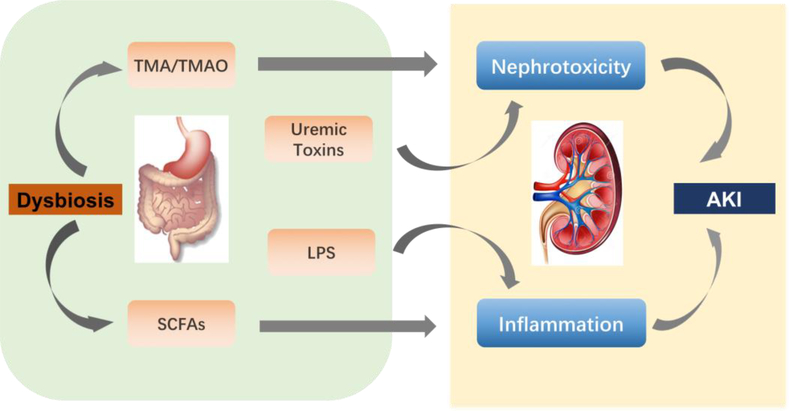
Fig.3.. Dysbiosis during AKI.
AKI involves multiple and overlapping immunological, biochemical, and hemodynamic mechanisms. Gut dysbiosis generates SCFAs, which regulate systemic consequences of AKI. TMA/TMAO, combined with uremic toxins and other gut-derived toxins, contributes to nephrotoxicity-induced AKI.

References

    1. Gilbert JA, Blaser MJ, Caporaso JG et al. Current understanding of the human microbiome. Nature medicine 2018; 24: 392–400 - PMC - PubMed
    1. Mergaert P Role of antimicrobial peptides in controlling symbiotic bacterial populations. Natural product reports 2018; February - PubMed
    1. Cummings JH, Pomare EW, Branch WJ et al. Short chain fatty acids in human large intestine, portal, hepatic and venous blood. Gut 1987; 28: 1221–1227 - PMC - PubMed
    1. Kranich J, Maslowski KM, Mackay CR. Commensal flora and the regulation of inflammatory and autoimmune responses. Seminars in immunology 2011; 23: 139–145 - PubMed
    1. Runkle EA, Mu D. Tight junction proteins: from barrier to tumorigenesis. Cancer letters 2013; 337: 41–48 - PMC - PubMed

LinkOut - more resources