


Utilization of Institutional Delivery Service in a Predominantly Pastoralist Community of Northeast Ethiopia
- PMID: 30607053
- PMCID: PMC6308731
- DOI: 10.4314/ejhs.v28i4.6
Utilization of Institutional Delivery Service in a Predominantly Pastoralist Community of Northeast Ethiopia
Erratum in
-
Correction: Correction to 'Clinical Policy: Critical Issues in the Evaluation and Management of Adult Patients Presenting to the Emergency Department With Acute Carbon Monoxide Poisoning' [Annals of Emergency Medicine 69 (2017) 98-107.e6].Ann Emerg Med. 2017 Nov;70(5):758. doi: 10.1016/j.annemergmed.2017.03.036. Epub 2017 Apr 7. Ann Emerg Med. 2017. PMID: 28395920
-
Erratum.Ethiop J Health Sci. 2018 Nov;28(6):809. doi: 10.4314/ejhs.v28i6.17. Ethiop J Health Sci. 2018. PMID: 30607099 Free PMC article.
Abstract
Background: Maternal mortality is high in sub-Saharan Africa, and most deaths occur around childbirth. In Ethiopia, most births happen at home without skilled delivery attendants, and particularly, the least utilization of skilled delivery is recorded in Afar Region. The factors that influence this utilization are not well documented in the region where utilization has been low. The aim of this study was to determine the prevalence of utilization of institutional delivery and associated factors.
Methods: A cross-section study with pretested structural questionnaire was conducted from August 5 to September 27, 2015, among women who gave birth within 24 months preceding the survey. A multivariable logistic regression analysis was done to identify factors associated with utilization of institutional delivery.
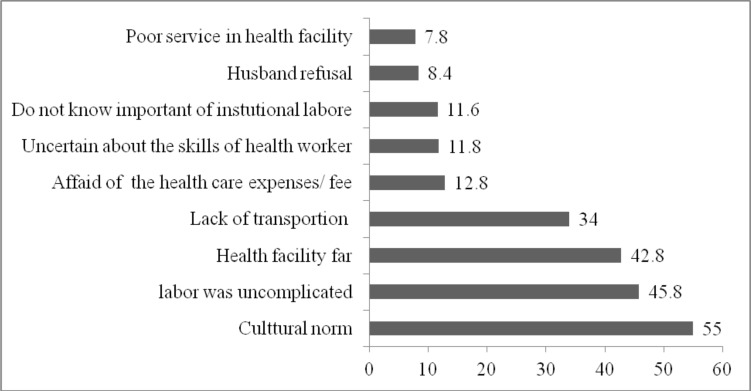
Results: Out of the total 1842 women, only 339(18.4%) of mothers reported having delivered their youngest child at a health facility. Home delivery was preferred due to cultural norms, low-risk perception, and distance from a health facility. The odds of delivering in a health facility were higher for mothers who attended at least four antenatal visits during the index pregnancy (AOR=3.08,95%CI=1.91-4.96), those whose husbands were educated to secondary school (AOR= 1.86, 95% CI=1.34-2.60), and those that had at least secondary school level education themselves (AOR=1.52, 95% CI=1.03-2.23).
Conclusion: Utilization of institution delivery among Afar communities is very low, and less educated mothers are lagging behind. Women's education and full attendance to antenatal care can help increase utilization of skilled delivery services. Qualitative studies to identify socio-cultural barriers are also essential.
Figures
References
-
- World Health Organization, Unicef, author. Trends in maternal mortality: 1990–2015: estimates from WHO, UNICEF, UNFPA, World Bank Group and the United Nations Population Division. Geneva: WHO; 2015.
-
- WHO, UNFPA, Unicef, AMDD, author. Monitoring emergency obstetric care: a handbook. Geneva: WHO; 2009. p. 152.
-
- CSA-Ethiopia, ICF, author. International: Ethiopia Demographic and Health Survey 2011. Ethiopia and Calverton, Maryland, USA: Central Statistical Agency of Ethiopia and ICF International Addis Ababa; 2012.
MeSH terms
LinkOut - more resources
Full Text Sources
Medical