


India's response to adolescent mental health: a policy review and stakeholder analysis
- PMID: 30607452
- PMCID: PMC6443608
- DOI: 10.1007/s00127-018-1647-2
India's response to adolescent mental health: a policy review and stakeholder analysis
Abstract
Purpose: Mental health problems and suicide are the leading cause of mortality in young people globally. India is home to the largest number of adolescents in the world. This study was undertaken to assess the policy environment for addressing adolescent mental health in India.
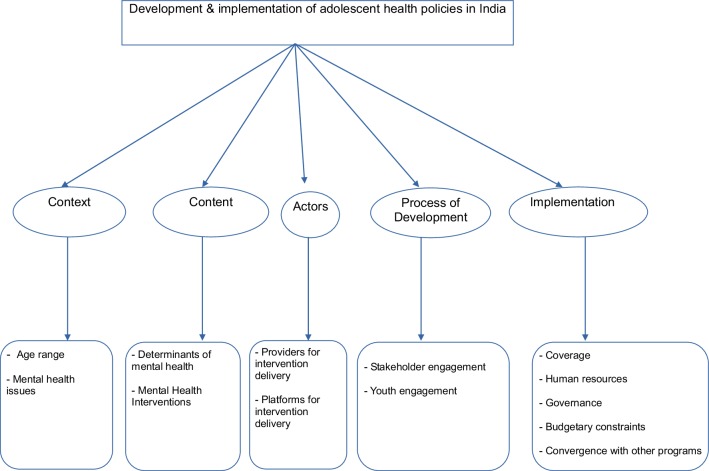
Methods: We conducted a review of 6 policies and programs and 11 in-depth interviews with key stakeholders. The findings were analyzed using the policy triangle analysis framework (i.e., context, content, actors and process).
Results: There is no conformity of the age ranges addressed by these documents nor are vulnerable groups explicitly recognized. Stress, anxiety and depression were commonly identified as mental health concerns and diverse platforms such as community, family, school, digital and health facility were recommended to deliver preventive and treatment interventions. Some interventions specifically targeted some social determinants (like safe and supportive schools) but many others (like social norms) were not addressed. Preventive interventions were recommended for delivery through peers and other non-specialist providers while treatment interventions were recommended for delivery in healthcare facilities by specialist health professionals. There was very little engagement of young people in the development of these policies or in their implementation, except for peer educators mentioned in one policy. Stakeholders identified several major challenges in implementing these policies, notably the lack of inter-sectoral coordination and fragmentation of governance; budgetary constraints; and scanty human resources.
Conclusions: Although there are now several policy instruments testifying to a comprehensive approach on adolescent mental health, there are gaps in the extent of engagement of young people and how these will be operationalized that may limit their impact on addressing the burden of mental health problems in young people in India.
Keywords: Adolescent; India; Mental health; Policy; Review.
Conflict of interest statement
Ethical standards
The study has been approved by the ethics board of LSHTM/Sangath. All participants had given their informed consent prior to their inclusion in the study.
Conflict of interest
The content of this publication is solely the responsibility of the authors. On behalf of all authors, the corresponding author states that there is no conflict of interest.
References
-
- Whiteford HA, Degenhardt L, Rehm J, Baxter AJ, Ferrari AJ, Erskine HE, Charlson FJ, Norman RE, Flaxman AD, Johns N, Burstein R, Murray CJ, Vos T. Global burden of disease attributable to mental and substance use disorders: findings from the Global Burden of Disease Study 2010. Lancet. 2013;382:1575–1586. doi: 10.1016/S0140-6736(13)61611-6. - DOI - PubMed
-
- Patton GC, Sawyer SM, Santelli JS, Ross DA, Afifi R, Allen NB, Arora M, Azzopardi P, Baldwin W, Bonell C, Kakuma R, Kennedy E, Mahon J, Mcgovern T, Mokdad AH, Patel V, Petroni S, Reavley N, Taiwo K, Waldfogel J, Wickremarathne D, Barroso C, Bhutta Z, Fatusi AO, Mattoo A, Diers J, Fang J, Ferguson J, Ssewamala F, Viner RM. Our future: a lancet commission on adolescent health and wellbeing. Lancet. 2016;387:2423–2478. doi: 10.1016/S0140-6736(16)00579-1. - DOI - PMC - PubMed
MeSH terms
Grants and funding
LinkOut - more resources
Full Text Sources
Medical
