


Synergistic anti-cancer activity of CDK4/6 inhibitor palbociclib and dual mTOR kinase inhibitor MLN0128 in pRb-expressing ER-negative breast cancer
- PMID: 30607633
- PMCID: PMC6452902
- DOI: 10.1007/s10549-018-05104-9
Synergistic anti-cancer activity of CDK4/6 inhibitor palbociclib and dual mTOR kinase inhibitor MLN0128 in pRb-expressing ER-negative breast cancer
Abstract
Purpose: Palbociclib is an approved cyclin-dependent kinase (CDK) 4/6 inhibitor for treatment of patients with ER-positive and HER2-negative breast cancers. While Retinoblastoma protein (pRb), a major substrate of CDK4/6, is a potential target in triple negative breast cancer (TNBC), the usefulness of CDK4/6 inhibitors in this cancer has not been established. This preclinical study investigated the combination effects of palbociclib and the dual mammalian target of rapamycin (mTOR) kinase inhibitor MLN0128 in estrogen receptor (ER)-negative breast cancer in vitro and in vivo.
Methods: The combined effects of two drugs on three TNBC cell lines (MB231, MB468, and CAL148) and an ER-negative and HER2-positive cell line (MB453) were investigated by MTT assay and colony formation analysis. Cell cycle measurements were examined as well as changes in expression of molecules related to G1/S transition and the mTOR pathway. Importantly, a pRb-expressing TNBC patient-derived xenograft (PDX) model was used to assess the effects of the combination in vivo.
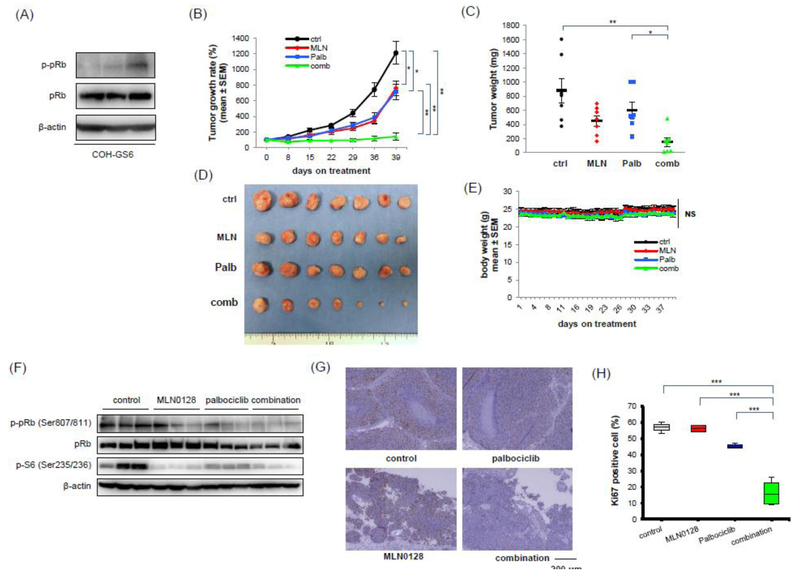
Results: A combination of palbociclib and MLN0128 synergistically inhibited the proliferation of pRb-expressing cell lines and induced G1 cell cycle arrest. Western blot analysis revealed that CDK4/6-pRb and mTOR pathways were inhibited by these treatments. In pRb-expressing TNBC PDX, the combination treatment drastically suppressed tumor growth compared to either the control or single drug treatments. In addition, the combination treatment significantly reduced the number of Ki67-positive cells.
Conclusions: We revealed that palbociclib and MLN0128 had synergistic anti-cancer activity in both pRb + ER-negative cell lines and a TNBC PDX model. Our results indicate that such combination therapy is worthy of further investigation in a clinical setting.
Keywords: CDK 4/6 inhibitor; MLN0128; Palbociclib; Retinoblastoma protein (pRb); Triple negative breast cancer (TNBC); mTOR inhibitor.
Conflict of interest statement
Conflict of interest
The authors declare that they have no competing interests.
Figures
References
-
- Yang XR, Chang-Claude J, Goode EL, Couch FJ, Nevanlinna H, Milne RL, Gaudet M, Schmidt MK, Broeks A, Cox A, Fasching PA, Hein R, Spurdle AB, Blows F, Driver K, Flesch-Janys D, Heinz J, Sinn P, Vrieling A, Heikkinen T, Aittomaki K, Heikkila P, Blomqvist C, Lissowska J, Peplonska B, Chanock S, Figueroa J, Brinton L, Hall P, Czene K, Humphreys K, Darabi H, Liu J, Van ‘t Veer LJ, van Leeuwen FE, Andrulis IL, Glendon G, Knight JA, Mulligan AM, O’Malley FP, Weerasooriya N, John EM, Beckmann MW, Hartmann A, Weihbrecht SB, Wachter DL, Jud SM, Loehberg CR, Baglietto L, English DR, Giles GG, McLean CA, Severi G, Lambrechts D, Vandorpe T, Weltens C, Paridaens R, Smeets A, Neven P, Wildiers H, Wang X, Olson JE, Cafourek V, Fredericksen Z, Kosel M, Vachon C, Cramp HE, Connley D, Cross SS, Balasubramanian SP, Reed MW, Dork T, Bremer M, Meyer A, Karstens JH, Ay A, Park-Simon TW, Hillemanns P, Arias Perez JI, Menendez Rodriguez P, Zamora P, Benitez J, Ko YD, Fischer HP, Hamann U, Pesch B, Bruning T, Justenhoven C, Brauch H, Eccles DM, Tapper WJ, Gerty SM, Sawyer EJ, Tomlinson IP, Jones A, Kerin M, Miller N, McInerney N, Anton-Culver H, Ziogas A, Shen CY, Hsiung CN, Wu PE, Yang SL, Yu JC, Chen ST, Hsu GC, Haiman CA, Henderson BE, Le Marchand L, Kolonel LN, Lindblom A, Margolin S, Jakubowska A, Lubinski J, Huzarski T, Byrski T, Gorski B, Gronwald J, Hooning MJ, Hollestelle A, van den Ouweland AM, Jager A, Kriege M, Tilanus-Linthorst MM, Collee M, Wang-Gohrke S, Pylkas K, Jukkola-Vuorinen A, Mononen K, Grip M, Hirvikoski P, Winqvist R, Mannermaa A, Kosma VM, Kauppinen J, Kataja V, Auvinen P, Soini Y, Sironen R, Bojesen SE, Orsted DD, Kaur-Knudsen D, Flyger H, Nordestgaard BG, Holland H, Chenevix-Trench G, Manoukian S, Barile M, Radice P, Hankinson SE, Hunter DJ, Tamimi R, Sangrajrang S, Brennan P, McKay J, Odefrey F, Gaborieau V, Devilee P, Huijts PE, Tollenaar RA, Seynaeve C, Dite GS, Apicella C, Hopper JL, Hammet F, Tsimiklis H, Smith LD, Southey MC, Humphreys MK, Easton D, Pharoah P, Sherman ME, Garcia-Closas M (2011) Associations of breast cancer risk factors with tumor subtypes: a pooled analysis from the Breast Cancer Association Consortium studies. J Natl Cancer Inst 103 (3):250–263. doi: 10.1093/jnci/djq526 - DOI - PMC - PubMed
-
- Bauer KR, Brown M, Cress RD, Parise CA, Caggiano V (2007) Descriptive analysis of estrogen receptor (ER)-negative, progesterone receptor (PR)-negative, and HER2-negative invasive breast cancer, the so-called triple-negative phenotype: a population-based study from the California cancer Registry. Cancer 109 (9):1721–1728. doi: 10.1002/cncr.22618 - DOI - PubMed
-
- Parise CA, Bauer KR, Brown MM, Caggiano V (2009) Breast cancer subtypes as defined by the estrogen receptor (ER), progesterone receptor (PR), and the human epidermal growth factor receptor 2 (HER2) among women with invasive breast cancer in California, 1999–2004. The breast journal 15 (6):593–602. doi: 10.1111/j.1524-4741.2009.00822.x - DOI - PubMed
MeSH terms
Substances
Grants and funding
LinkOut - more resources
Full Text Sources
Medical
Research Materials
Miscellaneous
