Impact of a Large-Scale Handwashing Intervention on Reported Respiratory Illness: Findings from a Cluster-Randomized Controlled Trial
- PMID: 30608050
- PMCID: PMC6402932
- DOI: 10.4269/ajtmh.18-0644
Impact of a Large-Scale Handwashing Intervention on Reported Respiratory Illness: Findings from a Cluster-Randomized Controlled Trial
Abstract
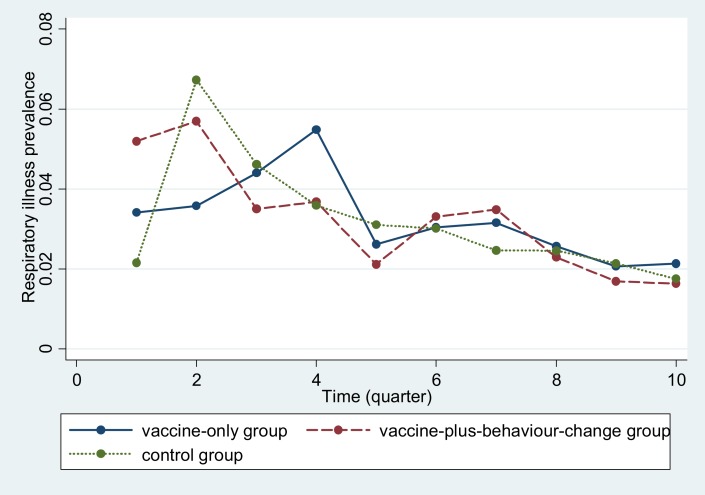
We assessed the impact of handwashing promotion on reported respiratory illness as a secondary outcome from among > 60,000 low-income households enrolled in a cluster-randomized trial conducted in Bangladesh. Ninety geographic clusters were randomly allocated into three groups: cholera-vaccine-only; vaccine-plus-behavior-change (handwashing promotion and drinking water chlorination); and control. Data on respiratory illness (fever plus either cough or nasal congestion or breathing difficulty within previous 2 days) and intervention uptake (presence of soap and water at handwashing station) were collected through monthly surveys conducted among a different subset of randomly selected households during the intervention period. We determined respiratory illness prevalence across groups and used log-binomial regression to examine the association between respiratory illness and presence of soap and water in the handwashing station. Results were adjusted for age, gender, wealth, and cluster-randomized design. The vaccine-plus-behavior-change group had more handwashing stations with soap and water present than controls (45% versus 25%; P < 0.001). Reported respiratory illness prevalence was similar across groups (vaccine-plus-behavior-change versus control: 2.8% versus 2.9%; 95% confidence interval [CI]: -0.008, 0.006; P = 0.6; cholera-vaccine-only versus control: 3.0% versus 2.9%; 95% CI: -0.006, 0.009; P = 0.4). Irrespective of intervention assignment, respiratory illness was lower among people who had soap and water present in the handwashing station than among those who did not (risk ratioadjusted: 0.82; 95% CI: 0.69-0.98). With modest uptake of the handwashing intervention, we found no impact of this large-scale intervention on respiratory illness. However, those who actually had a handwashing station with soap and water had less illness. This suggests improving the effectiveness of handwashing promotion in achieving sustained behavior change could result in health benefits.
Figures

References
-
- Liu L, et al. 2012. Global, regional, and national causes of child mortality: an updated systematic analysis for 2010 with time trends since 2000. Lancet 379: 2151–2161. - PubMed
-
- Wang H, Bhutta ZA, Coates MM, Coggeshall M, Dandona L, Diallo K, Franca EB, Fraser M, Fullman N, Gething PW, 2016. Global, regional, national, and selected subnational levels of stillbirths, neonatal, infant, and under-5 mortality, 1980–2015: a systematic analysis for the Global Burden of Disease Study 2015. Lancet 388: 1725. - PMC - PubMed
-
- Gwaltney JM, Moskalski PB, Hendley JO, 1978. Hand-to-hand transmission of rhinovirus colds. Ann Intern Med 88: 463–467. - PubMed
-
- Hall CB, Douglas RG, Geiman JM, 1980. Possible transmission by fomites of respiratory syncytial virus. J Infect Dis 141: 98–102. - PubMed
Publication types
MeSH terms
Substances
LinkOut - more resources
Full Text Sources