


Tobacco smoking induces cardiovascular mitochondrial oxidative stress, promotes endothelial dysfunction, and enhances hypertension
- PMID: 30608177
- PMCID: PMC6459311
- DOI: 10.1152/ajpheart.00595.2018
Tobacco smoking induces cardiovascular mitochondrial oxidative stress, promotes endothelial dysfunction, and enhances hypertension
Erratum in
-
Corrigendum.Am J Physiol Heart Circ Physiol. 2019 Apr 1;316(4):H939. doi: 10.1152/ajpheart.zh4-2748-corr.2019. Am J Physiol Heart Circ Physiol. 2019. PMID: 30958697 Free PMC article. No abstract available.
Abstract
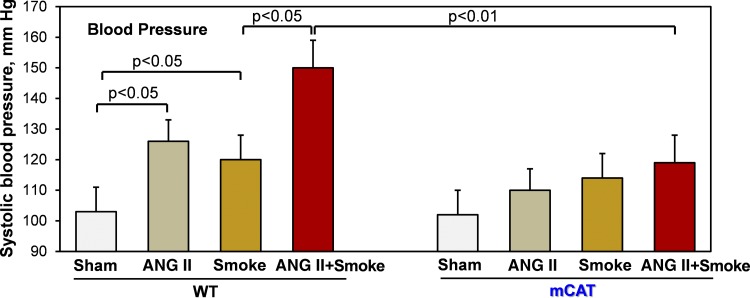
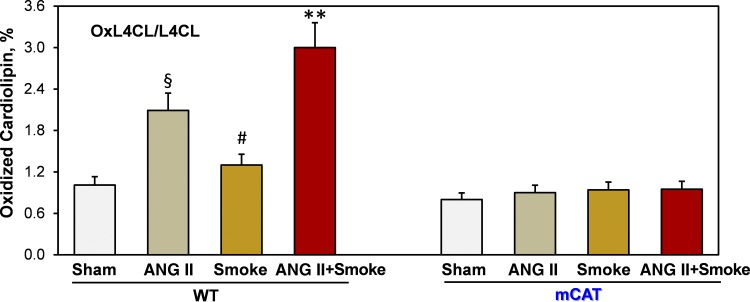
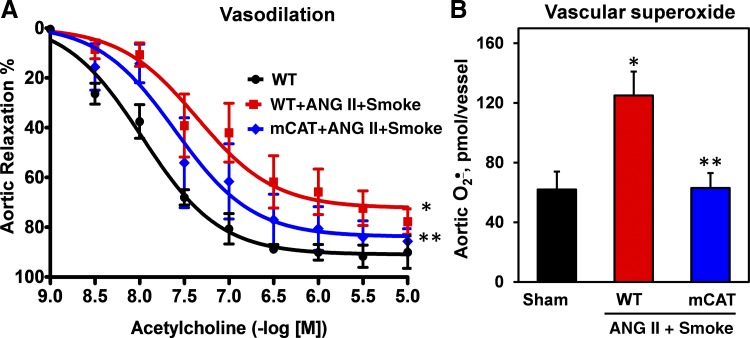
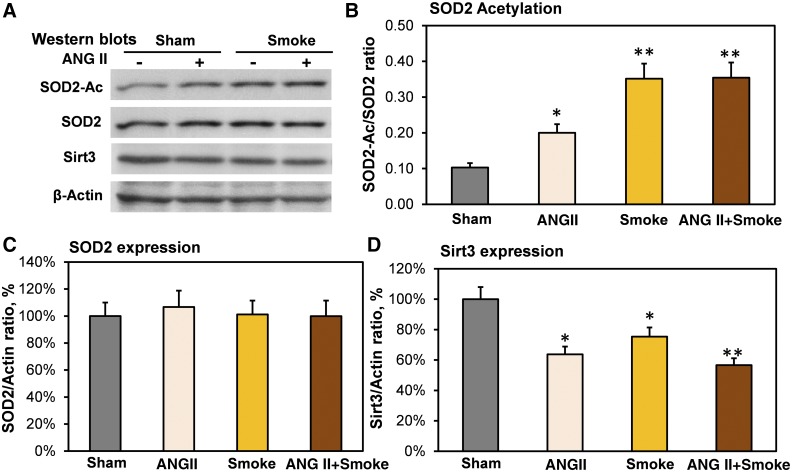
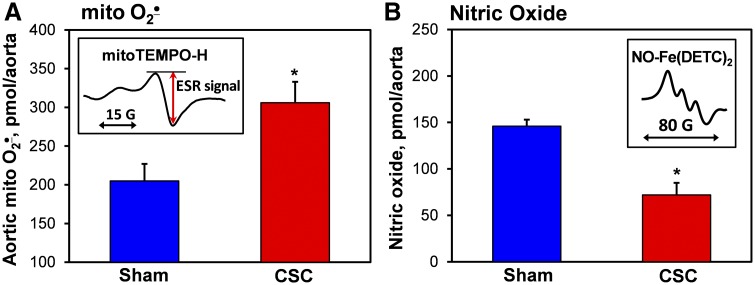
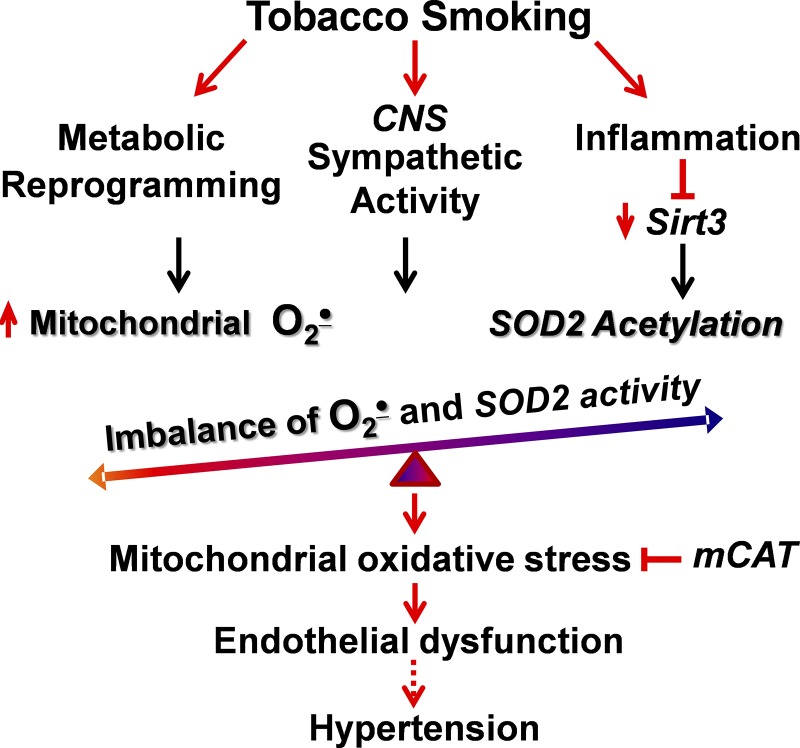
Tobacco smoking is a major risk factor for cardiovascular disease and hypertension. It is associated with the oxidative stress and induces metabolic reprogramming, altering mitochondrial function. We hypothesized that cigarette smoke induces cardiovascular mitochondrial oxidative stress, which contributes to endothelial dysfunction and hypertension. To test this hypothesis, we studied whether the scavenging of mitochondrial H2O2 in transgenic mice expressing mitochondria-targeted catalase (mCAT) attenuates the development of cigarette smoke/angiotensin II-induced mitochondrial oxidative stress and hypertension compared with wild-type mice. Two weeks of exposure of wild-type mice with cigarette smoke increased systolic blood pressure by 17 mmHg, which was similar to the effect of a subpresssor dose of angiotensin II (0.2 mg·kg-1·day-1), leading to a moderate increase to the prehypertensive level. Cigarette smoke exposure and a low dose of angiotensin II cooperatively induced severe hypertension in wild-type mice, but the scavenging of mitochondrial H2O2 in mCAT mice completely prevented the development of hypertension. Cigarette smoke and angiotensin II cooperatively induced oxidation of cardiolipin (a specific biomarker of mitochondrial oxidative stress) in wild-type mice, which was abolished in mCAT mice. Cigarette smoke and angiotensin II impaired endothelium-dependent relaxation and induced superoxide overproduction, which was diminished in mCAT mice. To mimic the tobacco smoke exposure, we used cigarette smoke condensate, which induced mitochondrial superoxide overproduction and reduced endothelial nitric oxide (a hallmark of endothelial dysfunction in hypertension). Western blot experiments indicated that tobacco smoke and angiotensin II reduce the mitochondrial deacetylase sirtuin-3 level and cause hyperacetylation of a key mitochondrial antioxidant, SOD2, which promotes mitochondrial oxidative stress. NEW & NOTEWORTHY This work demonstrates tobacco smoking-induced mitochondrial oxidative stress, which contributes to endothelial dysfunction and development of hypertension. We suggest that the targeting of mitochondrial oxidative stress can be beneficial for treatment of pathological conditions associated with tobacco smoking, such as endothelial dysfunction, hypertension, and cardiovascular diseases.
Keywords: catalase; cigarette smoke; hypertension; mitochondria; oxidative stress; superoxide dismutase.
Conflict of interest statement
No conflicts of interest, financial or otherwise, are declared by the authors.
Figures
References
-
- Abdelghany TM, Ismail RS, Mansoor FA, Zweier JR, Lowe F, Zweier JL. Cigarette smoke constituents cause endothelial nitric oxide synthase dysfunction and uncoupling due to depletion of tetrahydrobiopterin with degradation of GTP cyclohydrolase. Nitric Oxide 76: 113–121, 2018. doi: 10.1016/j.niox.2018.02.009. - DOI - PubMed
-
- Agarwal AR, Zhao L, Sancheti H, Sundar IK, Rahman I, Cadenas E. Short-term cigarette smoke exposure induces reversible changes in energy metabolism and cellular redox status independent of inflammatory responses in mouse lungs. Am J Physiol Lung Cell Mol Physiol 303: L889–L898, 2012. doi: 10.1152/ajplung.00219.2012. - DOI - PubMed
-
- Bharathi SS, Zhang Y, Mohsen AW, Uppala R, Balasubramani M, Schreiber E, Uechi G, Beck ME, Rardin MJ, Vockley J, Verdin E, Gibson BW, Hirschey MD, Goetzman ES. Sirtuin 3 (SIRT3) protein regulates long-chain acyl-CoA dehydrogenase by deacetylating conserved lysines near the active site. J Biol Chem 288: 33837–33847, 2013. doi: 10.1074/jbc.M113.510354. - DOI - PMC - PubMed
Publication types
MeSH terms
Substances
Grants and funding
LinkOut - more resources
Full Text Sources
Medical
Molecular Biology Databases
