


Review
doi: 10.1161/JAHA.118.009949.
Coronary Microvascular Injury in Reperfused Acute Myocardial Infarction: A View From an Integrative Perspective
Affiliations
- PMID: 30608201
- PMCID: PMC6404180
- DOI: 10.1161/JAHA.118.009949
Item in Clipboard
Review
Coronary Microvascular Injury in Reperfused Acute Myocardial Infarction: A View From an Integrative Perspective
J Am Heart Assoc.
.
No abstract available
Keywords: microcirculation; microvascular dysfunction; primary percutaneous angioplasty.
Figures

Compartmental schematization of the mechanisms behind post–primary percutaneous coronary intervention microvascular injury. Following reperfusion, factors contributing to microvascular injury at the subtended myocardial territory can be categorized under 2 major headings as intraluminal microvascular obstruction and extravascular compression of the microcirculation. Major pathologies contributing to luminal obstruction are distal thromboembolization, cellular plugging, in situ thrombosis, and vasospasm. External compression of microcirculation by cellular and/or interstitial edema, intramyocardial hemorrhage, and increased left ventricular filling pressures may also substantially contribute to microvascular impairment by generating an external compressive force on coronary microcirculation. LVEDP indicates left ventricular end‐diastolic pressure.
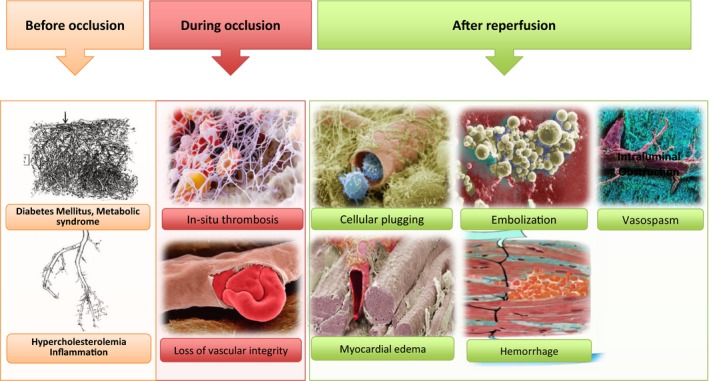
Intraluminal and extravascular factors of microvascular injury operating on the temporal scale (before, during, and after reperfusion). On the temporal scale, in addition to the preexisting microvascular impairment, dynamic events evolving both during coronary occlusion and after reperfusion seem to determine the final magnitude of microvascular damage in the subtended microcirculatory territory. In the preocclusive period, patients’ metabolic and inflammatory status and presence of diabetes mellitus, hypercholesterolemia, and hypertension may lead to a preexisting microvascular dysfunction. During epicardial occlusion, local procoagulant activity induced by local hypoxia in the downstream microcirculation may provide extremely suitable milieu for in situ microvascular thrombus formation. During this occlusive period, hypoxia‐induced endothelial disruption may also lead to loss of microvascular barrier function and microvascular leakage. After reperfusion, distal thromboembolization along with edema and intramyocardial hemorrhage developed in this destructed and leaky microcirculatory environment can markedly contribute to microvascular injury.
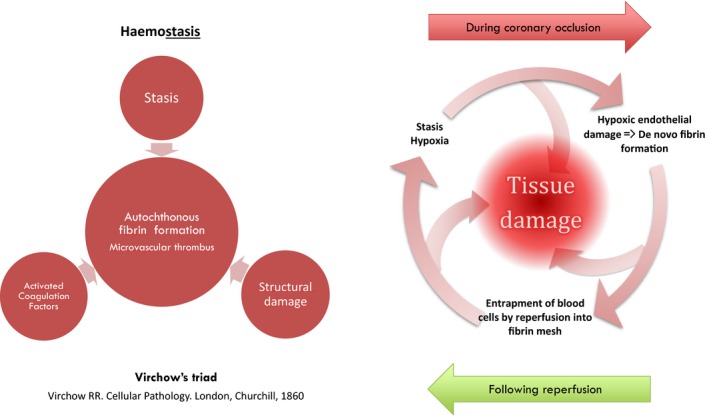
A vicious cycle of microvascular thrombosis: During epicardial occlusion, hypoxic endothelial damage, stasis, activated coagulation factors, and tissue factors trigger Virchow triad, which may lead to in situ microvascular fibrin generation. After reopening of the infarct‐related artery, formed blood cells supplied by reperfusion get entrapped in to the microvascular fibrin mesh, which may lead to further stasis and further fibrin generation.
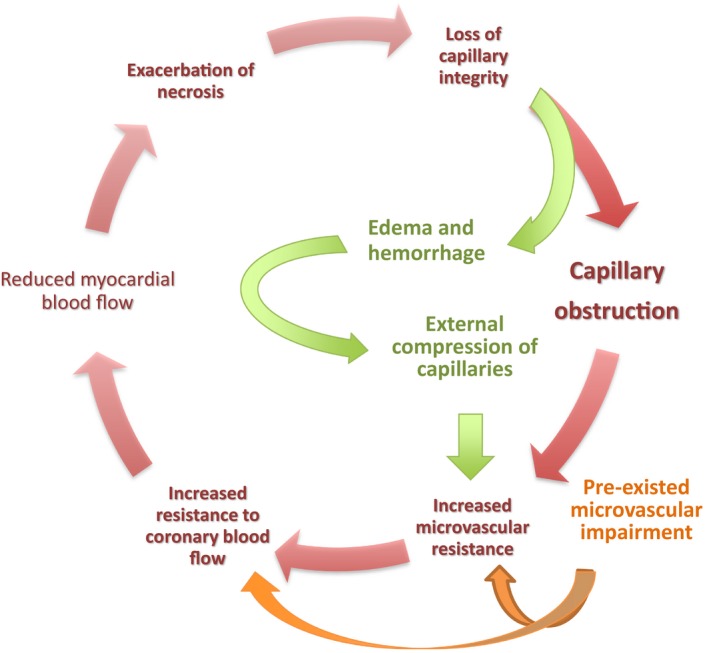
Myocardial edema and intramyocardial hemorrhage initially emerge as a consequence of prolonged ischemia and reperfusion, and they subsequently become one of the main contributors of the microvascular impairment by generating an external compressive force on coronary microvasculature.

Microvascular impairment in reperfused acute myocardial infarction: integrated association of the factors related to intravascular obstruction and extravascular compression of the microcirculation. LV indicates left ventricular.

Main stages of ischemia and reperfusion‐related events resulting in myocardial injury from a circulatory viewpoint.
References
-
- Yeh RW, Sidney S, Chandra M, Sorel M, Selby JV, Go AS. Population trends in the incidence and outcomes of acute myocardial infarction. N Engl J Med. 2010;362:2155–2165. - PubMed
-
- O'Gara PT, Kushner FG, Ascheim DD, Casey DE Jr, Chung MK, de Lemos JA, Ettinger SM, Fang JC, Fesmire FM, Franklin BA, Granger CB, Krumholz HM, Linderbaum JA, Morrow DA, Newby LK, Ornato JP, Ou N, Radford MJ, Tamis‐Holland JE, Tommaso CL, Tracy CM, Woo YJ, Zhao DX; American College of Cardiology Foundation, American Heart Association Task Force on Practice Guidelines, American College of Emergency Physicians, Society for Cardiovascular Angiography and Interventions . 2013 ACCF/AHA guideline for the management of ST‐elevation myocardial infarction: executive summary: a report of the American College of Cardiology Foundation/American Heart Association Task Force on Practice Guidelines: developed in collaboration with the American College of Emergency Physicians and Society for Cardiovascular Angiography and Interventions. Catheter Cardiovasc Interv. 2013;82:E1–E27. - PubMed
-
- Steg PG, James SK, Atar D, Badano LP, Blomstrom‐Lundqvist C, Borger MA, Di Mario C, Dickstein K, Ducrocq G, Fernandez‐Aviles F, Gershlick AH, Giannuzzi P, Halvorsen S, Huber K, Juni P, Kastrati A, Knuuti J, Lenzen MJ, Mahaffey KW, Valgimigli M, van ‘t Hof A, Widimsky P, Zahger D. ESC guidelines for the management of acute myocardial infarction in patients presenting with ST‐segment elevation. Eur Heart J. 2012;33:2569–2619. - PubMed
-
- Hamm CW, Bassand JP, Agewall S, Bax J, Boersma E, Bueno H, Caso P, Dudek D, Gielen S, Huber K, Ohman M, Petrie MC, Sonntag F, Uva MS, Storey RF, Wijns W, Zahger D; ESC Committee for Practice Guidelines . ESC guidelines for the management of acute coronary syndromes in patients presenting without persistent ST‐segment elevation: the Task Force for the management of acute coronary syndromes (ACS) in patients presenting without persistent ST‐segment elevation of the European Society of Cardiology (ESC). Eur Heart J. 2011;32:2999–3054. - PubMed
Publication types
MeSH terms
Grants and funding
LinkOut - more resources
Full Text Sources
Medical
