


Rapid Systolic Blood Pressure Changes After Standing Up Associate With Impaired Physical Performance in Geriatric Outpatients
- PMID: 30608209
- PMCID: PMC6404215
- DOI: 10.1161/JAHA.118.010060
Rapid Systolic Blood Pressure Changes After Standing Up Associate With Impaired Physical Performance in Geriatric Outpatients
Abstract
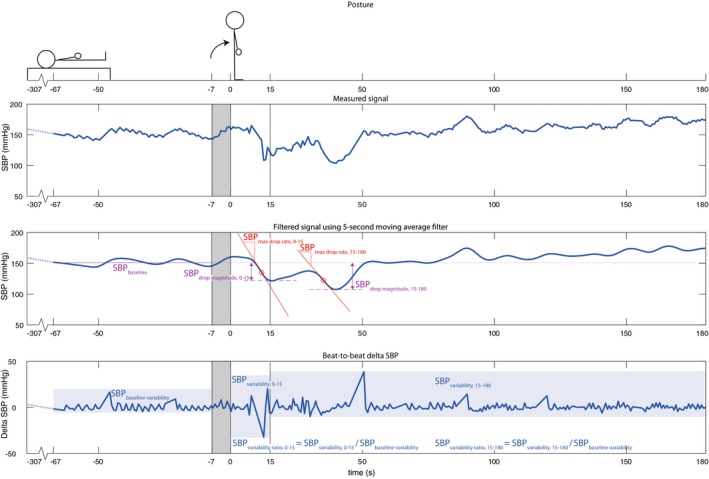
Background Orthostatic hypotension is a prevalent condition in older adults and is associated with impaired physical performance and falls. The ability of older adults to compensate for rapid changes in systolic blood pressure ( SBP ; ie, SBP decline rate and SBP variability) may be important for physical performance. This study investigates the association of rapid SBP changes after standing up with physical performance. Methods and Results Consecutive patients who visited the Center of Geriatrics Amsterdam in 2014 and 2015 were included. The following SBP parameters were computed in 2 intervals (0-15 and 15-180 seconds) after standing up: steepness of steepest SBP decline; ratio of standing/supine SBP variability; and magnitude of largest SBP decline. Physical performance was assessed using the following measures: chair stand time, timed up and go time, walking speed, handgrip strength, and tandem stance performance. A total of 109 patients (45% men; age, mean, 81.7 years [ standard deviation , 7.0 years]) were included. Steepness of steepest SBP decline (0-15 seconds) was associated with slower chair stand time ( P<0.001), timed up and go time ( P=0.022), and walking speed ( P=0.024). Ratio of standing/supine SBP variability (0-15 seconds) was associated with slower chair stand time ( P=0.005). Magnitude of largest SBP decline was not associated with physical performance. Conclusions SBP parameters reflecting rapid SBP changes were more strongly associated with physical performance compared with SBP decline magnitude in geriatric outpatients. These results support the hypothesis of an inadequate cerebral autoregulation during rapid SBP changes and advocate the use of continuous blood pressure measurements.
Keywords: cerebral autoregulation; continuous blood pressure measurement; geriatric assessment; orthostatic hypotension; physical performance.
Figures
References
-
- Freeman R, Wieling W, Axelrod FB, Benditt DG, Benarroch E, Biaggioni I, Cheshire WP, Chelimsky T, Cortelli P, Gibbons CH, Goldstein DS, Hainsworth R, Hilz MJ, Jacob G, Kaufmann H, Jordan J, Lipsitz LA, Levine BD, Low PA, Mathias C, Raj SR, Robertson D, Sandroni P, Schatz I, Schondorff R, Stewart JM, Van Dijk JG. Consensus statement on the definition of orthostatic hypotension, neurally mediated syncope and the postural tachycardia syndrome. Clin Auton Res. 2011;21:69–72. - PubMed
-
- Saedon NI, Zainal‐Abidin I, Chee KH, Khor HM, Tan KM, Kamaruzzaman SK, Chin AV, Poi PJH, Tan MP. Postural blood pressure electrocardiographic changes are associated with falls in older people. Clin Auton Res. 2016;26:41–48. - PubMed
-
- Verwoert GC, Mattace‐Raso FUS, Hofman A, Heeringa J, Stricker BHC, Breteler MMB, Witteman JCM. Orthostatic hypotension and risk of cardiovascular disease in elderly people: the Rotterdam study. J Am Geriatr Soc. 2008;56:1816–1820. - PubMed
-
- Ricci F, Fedorowski A, Radico F, Romanello M, Tatasciore A, Di Nicola M, Zimarino M, De Caterina R. Cardiovascular morbidity and mortality related to orthostatic hypotension: a meta‐analysis of prospective observational studies. Eur Heart J. 2015;36:1609–1617. - PubMed
-
- Rockwood MRHH, Howlett SE, Rockwood K. Orthostatic hypotension (OH) and mortality in relation to age, blood pressure and frailty. Arch Gerontol Geriatr. 2012;54:e255–e260. - PubMed
Publication types
MeSH terms
LinkOut - more resources
Full Text Sources
