


Risk factors of efficacy for patients receiving surgical treatment following terrible triad of the elbow joint: A comparative study
- PMID: 30608399
- PMCID: PMC6344182
- DOI: 10.1097/MD.0000000000013836
Risk factors of efficacy for patients receiving surgical treatment following terrible triad of the elbow joint: A comparative study
Abstract
Background: This study aims to explore the efficacy of surgical and conservative treatment for elbow joint terrible triad, and evaluate related factors affecting surgical treatment efficacy.
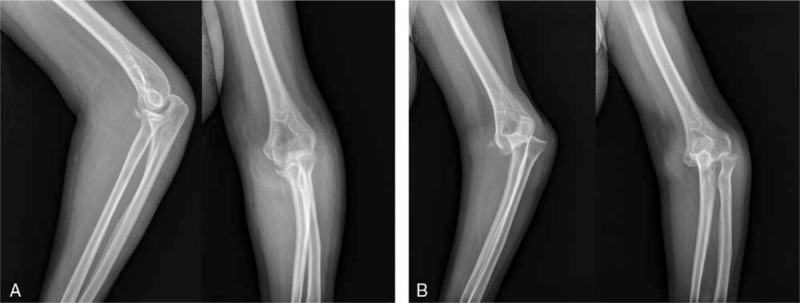
Methods: Patients with terrible triad of elbow joint (n = 165) were selected, among which 79 cases underwent conservative treatment (the control group) and 86 cases underwent surgical treatment (the experimental group). The range of flexion and extension, range of rotation and Mayo elbow performance score were recorded. In the experimental group, postoperation, according to the Mayo elbow performance score, patients were assigned into the effective group (72 cases) and ineffective group (14 cases). All patients were followed up regularly for 6 to 24 months. X-ray and computed tomography examination were used to examine anterior and posterior elbow joints preoperatively and postoperatively and the degree of arm rotation.
Results: The range of flexion and extension, range of rotation and Mayo elbow performance score were found to be significantly higher in the experimental group after treatment compared to the experimental group before treatment and in the control group after treatment. Seven days after treatment, compared with the control group, the expressions of interleukin (IL)-6, C-reactive protein, IL-8, and tumor necrosis factor-α in serum decreased, and returned to almost near normal levels in the experimental group. Age, mean operative time, and postoperative immobilization time were significantly different between the effective and ineffective groups. The incidence of joint stiffness, heterotopic ossification, and ulnar nerve symptoms in the effective group were lower than those in the ineffective group. The postoperative immobilization time served a protective factor for the efficacy of surgical treatment of elbow joint terrible triad, while age served as a risk factor.
Conclusion: The results indicated that surgical treatment regimens for elbow joint terrible triad exhibited better efficacy than conservative treatment regimens, and lower age and longer postoperative immobilization time serve as protective factors for surgical treatment efficacy.
Conflict of interest statement
The authors have no funding and conflicts of interest to disclose.
Figures
References
-
- Skelley NW, Chamberlain A. A novel reduction technique for elbow dislocations. Orthopedics 2015;38:42–4. - PubMed
-
- Fitzpatrick MJ, Diltz M, McGarry MH, et al. A new fracture model for “terrible triad” injuries of the elbow: influence of forearm rotation on injury patterns. J Orthop Trauma 2012;26:591–6. - PubMed
-
- Yan M, Ni J, Song D, et al. Radial head replacement or repair for the terrible triad of the elbow: which procedure is better? ANZ J Surg 2015;85:644–8. - PubMed
-
- Desai MM, Sonone SV, Badve SA. Terrible triad of the elbow: a case report of a new variant. J Postgrad Med 2006;52:43–4. - PubMed
Publication types
MeSH terms
Substances
LinkOut - more resources
Full Text Sources
Medical
Research Materials
