Elimination within reach: A cross-sectional study highlighting the factors that contribute to persistent lymphatic filariasis in eight communities in rural Ghana
- PMID: 30608931
- PMCID: PMC6342320
- DOI: 10.1371/journal.pntd.0006994
Elimination within reach: A cross-sectional study highlighting the factors that contribute to persistent lymphatic filariasis in eight communities in rural Ghana
Abstract
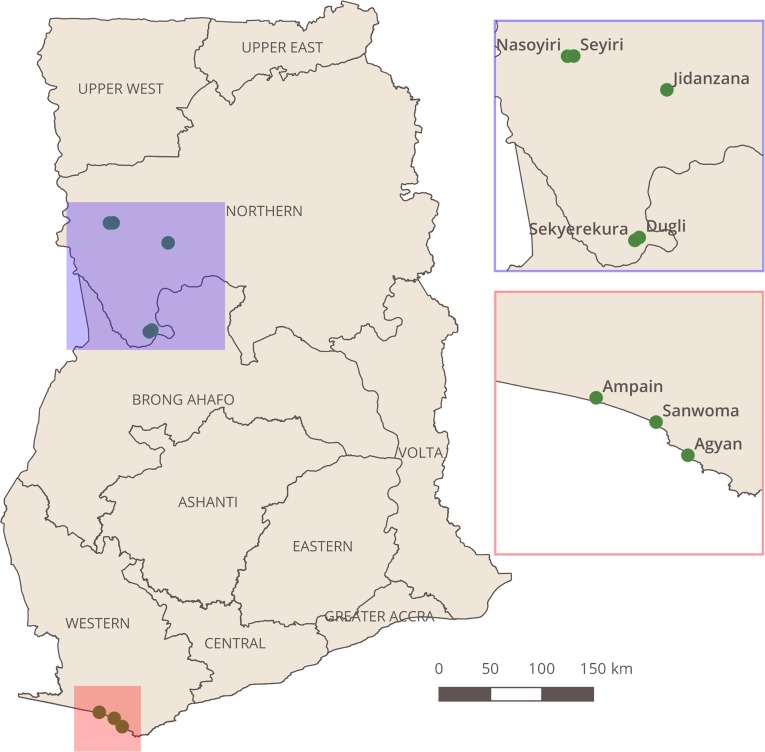
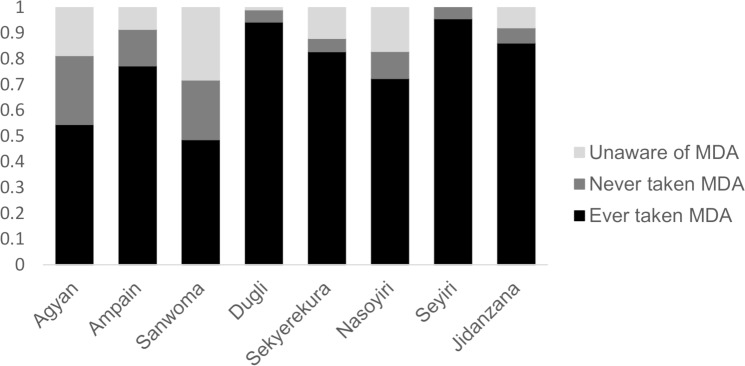
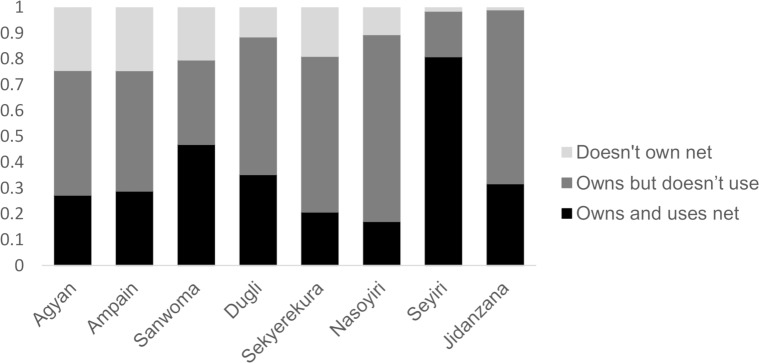
Background: Despite the progress achieved in scaling-up mass drug administration (MDA) for lymphatic filariasis (LF) in Ghana, communities with persistent LF still exist even after 10 years of community treatment. To understand the reasons for persistence, we conducted a study to assess the status of disease elimination and understand the adherence to interventions including MDA and insecticide treated nets.
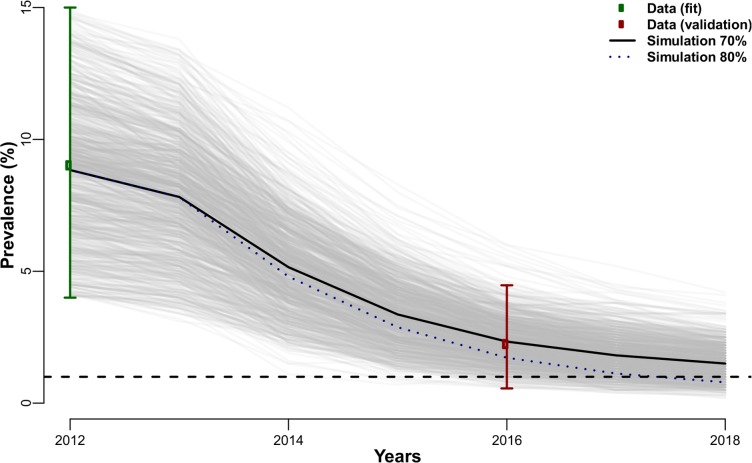
Methodology and principal findings: We conducted a parasitological and epidemiological cross-sectional study in adults from eight villages still under MDA in the Northern Region savannah and the coastal Western Region of the country. Prevalence of filarial antigen ranged 0 to 32.4% and in five villages the prevalence of night blood microfilaria (mf) was above 1%, ranging from 0 to 5.7%. Median mf density was 67 mf/ml (range: 10-3,560). LF antigen positivity was positively associated with male sex but negatively associated with participating in MDA the previous year. Male sex was also associated with a decreased probability of participating in MDA. A stochastic model (TRANSFIL) was used to assess the expected microfilaria prevalence under different MDA coverage scenarios using historical data on one community in the Western Region. In this example, the model simulations suggested that the slow decline in mf prevalence is what we would expect given high baseline prevalence and a high correlation between MDA adherence from year to year, despite high MDA coverage.
Conclusions: There is a need for an integrated quantitative and qualitative research approach to identify the variations in prevalence, associated risk factors and intervention coverage and use levels between and within regions and districts. Such knowledge will help target resources and enhance surveillance to the communities most at risk and to reach the 2020 LF elimination goals in Ghana.
Conflict of interest statement
The authors have declared that no competing interests exist.
Figures
References
-
- World Health Organization. Investing to overcome the global impact of neglected tropical diseases—Third WHO report on neglected tropical diseases [Internet]. Geneva: World Health Organization; 2015. Available: http://www.who.int/neglected_diseases
-
- World Health Organization. Lymphatic filariasis: a handbook of practical entomology for national lymphatic filariasis elimination programmes [Internet]. Geneva: World Health Organization; 2013. Available: http://www.who.int/lymphatic_filariasis/en/
-
- World Health Organization. Progress report 2000–2009 and strategic plan 2010–2020 of the global programme to eliminate lymphatic filariasis: halfway towards eliminating lymphatic fi lariasis. [Internet]. Geneva: World Health Organization; 2010. Available: http://www.who.int/lymphatic_filariasis/resources/annual_reports/en/
-
- World Health Organization. Global programme to eliminate lymphatic filariasis: progress report, 2015. Wkly Epidemiol Rec. 2016;91: 441–460. Available: http://www.who.int/wer
-
- World Health Organization. Global Programme to Eliminate Lymphatic Filariasis: Monitoring and Epidemiological Assessment of Mass Drug Administration. Geneva; 2011.
Publication types
MeSH terms
Substances
LinkOut - more resources
Full Text Sources