Review
. 2019 Jan 1;12(1):4.
doi: 10.3390/ph12010004.

Natural Compounds and Derivatives as Ser/Thr Protein Kinase Modulators and Inhibitors

Affiliations
Review

Natural Compounds and Derivatives as Ser/Thr Protein Kinase Modulators and Inhibitors

Barbara Guerra et al. Pharmaceuticals (Basel). .

Abstract

The need for new drugs is compelling, irrespective of the disease. Focusing on medical problems in the Western countries, heart disease and cancer are at the moment predominant illnesses. Owing to the fact that ~90% of all 21,000 cellular proteins in humans are regulated by phosphorylation/dephosphorylation it is not surprising that the enzymes catalysing these reactions (i.e., protein kinases and phosphatases, respectively) have attracted considerable attention in the recent past. Protein kinases are major team players in cell signalling. In tumours, these enzymes are found to be mutated disturbing the proper function of signalling pathways and leading to uncontrolled cellular growth and sustained malignant behaviour. Hence, the search for small-molecule inhibitors targeting the altered protein kinase molecules in tumour cells has become a major research focus in the academia and pharmaceutical companies.

Keywords: cancer; cellular signalling; flavonoids; kinase inhibition; natural compounds; phosphorylation; protein kinase.


Conflict of interest statement

The authors declare that they do not have conflicts of interest with the content of this article.

Figures
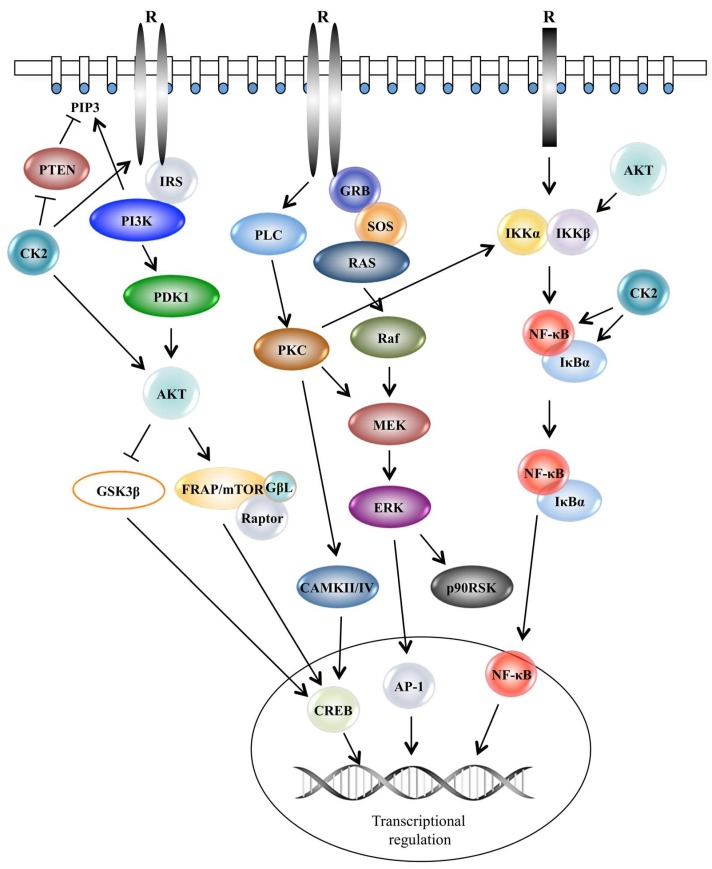
Figure 1
Figure 1
Schematic representation of intracellular signal transduction pathways supporting cell proliferation and survival. Activation of the PI3K/AKT/mTOR, RAS/Raf/MEK/ERK and IKK/NF-κB pathways occurs following a stimulus represented by a ligand, which binds a receptor tyrosine kinase located on the plasma membrane. These pathways control gene expression in a number of ways comprising phosphorylation of transcription factors and co-factors and modification of protein-binding DNA. R: Receptor; PTEN: phosphatase and tensin homolog; IRS: insulin receptor substrate; PI3K: phosphatidylinositol-3-kinase; PDK1: phosphoinositide-dependent-kinase-1; CK2: protein kinase CK2; AKT: protein kinase B; GSK3β: glycogen synthase kinase 3; FRAP/mTOR: 12-rapamycin-associated protein 1/mammalian target of rapamycin; GβL: G protein beta subunit-like; GRB: growth factor receptor-bound protein 2; SOS: son of sevenless; Raf: rapidly accelerated fibrosarcoma; PKC: protein kinase C; MEK: mitogen-activated protein kinase; ERK: extracellular signal-regulated kinase; CAMKII/IV: calcium-calmodulin kinase II/IV; p90RSK: p90 ribosomal s6 kinase; IKKα: IκB kinase α-subunit; IKKβ: IκB kinase β-subunit; NF-κB: nuclear factor-kappa B; IκBα: inhibitor of kappa B; AP-1: activator protein-1; CREB: cAMP response element-binding protein.
Figure 2
Figure 2
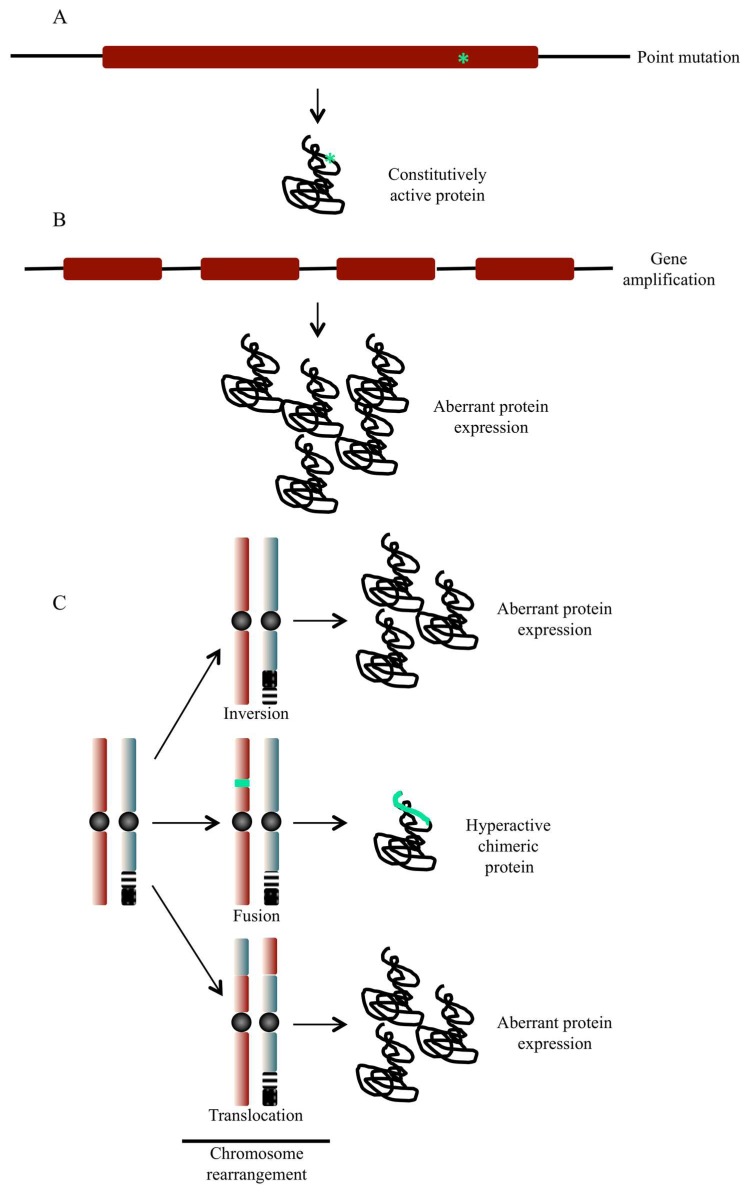
Possible alterations of protein kinase-coding genes and their outcome. (A) Point mutations are capable of activating a proto-oncogene product resulting in the expression of a constitutively active protein kinase. (B) In addition to nucleotide substitution, gene amplification that results from amplification of chromosomal fragments can result in aberrant expression of genes coding for protein kinases. This can result in uncontrolled activation of signalling pathways controlled by the overexpressed protein kinases. (C) Alteration in the structure of chromosomes can take several forms including translocation, inversion, deletion and insertion of genetic material. Chromosome abnormalities can result in the expression of higher levels of a protein, chimeric hyperactive proteins or loss of tumour suppressor gene products.

References

    1. Cragg G.M., Newman D.J. Plants as a source of anti-cancer agents. J. Ethnopharmacol. 2005;100:72–79. doi: 10.1016/j.jep.2005.05.011. - DOI - PubMed
    1. Newman D.J., Cragg G.M. Natural Products as Sources of New Drugs from 1981 to 2014. J. Nat. Prod. 2016;79:629–661. doi: 10.1021/acs.jnatprod.5b01055. - DOI - PubMed
    1. Cochet C., Feige J.J., Pirollet F., Keramidas M., Chambaz E.M. Selective inhibition of a cyclic nucleotide independent protein kinase (G type casein kinase) by quercetin and related polyphenols. Biochem. Pharmacol. 1982;31:1357–1361. doi: 10.1016/0006-2952(82)90028-4. - DOI - PubMed
    1. Graziani Y., Erikson E., Erikson R.L. The effect of quercetin on the phosphorylation activity of the Rous sarcoma virus transforming gene product in vitro and in vivo. Eur. J. Biochem. 1983;135:583–589. doi: 10.1111/j.1432-1033.1983.tb07692.x. - DOI - PubMed
    1. Nakano H., Kobayashi E., Takahashi I., Tamaoki T., Kuzuu Y., Iba H. Staurosporine inhibits tyrosine-specific protein kinase activity of Rous sarcoma virus transforming protein p60. J. Antibiot. 1987;40:706–708. doi: 10.7164/antibiotics.40.706. - DOI - PubMed

LinkOut - more resources