


Regulation of somatostatin receptor 2 by proinflammatory, microbial and obesity-related signals in periodontal cells and tissues
- PMID: 30609928
- PMCID: PMC6319011
- DOI: 10.1186/s13005-018-0185-1
Regulation of somatostatin receptor 2 by proinflammatory, microbial and obesity-related signals in periodontal cells and tissues
Abstract
Background: Periodontitis is a chronic disease characterized by a progressive and irreversible destruction of the tooth-supporting tissues, including gingiva and periodontal ligament (PDL). Microorganisms, such as Fusobacterium nucleatum, evoke an inflammatory host response, which leads to increased levels of inflammatory mediators, such as interleukin (IL)-1β. Periodontitis has been linked to obesity, and adipokines have been suggested to represent a pathomechanistic link. The hormone somatostatin (SST) exerts antiproliferative, antiangiogenetic, proapoptotic, anti-nociceptive and other effects through binding to its receptors, such as SSTR2. Therefore, the objective of the present study was to examine the regulation of SSTR2 in periodontal cells and tissues under inflammatory, microbial and obesity-related conditions.
Methods: In-vitro, human PDL fibroblasts were exposed to IL-1β, F. nucleatum, leptin or visfatin. The SSTR2 regulation was assessed by real-time PCR and immunocytochemistry. In-vivo, the SSTR2 expression was analyzed in gingival biopsies of periodontally diseased and healthy subjects by real-time PCR and immunohistochemistry. Additionally, the SSTR2 expression was determined in gingival biopsies of rats with ligature-induced periodontitis, rats with diet-induced obesity, and periodontally and systemically healthy control animals. For statistical analyses, the Mann-Whitney-U test and ANOVA with post-hoc tests were applied (p < 0.05).
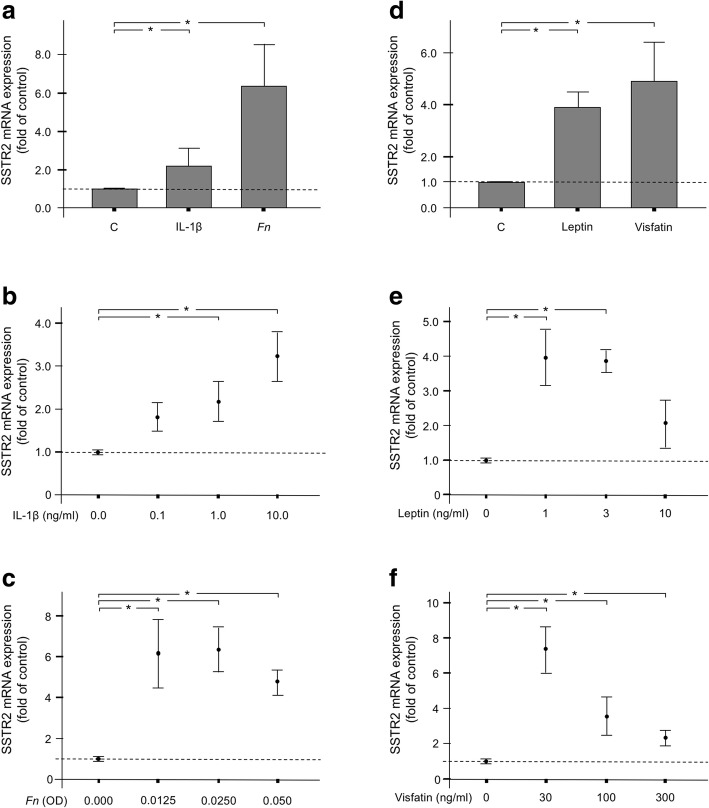
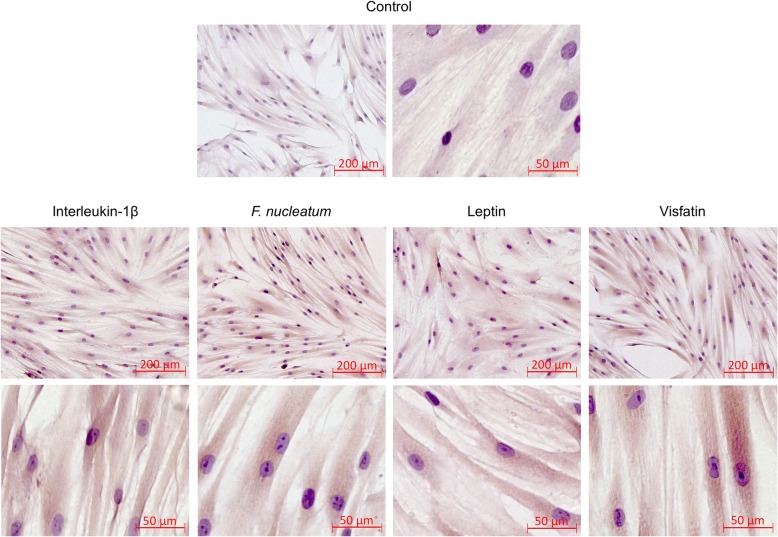
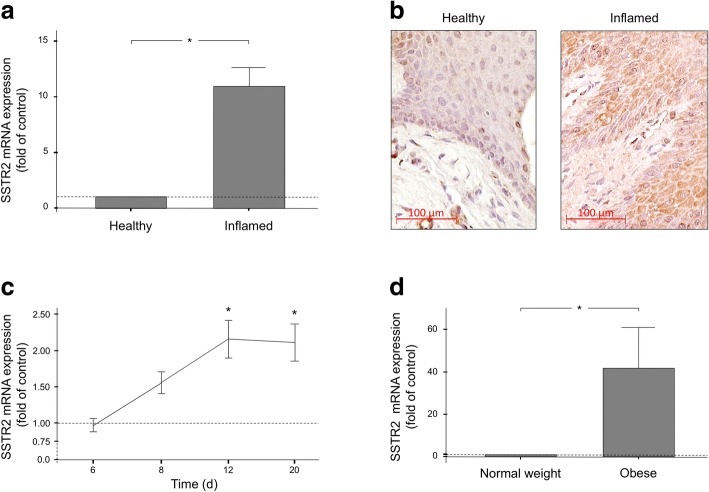
Results: Exposure of PDL cells to IL-1β and F. nucleatum caused a significant SSTR2 upregulation by 2.6-fold and 6.4-fold, respectively. Additionally, leptin and visfatin increased significantly the SSTR2 gene expression by 3.0-fold and 2.8-fold, respectively. These stimulatory effects were also observed at protein level. SSTR2 expressions in human gingival biopsies from sites of periodontitis were significantly higher than those in healthy biopsies. Similarly, SSTR2 expression levels were significantly enhanced at periodontally-diseased sites in rat experimental periodontitis. Finally, the SSTR2 expression was significantly upregulated in gingival biopsies of obese rats as compared to normal weight control animals.
Conclusions: Our study provides original insights into the SSTR2 regulation in cells and tissues of the periodontium. We demonstrate for the first time that proinflammatory, microbial and obesity-associated molecules result in an SSTR2 upregulation. Since SST has been shown to be antiproliferative, antiangiogenetic, and proapoptotic, our study suggests that SSTR2 might play a critical role in the aetiopathogenesis of periodontitis.
Keywords: Adipokines; Fusobacterium nucleatum; Inflammation; Periodontitis; SSTR2.
Conflict of interest statement
Ethics approval and consent to participate
For Experimental Use of PDL fibroblasts:
Approval of the Ethics Committee of the University of Bonn was obtained (#117/15).
The donors of the PDL fibroblasts or their legal guardians gave written informed consent.
For Human Tissue Biopsies:
Approval of the Ethics Committee of the University of Bonn was obtained (#043/11).
The donors of the tissue biopsies gave written and informed consent.
For the Experimental Periodontitis Model:
Approval of the Ethical Committee on Animal Experimentation from the School of Dentistry at Araraquara, São Paulo State University – UNESP, was obtained (protocol number: 23/2012). Protocol followed the ARRIVE guidelines.
For the Diet-induced Obesity Model:
All procedures in the present study were conducted according to the ethical standards of the University of Bonn (Az 87–51.04.2010.A394). All applicable international, national, and/or institutional guidelines for the care and use of animals were followed.
Consent for publication
Not applicable.
Competing interests
The authors declare that they have no competing interests.
Publisher’s Note
Springer Nature remains neutral with regard to jurisdictional claims in published maps and institutional affiliations.
Figures
References
MeSH terms
Substances
Grants and funding
LinkOut - more resources
Full Text Sources
Molecular Biology Databases
