


Evolution, phylogenetic distribution and functional ecology of division of labour in trematodes
- PMID: 30609937
- PMCID: PMC6320615
- DOI: 10.1186/s13071-018-3241-6
Evolution, phylogenetic distribution and functional ecology of division of labour in trematodes
Abstract
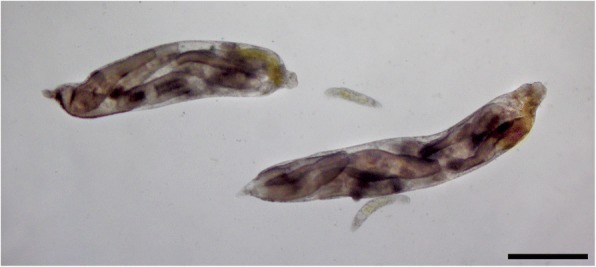
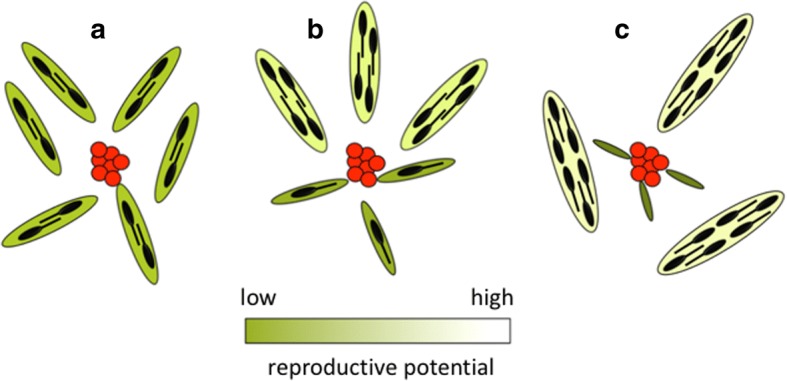
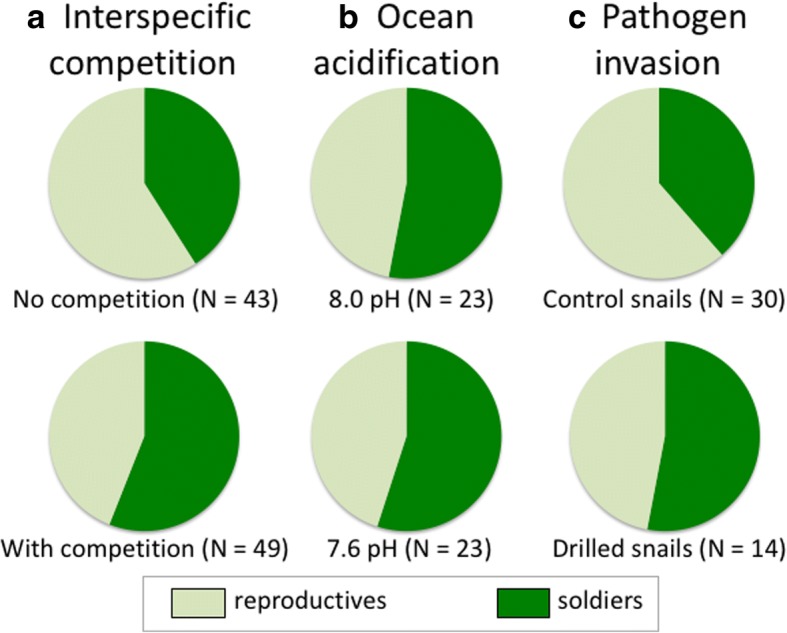
Division of labour has evolved in many social animals where colonies consist of clones or close kin. It involves the performance of different tasks by morphologically distinct castes, leading to increased colony fitness. Recently, a form of division of labour has been discovered in trematodes: clonal rediae inside the snail intermediate host belong either to a large-bodied reproductive caste, or to a much smaller and morphologically distinct 'soldier' caste which defends the colony against co-infecting trematodes. We review recent research on this phenomenon, focusing on its phylogenetic distribution, its possible evolutionary origins, and how division of labour functions to allow trematode colonies within their snail host to adjust to threats and changing conditions. To date, division of labour has been documented in 15 species from three families: Himasthlidae, Philophthalmidae and Heterophyidae. Although this list of species is certainly incomplete, the evidence suggests that division of labour has arisen independently more than once in the evolutionary history of trematodes. We propose a simple scenario for the gradual evolution of division of labour in trematodes facing a high risk of competition in a long-lived snail host. Starting with initial conditions prior to the origin of castes (size variation among rediae within a colony, size-dependent production of cercariae by rediae, and a trade-off between cercarial production and other functions, such as defence), maximising colony fitness (R0) can lead to caste formation or the age-structured division of labour observed in some trematodes. Finally, we summarise recent research showing that caste ratios, i.e. relative numbers of reproductive and soldier rediae per colony, become more soldier-biased in colonies exposed to competition from another trematode species sharing the same snail, and also respond to other stressors threatening the host's survival or the colony itself. In addition, there is evidence of asymmetrical phenotypic plasticity among individual caste members: reproductives can assume defensive functions against competitors in the absence of soldiers, whereas soldiers are incapable of growing into reproductives if the latter's numbers are reduced. We conclude by highlighting future research directions, and the advantages of trematodes as model systems to study social evolution.
Keywords: Caste; Cercariae; Fitness; Multiple infections; Philophthalmus; Rediae; Sociality; Soldiers; Trade-off.
Conflict of interest statement
Ethics approval
Not applicable.
Consent for publication
Not applicable.
Competing interests
The authors declare that they have no competing interests.
Publisher’s Note
Springer Nature remains neutral with regard to jurisdictional claims in published maps and institutional affiliations.
Figures
References
-
- Duarte A, Weissing FJ, Pen I, Keller L. An evolutionary perspective on self-organized division of labor in social insects. Annu Rev Ecol Evol Syst. 2011;42:91–110. doi: 10.1146/annurev-ecolsys-102710-145017. - DOI
Publication types
MeSH terms
Grants and funding
LinkOut - more resources
Full Text Sources
Research Materials
