


Expression and Function of Zinc-α2-Glycoprotein
- PMID: 30610461
- PMCID: PMC6527650
- DOI: 10.1007/s12264-018-00332-x
Expression and Function of Zinc-α2-Glycoprotein
Erratum in
-
Correction to: Expression and Function of Zinc-α2-Glycoprotein.Neurosci Bull. 2019 Aug;35(4):778. doi: 10.1007/s12264-019-00402-8. Neurosci Bull. 2019. PMID: 31183811 Free PMC article.
Abstract
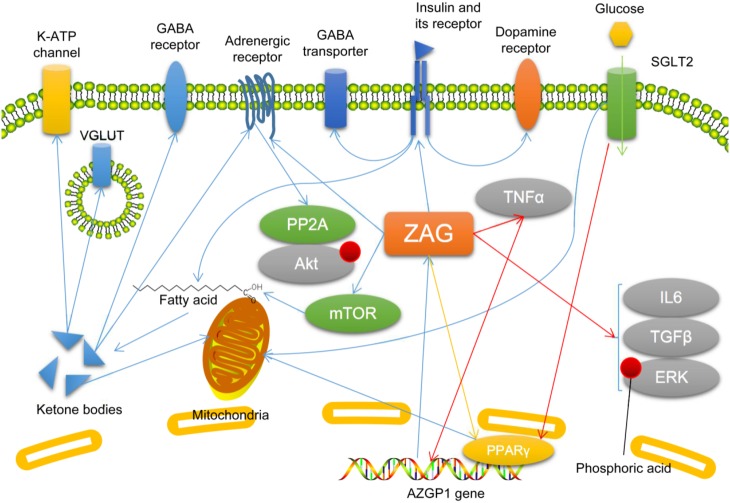
Zinc-α2-glycoprotein (ZAG), encoded by the AZGP1 gene, is a major histocompatibility complex I molecule and a lipid-mobilizing factor. ZAG has been demonstrated to promote lipid metabolism and glucose utilization, and to regulate insulin sensitivity. Apart from adipose tissue, skeletal muscle, liver, and kidney, ZAG also occurs in brain tissue, but its distribution in brain is debatable. Only a few studies have investigated ZAG in the brain. It has been found in the brains of patients with Krabbe disease and epilepsy, and in the cerebrospinal fluid of patients with Alzheimer disease, frontotemporal lobe dementia, and amyotrophic lateral sclerosis. Both ZAG protein and AZGP1 mRNA are decreased in epilepsy patients and animal models, while overexpression of ZAG suppresses seizure and epileptic discharges in animal models of epilepsy, but knowledge of the specific mechanism of ZAG in epilepsy is limited. In this review, we summarize the known roles and molecular mechanisms of ZAG in lipid metabolism and glucose metabolism, and in the regulation of insulin sensitivity, and discuss the possible mechanisms by which it suppresses epilepsy.
Keywords: Glucose; Insulin sensitivity; Lipid; Metabolism; Neuron; Zinc-α2-glycoprotein.
Conflict of interest statement
The authors declare that there is no conflict of interest.
Figures
References
-
- Freije JP, Fueyo A, Uría JA, Velasco G, Sánchez LM, López-Boado YS, et al. Human Zn-alpha 2-glycoprotein: complete genomic sequence, identification of a related pseudogene and relationship to class I major histocompatibility complex genes. Genomics. 1993;18:575–587. doi: 10.1016/S0888-7543(05)80359-3. - DOI - PubMed
Publication types
MeSH terms
Substances
LinkOut - more resources
Full Text Sources
Miscellaneous
