. 2019 Jan 5;19(1):9.
doi: 10.1186/s12885-018-5202-z.

Anti-cancer effect of dung beetle glycosaminoglycans on melanoma

Affiliations

Anti-cancer effect of dung beetle glycosaminoglycans on melanoma

Mi Young Ahn et al. BMC Cancer. .

Abstract

Background: Dung beetle glycosaminoglycan is known to possess anti-aging activities. However, its anti-cancer mechanisms are not fully elucidated yet. The objective of this study was to evaluate the anti-cancer effect of insect-derived polymer dung beetle glycosaminoglycan (GAG) after intraperitoneally injecting it to melanoma mice induced by B16F10 cells.

Methods: To determine molecular mechanism involved in the anti-cancer effect of dung beetle GAG, its origin N-glycan under 3KD Dalton was assayed for melanoma cell cytotoxicity. Quantitative comparisons of adhesive molecule on extracellular matrix and activities of tissue inhibitor of metalloprotease 2 (TIMP-2) were also investigated. In vivo anti-cancer effect of dung beetle GAG on solid tumor size, survival time and gene-expression profiles was also assayed using B10F10 melanoma mice model. Mice with induced melanoma were then treated with Catharsius molossus (dung beetle) GAG (CaG) at 5 mg/kg for 8 weeks to investigate its anti-cancer effects compared to bumblebee (Bombus ignitus) queen glycosaminoglycan (IQG) and Huechys sanguinea glycosaminoglycan (HEG).

Results: These N-glycans derived from these GAG were composed of many linear heparinoid polysaccharides, polymers with hexose and N-acetylhexose. Adminstration with these GAGs increased survival time and decreased melanoma sizes in mice, in accordance with their inhibitory effects on cell growth ratio of melanoma B16F10. In addition, treatment with N-glycans derived from theses glycosaminoglycan increased activities of TIMP-2 in HMVEC cells pretreated with TNF-alpha and in melanoma cells, suggesting that they had anti-inflammatory and anticancer activities. In DNA microarray results, compared to control, CaG treated mouse group showed upregulation of 192 genes including collagen,typeI,alpha1 (Col1a1), consistent with the highly increased in vitro extracellular matrix (ECM) adhesion on collagen 1 and up-regulation of heparanase (Hpse). After treatment with CaG, a total of 152 genes were down-regulated, including nuclear RNA export factor (Nxf3) and hyaluronan proteoglycan link protein1 (Hapln1).

Conclusions: Glycosaminoglycan, CaG can strengthen ECM by increasing activity of TIMP-2 and adhesion activity on collagen known to inhibit changes of ECM, leading to tumor cell invasion and progression.

Keywords: Anti-cancer effect; Catharsius molossus; Glycosaminoglycan; Microarray; Queen of B. ignitus.


Conflict of interest statement

Ethics approval

Studies involving animals were approved by the Laboratory Animals’ Ethical Committee of the National Academy of Agricultural Science for animal welfare (NIAS 201606), Rural Development Administration, South Korea.

Consent for publication

Not applicable.

Competing interests

The authors declare that they have no competing interests.

Publisher’s Note

Springer Nature remains neutral with regard to jurisdictional claims in published maps and institutional affiliations.

Figures
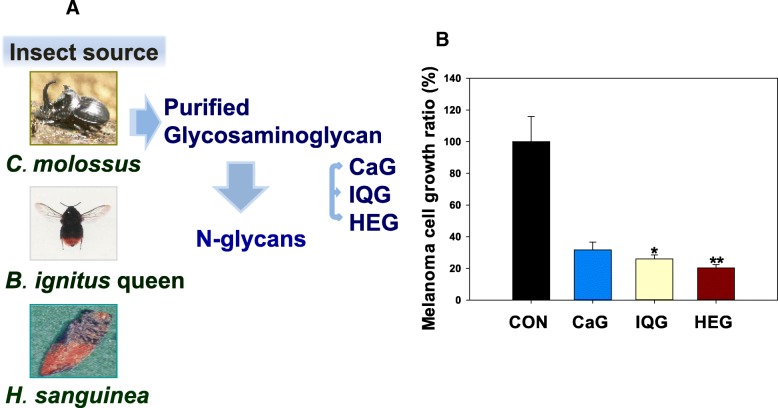
Fig. 1
Fig. 1
Anti-cancer activity of dung beetle glycosaminoglycan against melanoma cells. a Glycosaminoglycans and N-glycans were purified from insect sources: C. molossus, B. igitus queen, and H. sanguinea. b Measurement of growth ratios of melanoma (B16/F10) cells treated with N-glycans from various insect glycosaminoglycans for two days. CaG: dung beetle (C. molossus) glycosaminoglycan (40 μg/ml); IQG: bumblebee (B. ignitus) queen glycosaminoglycan (40 μg/ml); HEG: H. sanguinea glycosaminoglycan (40 μg/ml). Each value represents mean ± SE. n = 3. *p < 0.05, **p < 0.01 significant difference vs. control (PBS) group
Fig. 2
Fig. 2
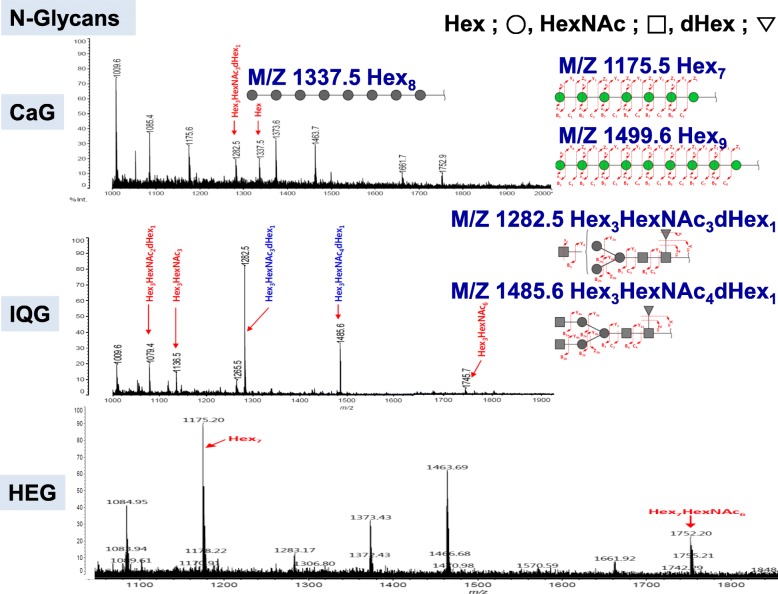
Identification of N-glycans from CaG, IQG, and HEG using MALDI-FOF MS and MS/MS spectrometry. N-glycan of CaG mass (MS) spectrum had main peaks with m/z 1175.5, Hex7; m/z 1337.5, Hex8; m/z 1499.6, Hex9 and m/z 1282.5, Hex3HexNAC3dHex1. N-glycan of IQG had main peaks in MS spectrum with m/z 1282.5, Hex3HexNAC3dHex1; m/z 1485.6, Hex3HexNAC4dHex1 and 1752.2, Hex7HexNAC6. N-glycan of HEG had main peaks in MS spectrum with m/z 1175.2 Hex7 and m/z 1752.2, Hex7HexNAC6. Proposed structure was analyzed by N-glycan sequence data library matched with MS/MS spectrum
Fig. 3
Fig. 3
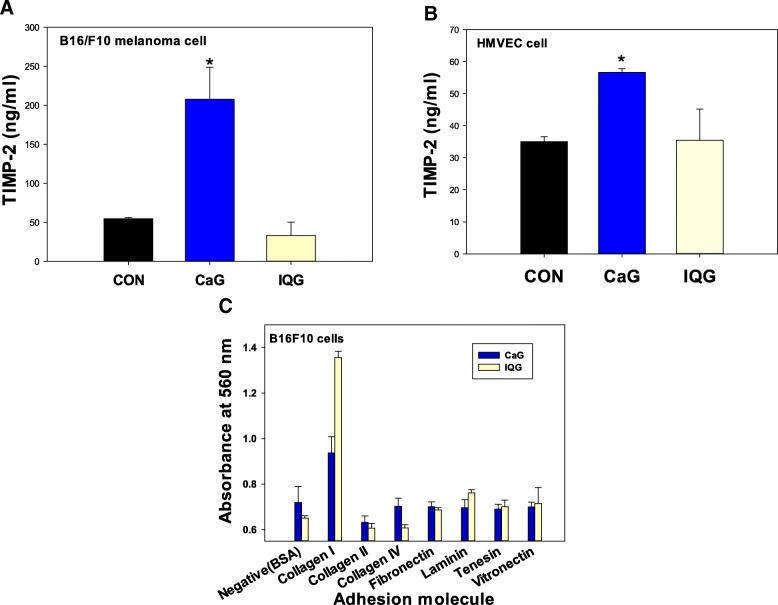
TIMP-2 activity and ECM adhesion. a TIMP-2 activity in melanoma cells following treatment with CaG or IQG N-glycan for two days. b TIMP-2 activity of CaG or IQG N-glycan in HUVEC cells in pretreated with TNF-alpha. Each value represents mean ± SD. N = 3, *p < 0.05 vs CON (PBS) group. TIMP-2, a secreted protein known to prevent degradation of the ECM, was increased by N-glycan from CaG in both melanoma and HMVEC endothelial cells. Otherwise, TIMP-2 level of N-glycan from IQG was selectively decreased in melanoma cells so that ECM of melanoma could be degraded. c ECM adhesion activity (microarray) colorimetric detection of N-glycan of CaG or IQG on melanoma cells incubated with various extracellular matrix adhesion molecules: collagen, fibronectin, laminin, tenascin and vibronectin. Both N-glycans from CaG and IQG were found to have high ECM adehesion activity for Collagen I. Each value represents mean ± SD. N = 3
Fig. 4
Fig. 4
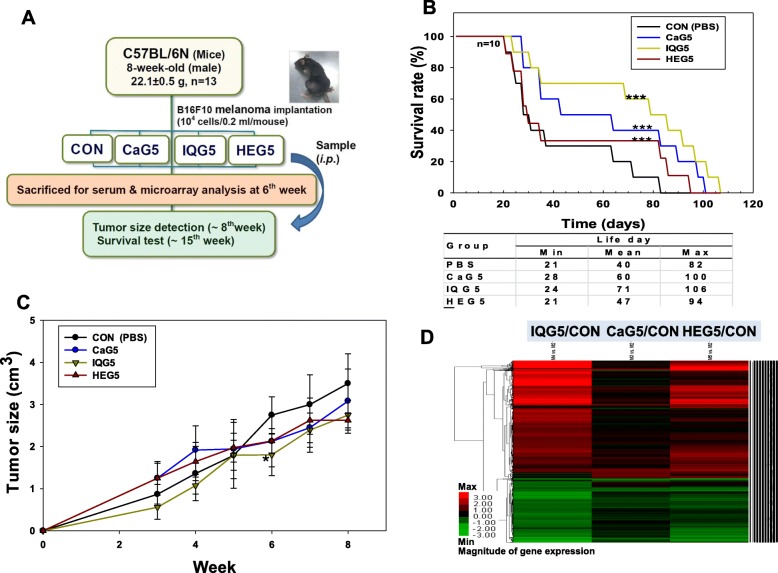
Anti-cancer effect of ding beetle glycosaminoglycan on melanoma mice. a Animal experimental design. CaG5: C. molossus (dung beetle) glycosaminoglycan 5 mg/kg; IQG5: B. ignitus queen glycosaminoglycan 5 mg/kg; HeG5: H. sanguinea glycosaminoglycan 5 mg/kg. b Survival curve of B16/F10 melanoma mice treated with various insect glycosaminoglycans. N = 10, ***p < 0.001 means each sample group significantly different from the control group. c Tumor size of B16/F10 melanoma mice treated with various insect glycosaminoglycans from 3 to 8 weeks. N = 10, * p < 0.05 means each sample group significantly different from control (PBS treated) group by t-test. d Heat map of microarray on melanoma tissue of B16F10 melanoma mice treated with CaG5, IQG5 or HEG5
Fig. 5
Fig. 5
Proposed role of dung beetle/bumblebee queen glycosaminoglycan against melanoma. CaG can strengthen ECM by increasing activity of TIMP-2 and adhesion activity on to collagen 1 to inhibit changes of ECM, leading to tumor cell invasion and progression along with increased activities of heparanase and angiotensin converting enzyme as well as fibronectin regulation (small amount ECM adhesion) in melanoma cells

References

    1. Ryan CN, Sorushanova A, Lomas AJ, Mullen AM, Pandit A, Zeugolis DI. Glycosaminoglycans in tendon physiology, pathophysiology, and therapy. Bioconjg Chem. 2015;26:1237–1251. doi: 10.1021/acs.bioconjchem.5b00091. - DOI - PubMed
    1. Basappa RKS, Sugahara K. Roles of glycosaminoglycans and glycanmimetics in tumor progression and metastasis. Glycoconj. 2014;31:461–467. doi: 10.1007/s10719-014-9551-9. - DOI - PubMed
    1. Ahn MY, Kim SJ, Kim NJ, Hwang JS, Yun EY. Immune modulation of glycosaminoglycan derived from P. lewisi in TNF-alpha stimulated cells. Arch Pharm Res. 2015;38:1983–1991. doi: 10.1007/s12272-015-0616-5. - DOI - PubMed
    1. Fuster MM, Wang L, Castagnola J, Sikora L, Reddi K, Lee PH, Radek KA, Schuksz M, Bishop JR, Gallo RL, Sriramarao P, Esko JD. Genetic alteration of endothelial heparan sulfate selectively inhibits tumor angiogenesis. J Cell Biol. 2007;177:539–549. doi: 10.1083/jcb.200610086. - DOI - PMC - PubMed
    1. Weiss RJ, Esko JD, Tor Y. Targeting heparin and heparan sulfate protein interactions. Org Biomol Chem. 2017;15:5656–5668. doi: 10.1039/C7OB01058C. - DOI - PMC - PubMed

MeSH terms