


Gaining the patient perspective on pelvic floor disorders' surgical adverse events
- PMID: 30612960
- PMCID: PMC6351201
- DOI: 10.1016/j.ajog.2018.10.033
Gaining the patient perspective on pelvic floor disorders' surgical adverse events
Abstract
Background: The Institute for Healthcare Improvement defines an adverse event as an unintended physical injury resulting from or contributed to by medical care that requires additional monitoring, treatment, or hospitalization or that results in death. The majority of research has focused on adverse events from the provider's perspective.
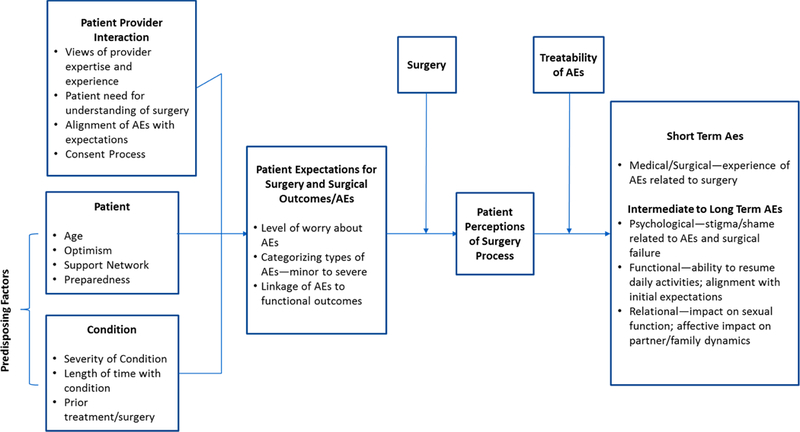
Objective: The objective of this qualitative study was to describe patient perceptions on adverse events following surgery for pelvic floor disorders.
Study design: Women representing the following 3 separate surgical populations participated in focus groups: (1) preoperative (women <12 weeks prior to surgery); (2) short-term postoperative (women up to 12 weeks after surgery); and (3) long-term postoperative (women 1-5 years after surgery). Deidentified transcripts of audio recordings were coded and analyzed with NVivo 10 software to identify themes, concepts, and adverse events. Women were asked to rank patient-identified and surgeon-identified adverse events in order of perceived severity.
Results: Eighty-one women participated in 12 focus groups. Group demographics were similar between groups, and all groups shared similar perspectives regarding surgical expectations. Women commonly reported an unclear understanding of their surgery and categorized adverse events such as incontinence, constipation, nocturia, and lack of improvement in sexual function as very severe, ranking these comparably with intensive care unit admissions or other major surgical complications. Women also expressed a sense of personal failure and shame if symptoms recurred.
Conclusion: Women consider functional outcomes such as incontinence, sexual dysfunction, and recurrence of symptoms as severe adverse events and rate them as similar in severity to intensive care unit admissions and death.
Keywords: function outcomes; pelvic floor disorders; qualitative study; surgical adverse events.
Copyright © 2018 Elsevier Inc. All rights reserved.
Figures

References
-
- Brubaker L, Cundiff G, Fine P, et al. Abdominal Sacrocolpopexy with Burch Colposuspension to Reduce Urinary Stress Incontinence. N Engl J Med 2006: 354:1557–1566. - PubMed
-
- U.S. Food and Drug Administration. http://www.fda.gov/safety/medwatch/howtoreport/ucm053087.htm Accessed September 14, 2013.
Publication types
MeSH terms
Grants and funding
- U10 HD041261/HD/NICHD NIH HHS/United States
- U10 HD054215/HD/NICHD NIH HHS/United States
- U10 HD054214/HD/NICHD NIH HHS/United States
- UG1 HD069006/HD/NICHD NIH HHS/United States
- UL1 TR001449/TR/NCATS NIH HHS/United States
- U01 HD069031/HD/NICHD NIH HHS/United States
- UG1 HD069010/HD/NICHD NIH HHS/United States
- U10 HD069013/HD/NICHD NIH HHS/United States
- U10 HD041267/HD/NICHD NIH HHS/United States
- UG1 HD054214/HD/NICHD NIH HHS/United States
- U10 HD069006/HD/NICHD NIH HHS/United States
- U10 HD069010/HD/NICHD NIH HHS/United States
- UG1 HD041267/HD/NICHD NIH HHS/United States
- U24 HD069031/HD/NICHD NIH HHS/United States
- L30 HD085503/HD/NICHD NIH HHS/United States
- U10 HD069025/HD/NICHD NIH HHS/United States
LinkOut - more resources
Full Text Sources
Medical
