Comment
doi: 10.21037/tcr.2017.05.05.
Branched chain amino acid metabolism and cancer: the importance of keeping things in context
Affiliations
- PMID: 30613481
- PMCID: PMC6319930
- DOI: 10.21037/tcr.2017.05.05
Item in Clipboard
Comment
Branched chain amino acid metabolism and cancer: the importance of keeping things in context
Transl Cancer Res.
2017 May.
No abstract available
Conflict of interest statement
Conflicts of Interest: The authors have no conflicts of interest to declare.
Figures
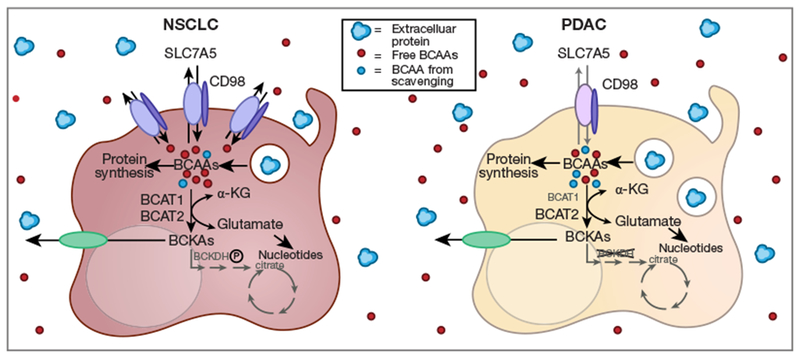
Differential acquisition of BCAAs in KP NSCLC and KP−/−C PDAC as described by Mayers et
al. (16). Relative to normal tissue, SLC7A5 and BCAT1 were over-expressed in
NSCLC but not PDAC; BCAT2 protein levels increased in both NSCLC and PDAC. BCKDH was inactivated by phosphorylation in NSCLC while
in PDAC BCKDH total protein was greatly reduced. Isotopic labeling studies indicated that carbon from circulating BCAAs ended up
in protein and BCKAs in NSCLC to a greater extent than in PDAC. Nitrogen from dietary leucine was used for BCAT-dependent
nucleotide synthesis in NSCLC. BSA degradation in the lysosome was increased in isolated PDAC cells relative to NSCLC cells
suggesting that PDAC cells may rely on macropinocytosis to compensate for reduced import of extracellular BCAAs through SLC7A5.
BCAA, branched chain amino acid; NSCLC, non-small cell lung cancer; PDAC, pancreatic ductal adenocarcinoma; BCKDHA, branched chain
keto acid dehydrogenase El alpha; BCAT, branched chain amino acid transferase.
Comment on
-
Tissue of origin dictates branched-chain amino acid metabolism in mutant Kras-driven cancers.Science. 2016 Sep 9;353(6304):1161-5. doi: 10.1126/science.aaf5171. Science. 2016. PMID: 27609895 Free PMC article.
References
-
- Röhrig F, Schulze A. The multifaceted roles of fatty acid synthesis in cancer. Nat Rev Cancer 2016;16:732–49. - PubMed