Comment
doi: 10.21037/tcr.2017.06.07.
New incriminating evidence against IGF2
Affiliations
- PMID: 30613484
- PMCID: PMC6320226
- DOI: 10.21037/tcr.2017.06.07
Item in Clipboard
Comment
New incriminating evidence against IGF2
Transl Cancer Res.
2017 Aug.
No abstract available
Conflict of interest statement
Conflicts of Interest: The authors have no conflicts of interest to declare.
Figures
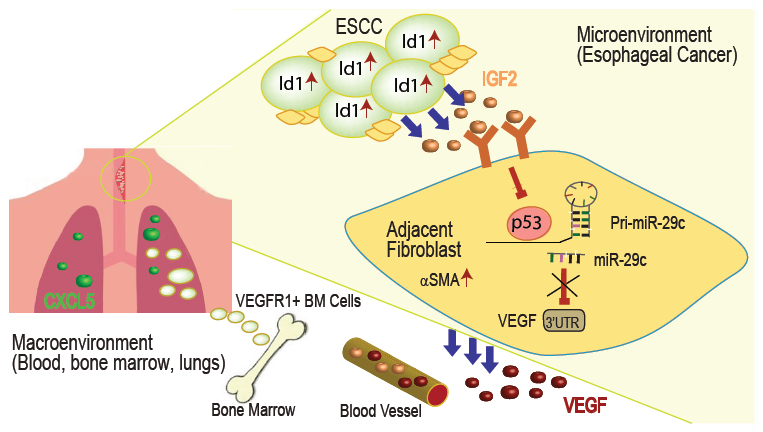
Schematic diagram summarizing the regulatory role of the Id1/IGF2/VEGF/VEGFR pathway in esophageal squamous cell carcinoma (ESCC) progression. In the tumor microenvironment, IGF2 secreted by Id1-expressing cancer cells activates adjacent fibroblasts to become αSMA+ myofibroblasts, and to reduce expression of p53 causing reduction in miR-29c expression and subsequent de-repression of VEGF. In the tumor macro environment, VEGF secreted from the activated fibroblasts travels through the blood to the bone marrow instigating VEGFR+ bone marrow cells to migrate to the lung where CXCL5 expression attracts the invading cancer cells.
Comment on
-
Cancer cell-secreted IGF2 instigates fibroblasts and bone marrow-derived vascular progenitor cells to promote cancer progression.Nat Commun. 2017 Feb 10;8:14399. doi: 10.1038/ncomms14399. Nat Commun. 2017. PMID: 28186102 Free PMC article.
References
-
- Pennathur A, Gibson MK, Jobe BA, et al. Oesophageal carcinoma. Lancet 2013;381:400–12. - PubMed
-
- Gupta GP, Massague J. Cancer metastasis: building a framework. Cell 2006;127:679–95. - PubMed
-
- Weis SM, Cheresh DA. Tumor angiogenesis: molecular pathways and therapeutic targets. Nat Med 2011;17:1359–70. - PubMed
-
- Lyden D, Young AZ, Zagzag D, et al. Id1 and Id3 are required for neurogenesis, angiogenesis and vascularization of tumour xenografts. Nature 1999;401:670–7. - PubMed
Publication types
Grants and funding
LinkOut - more resources
Full Text Sources
Miscellaneous