


Association of type and intensity of physical activity with plasma biomarkers of inflammation and insulin response
- PMID: 30614528
- PMCID: PMC6525061
- DOI: 10.1002/ijc.32111
Association of type and intensity of physical activity with plasma biomarkers of inflammation and insulin response
Abstract
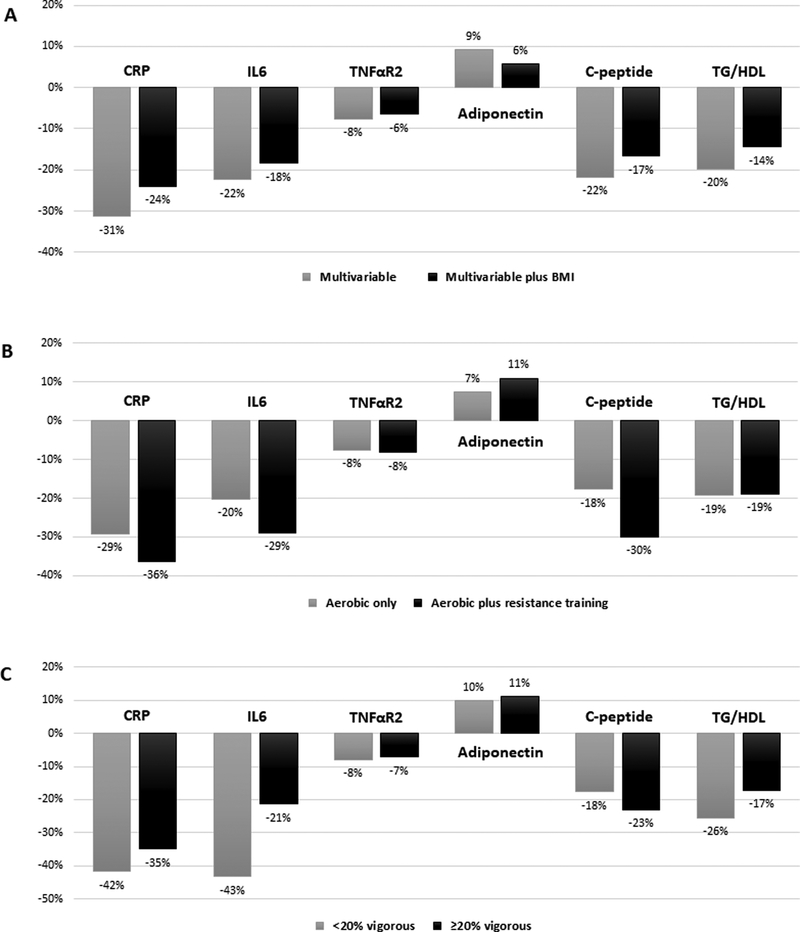
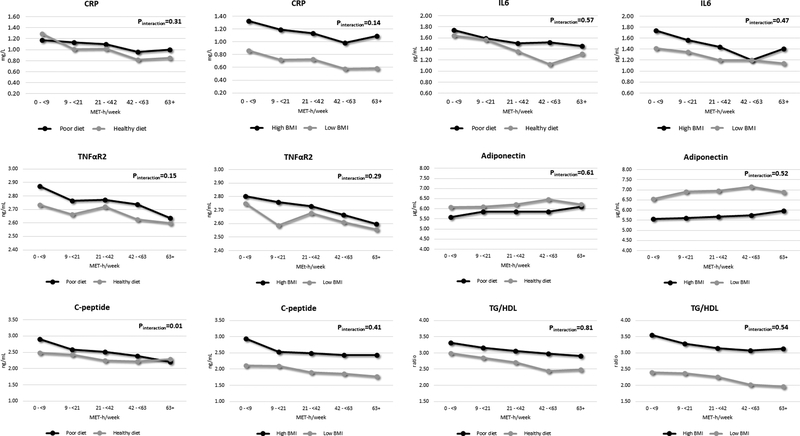
Several biological mechanisms linking physical activity with cancer have been proposed. However, the influence of specific components of physical activity (volume, type and intensity), and their interaction with adiposity and diet, on cancer-related biomarkers remain unclear. We used cross-sectional data on 7,219 men in the Health Professionals Follow-up Study (1992-1994) with C-reactive protein (CRP), interleukin-6 (IL6), tumor necrosis factor alpha receptor 2 (TNFαR2), adiponectin, C-peptide and triglycerides/high-density lipoprotein cholesterol ratio (TG/HDL). Details on physical activity, diet and adiposity were assessed by questionnaires. We used multivariable-adjusted linear regression analyses to estimate relative concentrations of biomarkers by physical activity. Total physical activity was favorably associated with all biomarkers in a fairly linear manner. Comparing the highest (63+ metabolic equivalent (MET)-hr/week) to the lowest (0-8.9 MET-hr/week) physical activity groups, the percent relative difference in concentration of biomarkers was -31% for CRP, -22% for IL6, -8% for TNFαR2, +9% for adiponectin, -22% for C-peptide, and -20% for TG/HDL. These differences were modestly attenuated after adjustment for adiposity. For the same total MET-hours of physical activity, the association was stronger for men engaging in both aerobic and resistance exercises compared to those engaging in aerobic only. However, no difference was found between those engaging in vigorous activities (≥20% of total MET-hours) compared to those who did smaller amount of vigorous activities. Physical activity showed similar associations for these biomarkers regardless of adiposity and dietary pattern. In conclusion, high physical activity, preferably aerobic plus resistance training, was associated with favorable cancer-related biomarkers.
Keywords: adiposity; diet; inflammation; insulin; interaction; physical activity.
© 2019 UICC.
Conflict of interest statement
Figures
References
-
- Giovannucci E An Integrative Approach for Deciphering the Causal Associations of Physical Activity and Cancer Risk: The Role of Adiposity. J Natl Cancer Inst 2018. - PubMed
-
- Rezende LFM, Sa TH, Markozannes G, Rey-Lopez JP, Lee IM, Tsilidis KK, Ioannidis JPA, Eluf-Neto J. Physical activity and cancer: an umbrella review of the literature including 22 major anatomical sites and 770 000 cancer cases. Br J Sports Med 2017. - PubMed
-
- World Cancer Research Fund/American Institute for Cancer Research. Continuous Update Project Expert Report 2018. Physical activity and risk of cancer.
-
- International Agency for Research on Cancer (IARC). Weight Control and Physical Activity IARC Handbook of Cancer Prevention Volume 6ed. Lyon: IARC press, 2002.
-
- Moore SC, Lee IM, Weiderpass E, Campbell PT, Sampson JN, Kitahara CM, Keadle SK, Arem H, Berrington de Gonzalez A, Hartge P, Adami HO, Blair CK, et al. Association of Leisure-Time Physical Activity With Risk of 26 Types of Cancer in 1.44 Million Adults. JAMA Intern Med 2016;176: 816–25. - PMC - PubMed
Publication types
MeSH terms
Substances
Grants and funding
LinkOut - more resources
Full Text Sources
Medical
Research Materials
Miscellaneous
