


Factors associated with breast cancer screening awareness and practices of women in Addis Ababa, Ethiopia
- PMID: 30616640
- PMCID: PMC6323829
- DOI: 10.1186/s12905-018-0695-9
Factors associated with breast cancer screening awareness and practices of women in Addis Ababa, Ethiopia
Abstract
Background: Breast cancer is a global health problem being the most common cancer of women in both developed and under-developed countries. Public and individual awareness can play a vital role in the prevention, early diagnosis and treatment of breast cancer. However evidence is sparse on awareness and practice of breast cancer screening methods used among women of reproductive age in Ethiopia. The present study was designed to determine factors associated with breast cancer screening awareness and practices of women in Addis Ababa.
Methods: A facility based cross-sectional study was conducted among women who came for maternal and child health care services to selected public health centers. The participants were interviewed using a structured questionnaire. Following data collection, data entry and analysis was done using Epi-Info version 7and SPSS Version 21 respectively. Cross tabulation of each independent variable with the dependent variable with their 95% confidence interval was done and those variables associated at binary logistic regression with a significance level of 0.2 were entered into multiple logistic regression.
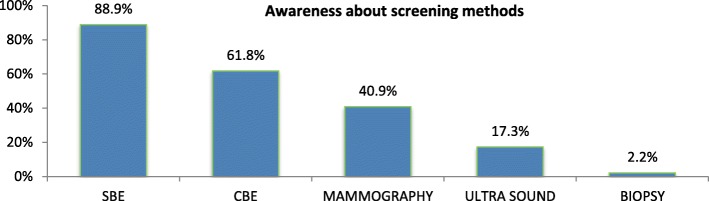
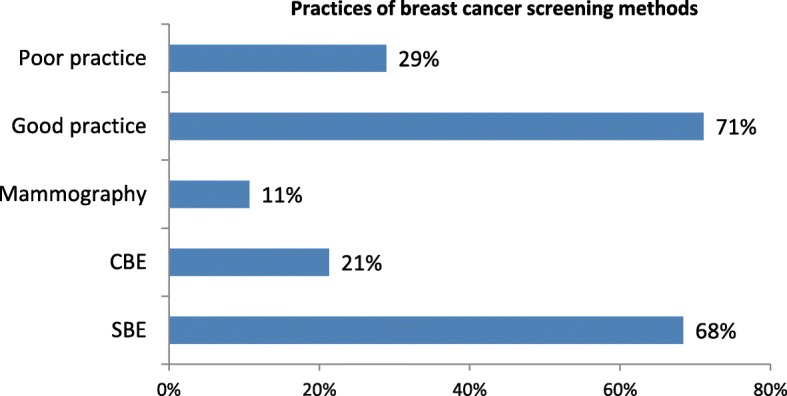
Results: About half (53%) of women have heard about breast cancer and 35.5% of women are aware of at least one breast cancer screening method. Among those who are informed about breast cancer screening, 97% indicated that screening improves the chance of survival. Among the common screening methods; self-breast examination, clinical-breast examination and mammographic examination were practiced by 24.3%, 7.6% and 3.8% of respondents, respectively. Women who had high level of income were about 3 times more likely to be aware about breast cancer screening methods, [AOR = 2.5; 95%CI (1.04--5.91)], while women who attended secondary and tertiary school were 2 and 4 times more likely to practice breast cancer screening methods [AOR = 2.46; 95% CI (1.12--5.38)] and [AOR = 4.00; 95% CI(1.48--10.86)] respectively.
Conclusion: This study has showed that self-reported breast cancer screening coverage is low. About two-thirds of women had no information about breast cancer screening methods.
Keywords: Awareness and pPractice; Breast cancer screening.
Conflict of interest statement
Ethics approval and consent to participate
Ethical clearance was obtained from IRB of School of Public Health in AAU. Following the endorsement by the IRB, a written permission was presented to Addis Ababa regional health bureau and study health centers. Informed verbal consent was obtained during a data collection. Furthermore confidentiality was assured throughout the study.
Consent for publication
Not applicable.
Competing interests
The authors declare that they have no competing interests.
Publisher’s Note
Springer Nature remains neutral with regard to jurisdictional claims in published maps and institutional affiliations.
Figures
References
-
- Simpson JF, Wilkinson EJ. In: Malignant neoplasia of the breast: infiltrating carcinomas. Bland KI, Copeland EM, editors. 2004.
-
- Bray F, Ferlay J, Soerjomataram I, Siegel RL, Torre LA, Jemal A. Global cancer statistics 2018: GLOBOCAN estimates of incidence and mortality worldwide for 36 cancers in 185 countries. CA: a cancer Journal for clinicians. 2018;68(6):394-424. - PubMed
-
- Ferlay J, E.M., Lam F, Colombet M, Mery L, Pineros M, Znaor A, Soerjomataram I, Bray F, Global Cancer Observatory: Cancer Today. Lyon, France: International Agency for Research on Cancer 2018.
-
- Registry, A.A.C., Top 10 female cancer in Addis Ababa, 2015.
Publication types
MeSH terms
LinkOut - more resources
Full Text Sources
Medical
