


Nosocomial outbreak of influenza A H3N2 in an inpatient oncology unit related to health care workers presenting to work while ill
- PMID: 30616930
- PMCID: PMC7115309
- DOI: 10.1016/j.ajic.2018.10.024
Nosocomial outbreak of influenza A H3N2 in an inpatient oncology unit related to health care workers presenting to work while ill
Abstract
Objective: To describe an outbreak of influenza A in an oncology unit, highlighting infection control methods implemented, and examining reasons health care workers (HCWs) present to work with influenza-like illness (ILI).
Methods: Confirmed cases were defined by the presence of ILI and a positive nasopharyngeal polymerase chain reaction swab for influenza A H3. Probable cases were defined as exposed HCWs with ILI who were unavailable for polymerase chain reaction testing. Infection prevention measures included closing the ward for new admissions, oseltamivir prophylaxis for all exposed groups, and dismissal from work of HCWs with ILI until resolution of symptoms. An anonymous survey of the cases in our HCWs was conducted to better elucidate reasons behind presenteeism.
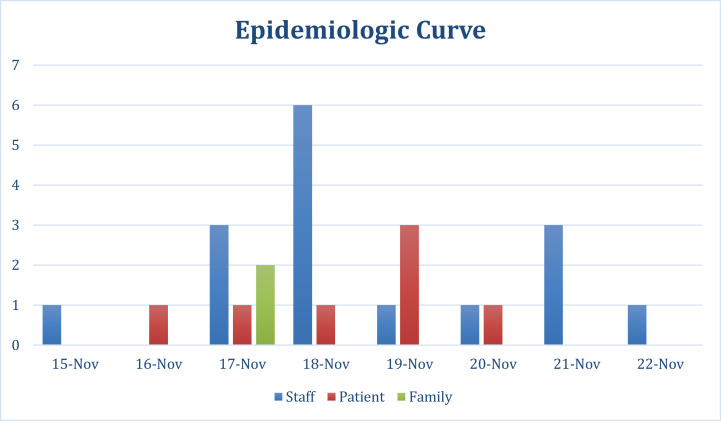
Results: Over the course of 8 days (November 16, 2017, to November 22, 2017), influenza was diagnosed in 7 of 10 inpatients on the oncology ward, 16 HCWs (14 confirmed, 2 probable), and 2 visitors. The suspected index case was an HCW. Of the surveyed HCWs, 64% presented to work despite feeling ill (ie, presenteeism). The most common reason was "sense of duty as a health care worker."
Conclusions: This nosocomial outbreak of influenza highlights the challenges of protecting inpatients from viral respiratory tract infections. HCWs and patient visitors with ILI should avoid work or visiting until resolution of peak respiratory symptoms and adhere to strict respiratory etiquette.
Keywords: Hospital epidemiology; Presenteeism.
Copyright © 2018 Association for Professionals in Infection Control and Epidemiology, Inc. Published by Elsevier Inc. All rights reserved.
Figures
References
-
- Centers for Disease Control and Prevention. Influenza (flu). Available from: https://www.cdc.gov/flu/index.htm. Accessed December 12, 2017.
-
- Flannery B, Chung JR, Belongia EA, McLean HQ, Gaglani M, Murthy K, et al. Interim estimates of 2017-18 seasonal influenza vaccine effectiveness—United States, February 2018. Am J Transplant. 2018;18:1020–1025. - PubMed
-
- Taylor G, Mitchell R, McGeer A, Frenette C, Suh KN, Wong A, et al. Healthcare-associated influenza in Canadian hospitals from 2006 to 2012. Infect Control Hosp Epidemiol. 2014;35:169–175. - PubMed
-
- Pollara CP, Piccinelli G, Rossi G, Cattaneo C, Perandin F, Corbellini S, et al. Nosocomial outbreak of the pandemic influenza A (H1N1) 2009 in critical hematologic patients during seasonal influenza 2010-2011: detection of oseltamivir resistant variant viruses. BMC Infect Dis. 2013;13:127. - PMC - PubMed
-
- Eibach D, Casalegno JS, Bouscambert M, Bénet T, Regis C, Comte B, et al. Routes of transmission during a nosocomial influenza A(H3N2) outbreak among geriatric patients and healthcare workers. J Hosp Infect. 2014;86:188–193. - PubMed
