Review
. 2018 Dec 19:9:2976.
doi: 10.3389/fimmu.2018.02976. eCollection 2018.

Beyond Killing Mycobacterium tuberculosis: Disease Tolerance

Affiliations
Review

Beyond Killing Mycobacterium tuberculosis: Disease Tolerance

Maziar Divangahi et al. Front Immunol. .

Abstract

Host defense strategies against infectious diseases are comprised of both host resistance and disease tolerance. Resistance is the ability of the host to prevent invasion or to eliminate the pathogen, while disease tolerance is defined by limiting the collateral tissue damage caused by the pathogen and/or the immune response without exerting direct effects on pathogen growth. Our incomplete understanding of host immunity against tuberculosis (TB) is predominately rooted in our bias toward investigating host resistance. Thus, we must refocus our efforts to understand the entire spectrum of immunity against M. tuberculosis to control TB.

Keywords: adaptive immunity; disease tolerance; host defense against pathogenic bacteria; innate immunity; tuberculosis.


Figures
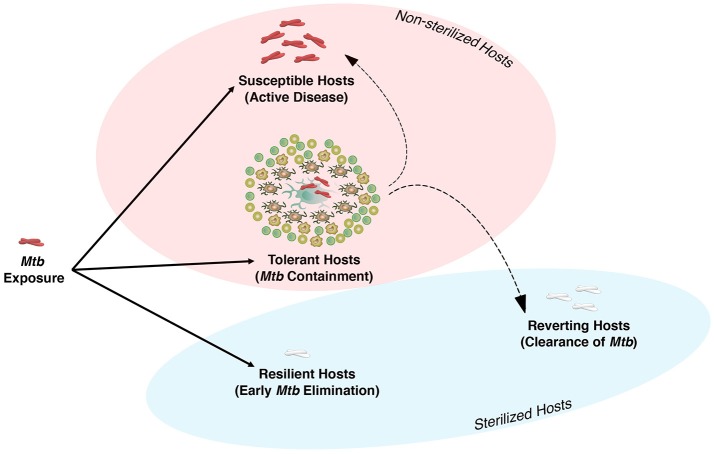
Figure 1
Figure 1
The spectrum of Mycobacterium tuberculosis infection in humans. Humans and Mtb have co-evolved to reach a dynamic equilibrium. There are three major outcomes following exposure to Mtb. (1) Resilient Host: These individuals are able to eliminate the bacteria at the early stage of infection via host defense mechanisms of the upper or lower airways. (2) Tolerance Host: if innate immunity is unable to eliminate Mtb, the host initiates adaptive immunity and granuloma formation, which is the beginning of the chronic phase of infection and disease tolerance to contain or ultimately eliminate Mtb (reverting host). Conditions associated with immunocompromised host may result in loss of Mtb containment and active disease in tolerant host. Although 90–95% of individuals are considered to be tolerant hosts, the exact number of these individuals who are able to clear Mtb or succumb to disease is still unknown. (3) Susceptible Host: individuals with impaired natural immunity to Mtb who progress to active disease and transmit the infection.

References

    1. Cannon W. Organization for physiological homeostasis. Physiol. Rev. (1929) 9:399–431. 10.1152/physrev.1929.9.3.399 - DOI
    1. Ayres JS, Schneider DS. Tolerance of infections. Annu Rev Immunol. (2012) 30:271–94. 10.1146/annurev-immunol-020711-075030 - DOI - PubMed
    1. Soares MP, Gozzelino R, Weis S. Tissue damage control in disease tolerance. Trends Immunol. (2014) 35:483–94. 10.1016/j.it.2014.08.001 - DOI - PubMed
    1. Jeney V, Ramos S, Bergman ML, Bechmann I, Tischer J, Ferreira A, et al. . Control of disease tolerance to malaria by nitric oxide and carbon monoxide. Cell Rep. (2014) 8:126–36. 10.1016/j.celrep.2014.05.054 - DOI - PubMed
    1. Ferreira A, Marguti I, Bechmann I, Jeney V, Chora A, Palha NR, et al. . Sickle hemoglobin confers tolerance to Plasmodium infection. Cell (2011) 145:398–409. 10.1016/j.cell.2011.03.049 - DOI - PubMed

Publication types

MeSH terms

Grants and funding

LinkOut - more resources
