Review
. 2018 Dec 11:8:606.
doi: 10.3389/fonc.2018.00606. eCollection 2018.

Insights Into SND1 Oncogene Promoter Regulation

Affiliations
Review

Insights Into SND1 Oncogene Promoter Regulation

Begoña Ochoa et al. Front Oncol. .

Abstract

The staphylococcal nuclease and Tudor domain containing 1 gene (SND1), also known as Tudor-SN, TSN or p100, encodes an evolutionarily conserved protein with invariant domain composition. SND1 contains four repeated staphylococcal nuclease domains and a single Tudor domain, which confer it endonuclease activity and extraordinary capacity for interacting with nucleic acids, individual proteins and protein complexes. Originally described as a transcriptional coactivator, SND1 plays fundamental roles in the regulation of gene expression, including RNA splicing, interference, stability, and editing, as well as in the regulation of protein and lipid homeostasis. Recently, SND1 has gained attention as a potential disease biomarker due to its positive correlation with cancer progression and metastatic spread. Such functional diversity of SND1 marks this gene as interesting for further analysis in relation with the multiple levels of regulation of SND1 protein production. In this review, we summarize the SND1 genomic region and promoter architecture, the set of transcription factors that can bind the proximal promoter, and the evidence supporting transactivation of SND1 promoter by a number of signal transduction pathways operating in different cell types and conditions. Unraveling the mechanisms responsible for SND1 promoter regulation is of utmost interest to decipher the SND1 contribution in the realm of both normal and abnormal physiology.

Keywords: SND1-IT1; Tudor-SN; chromosome 7 band 7q.32.1; miR-593; oncogene promoter; staphylococcal nuclease and Tudor domain containing 1; transcriptional regulation.


Figures

Figure 1
Figure 1
Schematic representation of the structure and functions of SND1 protein. The protein comprises a tandem of four Staphylococcal nuclease-like domains (SN1-4) followed by a fusion of an entire Tudor domain and a truncated SN domain (SN5). SN and Tudor domains enable SND1 for interacting with RNA/DNA and proteins to operate in a plethora of processes.
Figure 2
Figure 2
Genomic regions for the human SND1 and the rat and mouse orthologues. Contexts are well conserved in the three species regarding PAX4, FCSN3 and Mir129-1. The SND1 gene hosts LRRC4 while the intronic genes MIR593 and SND1-IT1 (SND1-intronic transcript 1) are present only in the human genome in sense orientation.
Figure 3
Figure 3
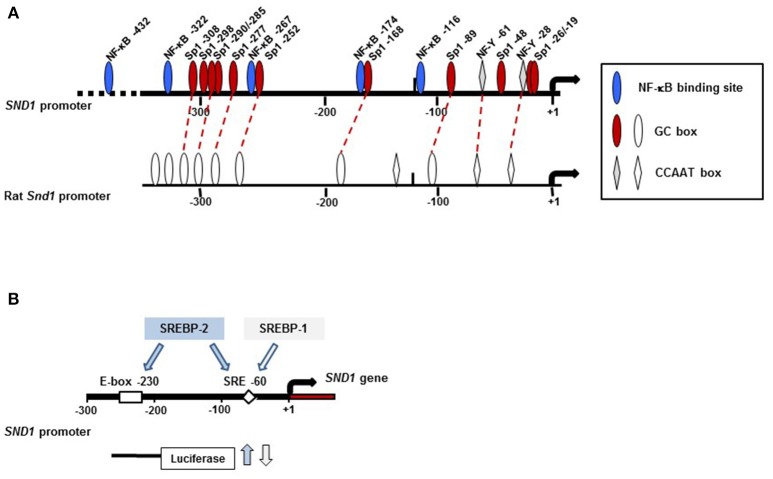
Location of key regulatory elements of the human SND1 proximal promoter. (A) Diagram of region (-400, +10) of the promoter. Promoter activity is under the control of the transcription factors Sp1, NF-κB and NF-Y with 11 (GC boxes, red and white ovals), 5 (NF-κB elements, blue ovals) and 2 (CCAAT boxes, gray and white diamonds) binding sites identified, respectively. The rat promoter conserves some of these regulatory sites. (B) Promoter activity is increased by SREBP-2 binding to E-box −230 and/or SRE −60 whereas it is inhibited by SREBP-1 binding to SRE −60. The arrow indicates the transcription initiation site.
Figure 4
Figure 4
Scheme illustrating the signaling pathways and transcription factors contributing to SND1 promoter activation. SND1 is transcriptionally upregulated by several stress settings, including TGF/Smads pathway through Smad2/3 binding, NF-κB-mediated inflammation, SREBP activation concomitant to cholesterol depletion and ATF6/XBP1-mediated endoplasmic reticulum stress.
Figure 5
Figure 5
Predicted G-quadruplex structures in the SND1 proximal promoter and the 3′UTR sequence. In silco prediction and distribution of the quadruplex forming G-rich sequences (each G-group in boxes) found by QGRS Mapper program (91) in the nucleotide sequence of human SND1 promoter (A) and 3′ untranslated region (B).

References

    1. Broadhurst MK, Wheeler TT. The p100 coactivator is present in the nuclei of mammary epithelial cells and its abundance is increased in response to prolactin in culture and in mammary tissue during lactation. J Endocrinol. (2001) 171:329–37. 10.1677/joe.0.1710329 - DOI - PubMed
    1. Zhao CT, Shi KH, Su Y, Liang LY, Yan Y, Postlethwait J, et al. . Two variants of zebrafish p100 are expressed during embryogenesis and regulated by nodal signaling. FEBS Lett. (2003) 543:190–5. 10.1016/S0014-5793(03)00445-9 - DOI - PubMed
    1. Hossain MJ, Korde R, Singh PK, Kanodia S, Ranjan R, Ram G, et al. . Plasmodium falciparum Tudor Staphylococcal Nuclease interacting proteins suggest its role in nuclear as well as splicing processes. Gene (2010) 468:48–57. 10.1016/j.gene.2010.08.004 - DOI - PubMed
    1. dit Frey NF, Muller P, Jammes F, Kizis D, Leung J, Perrot-Rechenmann C, et al. The RNA binding protein Tudor-SN is essential for stress tolerance and stabilizes levels of stress-responsive mRNAs encoding secreted proteins in Arabidopsis. Plant Cell (2010) 22:1575–91. 10.1105/tpc.109.070680 - DOI - PMC - PubMed
    1. Callebaut I, Mornon JP. The human EBNA-2 coactivator p100: multidomain organization and relationship to the staphylococcal nuclease fold and to the tudor protein involved in Drosophila melanogaster development. Biochem J. (1997) 321:125–32. 10.1042/bj3210125 - DOI - PMC - PubMed

LinkOut - more resources