


Mobile Technology for Cognitive Assessment of Older Adults: A Scoping Review
- PMID: 30619948
- PMCID: PMC6312550
- DOI: 10.1093/geroni/igy038
Mobile Technology for Cognitive Assessment of Older Adults: A Scoping Review
Abstract
Background and objectives: The number of people diagnosed with dementia is rising appreciably as the population ages. In an effort to improve outcomes, many have called for facilitating early detection of cognitive decline. Increased use of mobile technology by older adults provides the opportunity to deliver convenient, cost-effective assessments for earlier detection of cognitive impairment. This article presents a review of the literature on how mobile platforms-smartphones and tablets-are being used for cognitive assessment of older adults along with benefits and opportunities associated with using mobile platforms for cognitive assessment.
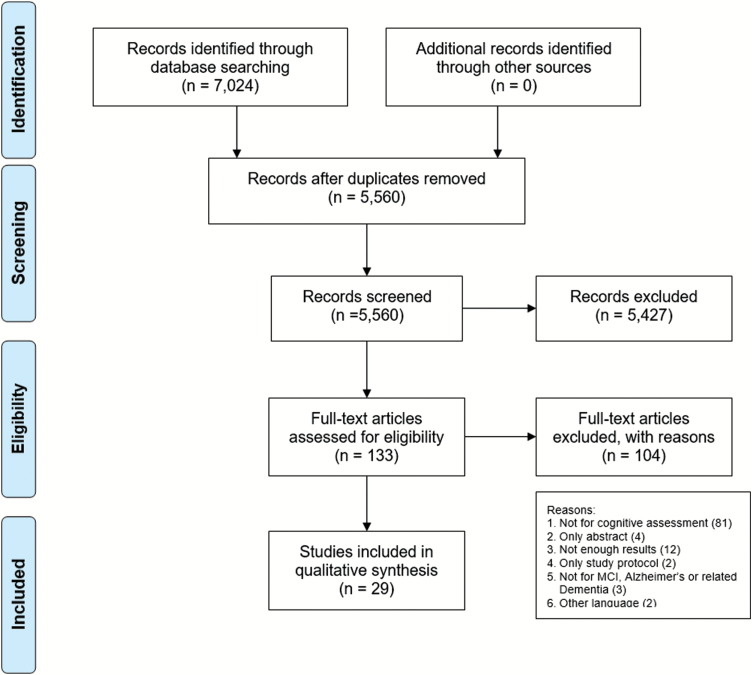
Research design and methods: We searched MEDLINE, Web of Science, PsycInfo, CINAHL, EMBASE, and Cochrane Central Register of Controlled Trials in October 2018. This search returned 7,024 articles. After removing 1,464 duplicates, we screened titles and abstracts then screened full-text for those articles meeting inclusion and exclusion criteria.
Results: Twenty-nine articles met our inclusion criteria and were categorized into 3 groups as follows: (a) mobile versions of existing article or computerized neuropsychological tests; (b) new cognitive tests developed specifically for mobile platforms; and (c) the use of new types of data for cognitive assessment. This scoping review confirms the considerable potential of mobile assessment.
Discussion and implications: Mobile technologies facilitate repeated and continuous assessment and support unobtrusive collection of auxiliary behavioral markers of cognitive impairment, thus allowing users to view trends and detect acute changes that have traditionally been difficult to identify. Opportunities include using new mobile sensors and wearable devices, improving reliability and validity of mobile assessments, determining appropriate clinical use of mobile assessment information, and incorporating person-centered assessment principles and digital phenotyping.
Keywords: Alzheimer’s disease; Cognition; Dementia; Information technology; Memory; Psychometrics; mHealth.
Figures

References
-
- Alzheimer’s Association (2017). Alzheimer’s disease facts and figures Retrieved from https://www.alz.org/facts/
-
- American Psychological Association (2012). Guidelines for the evaluation of dementia and age-related cognitive change. American Psychologist, 67, 1–9. - PubMed
-
- Anderson M., & Perrin A (2017). Tech adoption climbs among older adults Retrieved from http://www.pewinternet.org/2017/05/17/tech-adoption-climbs-among-older-a...
Publication types
Grants and funding
LinkOut - more resources
Full Text Sources
Other Literature Sources
Miscellaneous
