. 2019 Jan 4;11(1):16.
doi: 10.3390/pharmaceutics11010016.

Sequential Photodynamic Therapy with Phthalocyanine Encapsulated Chitosan-Tripolyphosphate Nanoparticles and Flucytosine Treatment against Candida tropicalis

Affiliations

Sequential Photodynamic Therapy with Phthalocyanine Encapsulated Chitosan-Tripolyphosphate Nanoparticles and Flucytosine Treatment against Candida tropicalis

Yi-Hsuan Hsieh et al. Pharmaceutics. .

Abstract

Antibiotic resistance has become a crisis. Candida tropicalis (C. tropicalis) is one of the most highly virulent and drug-resistant pathogens. An alternative antimicrobial therapy to eradicate C. tropicalis effectively, without the risk of developing drug-resistance, is needed. Photodynamic therapy (PDT) is an alternative therapy that does not carry the risk of undesired drug resistance. To target the pathogens and to enhance the cellular penetration of the applied photosensitizer, we fabricated cationic chitosan/tripolyphosphate nanoparticles to encapsulate phthalocyanine. Our strategy promotes the uptake of phthalocyanine four-fold. This enhanced PDT can effectively inhibit planktonic C. tropicalis, such that only ~20% of C. tropicalis in the test survived; but it has a limited ability to inhibit adherent C. tropicalis. Further tests with adherent C. tropicalis indicated that sequential treatment with PDT and flucytosine significantly eliminates pseudohyphae and yeast-like C. tropicalis cells. The cell viability is only ~10% after this sequential treatment. This study provides evidence of an effective therapy against drug resistant C. tropicalis, and this strategy can be potentially applied to other pathogens.

Keywords: Candida tropicalis; chitosan; flucytosine; photodynamic therapy; phthalocianine.


Conflict of interest statement

The authors declare no conflict of interest.

Figures
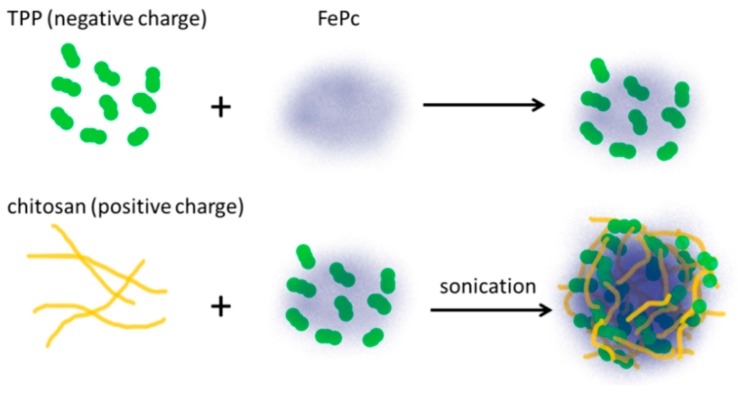
Figure 1
Figure 1
A schematic diagram for the fabrication of phthalocyanine encapsulated chitosan/TPP nanoparticles (FNP) from chitosan, tripolyphosphate (TPP), and phthalocyanine-4,4′,4″,4‴-tetrasulfonic acid (FePC).
Figure 2
Figure 2
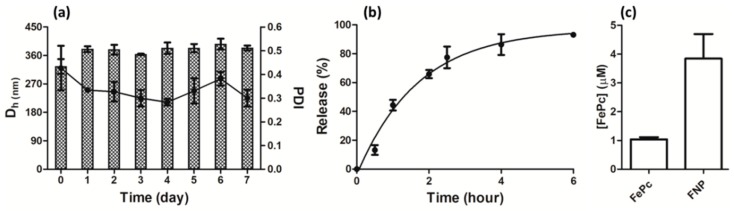
Characterization of FNP. (a) Time-course measurements of Dh and polydispersity indexes (PDI) by dynamic light scattering (DLS) shown in columns and dots, respectively; (b) the release of FePC from FNP; (c) uptake of FePC in C. tropicalis after treatment with 80 μM FePC or FNP for 4 h.
Figure 3
Figure 3
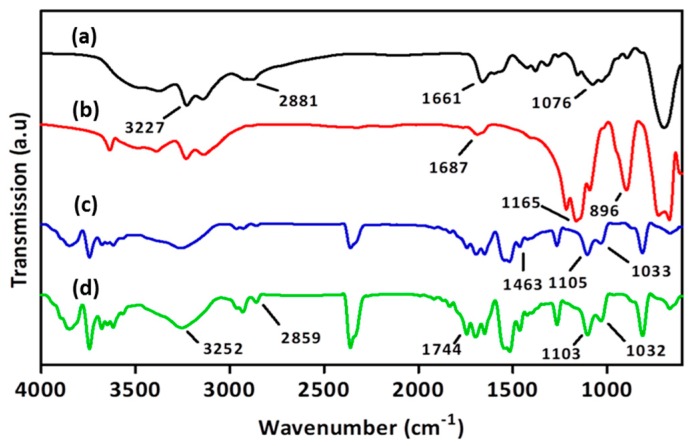
FT-IR spectra of (a) chitosan; (b) TPP; (c) FePC; and (d) FNP.
Figure 4
Figure 4
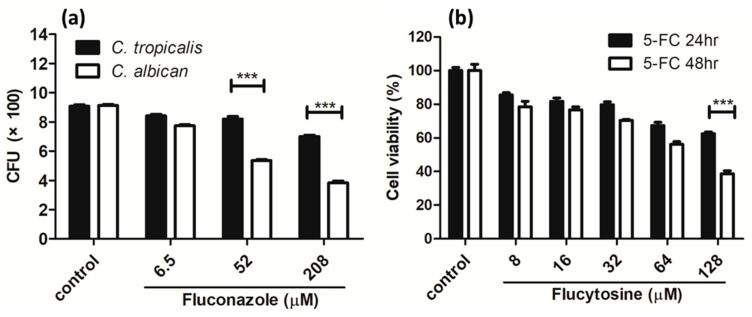
Viability of C. tropicalis after treatment with (a) fluconazole in planktonic culture in comparison to C. albican and (b) flucytosine (5-FC) in adherent culture. *** p < 0.001.
Figure 5
Figure 5
Viability of C. tropicalis in (a) planktonic cultures with FNP-PDT, and (b) adherent cultures after PDT with FePC or FNP. P and L represent photosensitizer and light, respectively. The symbol + indicates that the specific factor was used, and – indicates that the specific factor was not used. * p < 0.05, ** p < 0.01, or *** p < 0.001.
Figure 6
Figure 6
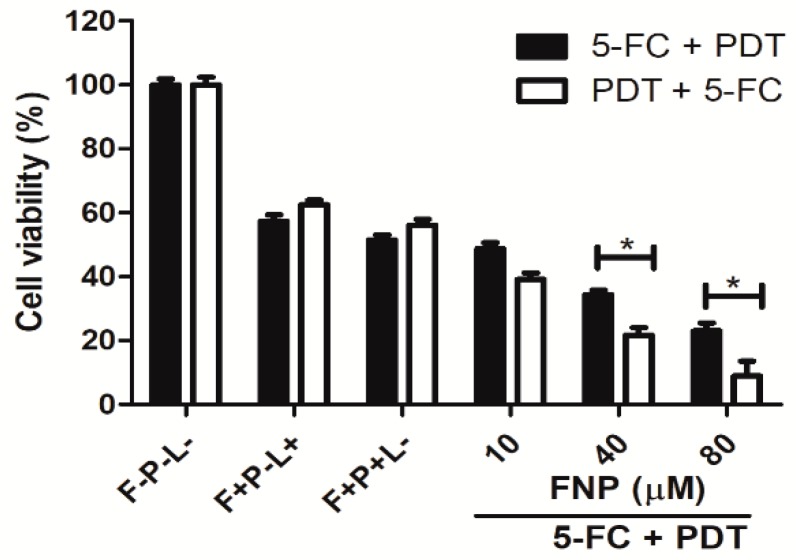
Viability of C. tropicalis in the combined therapy of flucytosine (5-FC) and FNP-PDT sequentially shown in the solid columns, and the reversed order shown in the unfilled columns. F, P and L represent flucytosine, photosensitizer and light, respectively. The symbol + indicates that the specific factor was used, and – indicates that the specific factor was not used. *p < 0.05.
Figure 7
Figure 7
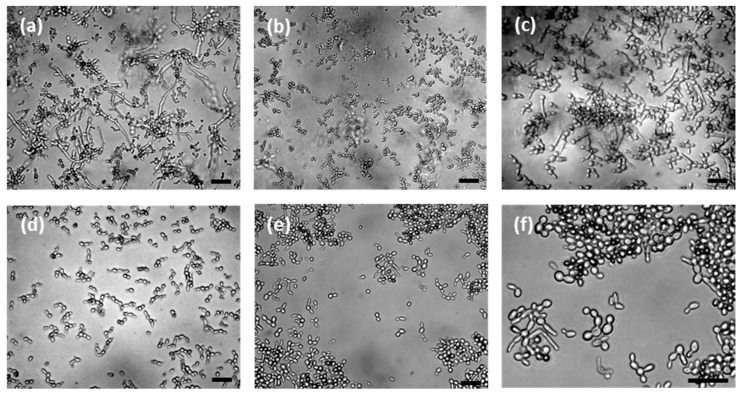
The morphology of C. tropicalis (a) before the treatment, and after treatment with (b) FNP-PDT; (c) flucytosine, and combination treatments of (d) flucytosine for 24 h followed by FNP-PDT, and (e) FNP-PDT followed by flucytosine treatment for 24 h; (f) An enlarged image of (e). The scale bar represents 10 μm.

References

    1. Ventola C.L. The antibiotic resistance crisis: Part 1: Causes and threats. P T. 2015;40:277–283. - PMC - PubMed
    1. Yapar N. Epidemiology and risk factors for invasive candidiasis. Ther. Clin. Risk Manag. 2014;10:95–105. doi: 10.2147/TCRM.S40160. - DOI - PMC - PubMed
    1. Sardi J.C., Scorzoni L., Bernardi T., Fusco-Almeida A.M., Mendes Giannini M.J. Candida species: Current epidemiology, pathogenicity, biofilm formation, natural antifungal products and new therapeutic options. J. Med. Microbiol. 2013;62:10–24. doi: 10.1099/jmm.0.045054-0. - DOI - PubMed
    1. Dimopoulos G., Karabinis A., Samonis G., Falagas M.E. Candidemia in immunocompromised and immunocompetent critically ill patients: A prospective comparative study. Eur. J. Clin. Microbiol. 2007;26:377–384. doi: 10.1007/s10096-007-0316-2. - DOI - PMC - PubMed
    1. Bennett R.J. The parasexual lifestyle of Candida albicans. Curr. Opin. Microbiol. 2015;28:10–17. doi: 10.1016/j.mib.2015.06.017. - DOI - PMC - PubMed

LinkOut - more resources