Meta-Analysis
. 2018 Dec 4:2018:1232583.
doi: 10.1155/2018/1232583. eCollection 2018.

Effects of Newer Antidiabetic Drugs on Endothelial Function and Arterial Stiffness: A Systematic Review and Meta-Analysis

Affiliations
Meta-Analysis

Effects of Newer Antidiabetic Drugs on Endothelial Function and Arterial Stiffness: A Systematic Review and Meta-Analysis

Konstantinos Batzias et al. J Diabetes Res. .

Abstract

Background: Newer antidiabetic drugs, i.e., dipeptidyl peptidase-4 (DPP-4) inhibitors, sodium-glucose cotransporter-2 (SGLT-2) inhibitors, and glucagon-like peptide-1 receptor agonists (GLP-1 RAs) may exert distinct cardiovascular effects. We sought to explore their impact on vascular function.

Methods: Published literature was systematically searched up to January 2018 for clinical studies assessing the effects of DPP-4 inhibitors, GLP-1 RAs, and SGLT-2 inhibitors on endothelial function and arterial stiffness, assessed by flow-mediated dilation (FMD) of the brachial artery and pulse wave velocity (PWV), respectively. For each eligible study, we used the mean difference (MD) with 95% confidence intervals (CIs) for FMD and PWV. The pooled MD for FMD and PWV were calculated by using a random-effect model. The presence of heterogeneity among studies was evaluated by the I 2 statistic.

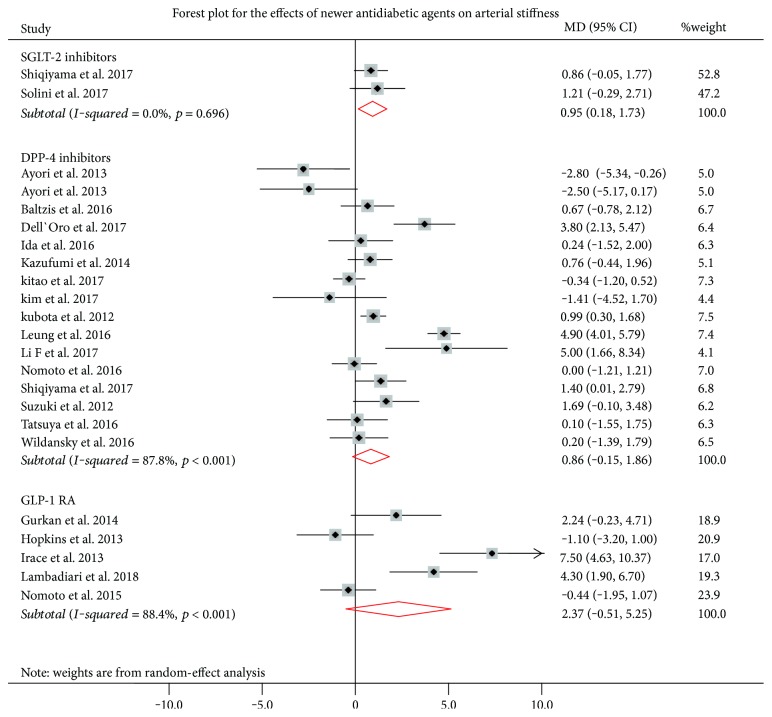
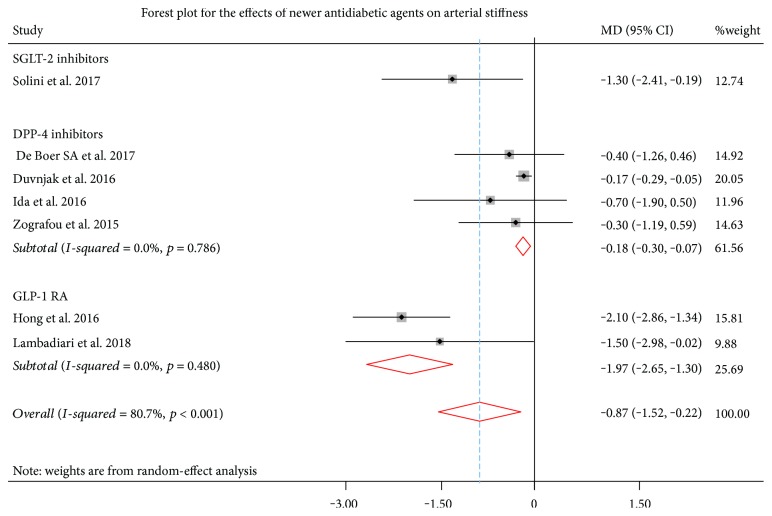
Results: A total of 26 eligible studies (n = 668 patients) were included in the present meta-analysis. Among newer antidiabetic drugs, only SGLT-2 inhibitors significantly improved FMD (pooled MD 1.14%, 95% CI: 0.18 to 1.73, p = 0.016), but not DPP-4 inhibitors (pooled MD = 0.86%, 95% CI: -0.15 to 1.86, p = 0.095) or GLP-1 RA (pooled MD = 2.37%, 95% CI: -0.51 to 5.25, p = 0.107). Both GLP-1 RA (pooled MD = -1.97, 95% CI: -2.65 to -1.30, p < 0.001) and, to a lesser extent, DPP-4 inhibitors (pooled MD = -0.18, 95% CI: -0.30 to -0.07, p = 0.002) significantly decreased PWV.

Conclusions: Newer antidiabetic drugs differentially affect endothelial function and arterial stiffness, as assessed by FMD and PWV, respectively. These findings could explain the distinct effects of these drugs on cardiovascular risk of patients with type 2 diabetes.


Figures
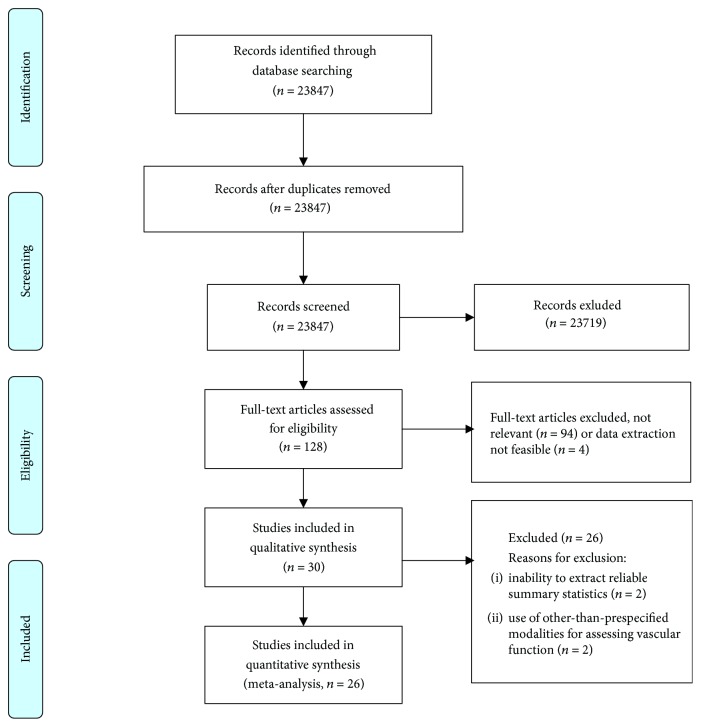
Figure 1
Figure 1
Study flow chart.
Figure 2
Figure 2
Effects of newer antidiabetic drugs on endothelial function. Squares indicate the mean difference (MD) and the respective 95% confidence intervals in flow-mediated dilatation (FMD) before/after treatment from eligible studies. The size of the squares corresponds to the weight of each study. The diamonds and their width represent the pooled MD and the 95% CI, respectively. DPP-4 = DPP-4 inhibitors, SGLT-2 inhibitors, and GLP-1 RAs and defines them under the figure. DPP-4: dipeptidyl peptidase-4; GLP-1 RAs: glucagon-like peptide-1 receptor agonists; SGLT-2: sodium-glucose cotransporter-2.
Figure 3
Figure 3
Effects of newer antidiabetic drugs on arterial stiffness. Squares indicate the mean difference (MD) and the respective 95% confidence intervals in pulse wave velocity (PWV) before/after treatment from eligible studies. The size of the squares corresponds to the weight of each study. The diamonds and their width represent the pooled weighted MD and the 95% CI, respectively. DPP-4: dipeptidyl peptidase-4; GLP-1 RAs: glucagon-like peptide-1 receptor agonists; SGLT-2: sodium-glucose cotransporter-2.
Figure 4
Figure 4
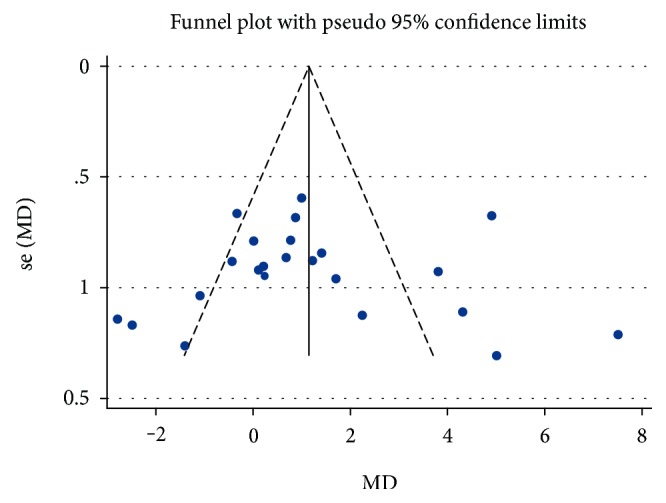
Funnel plot and assessment of publication bias. Funnel plot with 95% pseudoconfidence intervals of the effect size and its standard error for studies assessing the effects of newer antidiabetic drugs on the primary endpoint endothelial function. Large studies appear toward the top of the graph and tend to cluster near the mean effect size. Smaller studies appear toward the bottom of the graph and (since there is more sampling variation in effect size estimates in the smaller studies) will be dispersed across a range of values. The symmetric distribution of studies about the combined effect size indicates the absence of publication bias.

References

    1. Shaw J. E., Sicree R. A., Zimmet P. Z. Global estimates of the prevalence of diabetes for 2010 and 2030. Diabetes Research and Clinical Practice. 2010;87(1):4–14. doi: 10.1016/j.diabres.2009.10.007. - DOI - PubMed
    1. The Emerging Risk Factors Collaboration. Diabetes mellitus, fasting blood glucose concentration, and risk of vascular disease: a collaborative meta-analysis of 102 prospective studies. The Lancet. 2010;375(9733):2215–2222. doi: 10.1016/s0140-6736(10)60484-9. - DOI - PMC - PubMed
    1. Low Wang C. C., Hess C. N., Hiatt W. R., Goldfine A. B. Clinical update: cardiovascular disease in diabetes mellitus. Atherosclerotic cardiovascular disease and heart failure in type 2 diabetes mellitus – mechanisms, management and clinical considerations. Circulation. 2016;133(24):2459–2502. doi: 10.1161/circulationaha.116.022194. - DOI - PMC - PubMed
    1. Antonopoulos A. S., Siasos G., Tousoulis D. Microangiopathy, arterial stiffness, and risk stratification in patients with type 2 diabetes. JAMA Cardiology. 2017;2(7):820–821. doi: 10.1001/jamacardio.2017.0159. - DOI - PubMed
    1. Antonopoulos A. S., Margaritis M., Coutinho P., et al. Adiponectin as a link between type 2 diabetes and vascular NADPH oxidase activity in the human arterial wall: the regulatory role of perivascular adipose tissue. Diabetes. 2015;64(6):2207–2219. doi: 10.2337/db14-1011. - DOI - PubMed

MeSH terms

Substances