


Patterns of body mass index milestones in early life and cardiometabolic risk in early adolescence
- PMID: 30624710
- PMCID: PMC6380298
- DOI: 10.1093/ije/dyy286
Patterns of body mass index milestones in early life and cardiometabolic risk in early adolescence
Abstract
Background: Few studies have examined the independent and combined relationships of body mass index (BMI) peak and rebound with adiposity, insulin resistance and metabolic risk later in life. We used data from Project Viva, a well-characterized birth cohort from Boston with repeated measures of BMI, to help fill this gap.
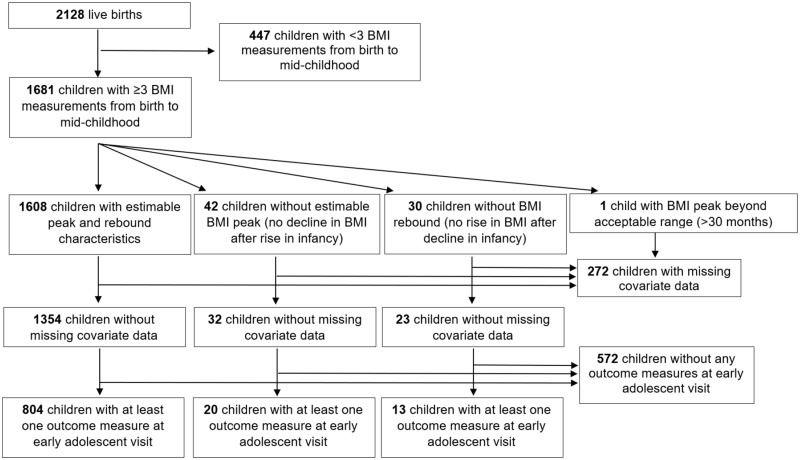
Methods: Among 1681 children with BMI data from birth to mid childhood, we fitted individual BMI trajectories using mixed-effects models with natural cubic splines and estimated age, and magnitude of BMI, at peak (in infancy) and rebound (in early childhood). We obtained cardiometabolic measures of the children in early adolescence (median 12.9 years) and analysed their associations with the BMI parameters.
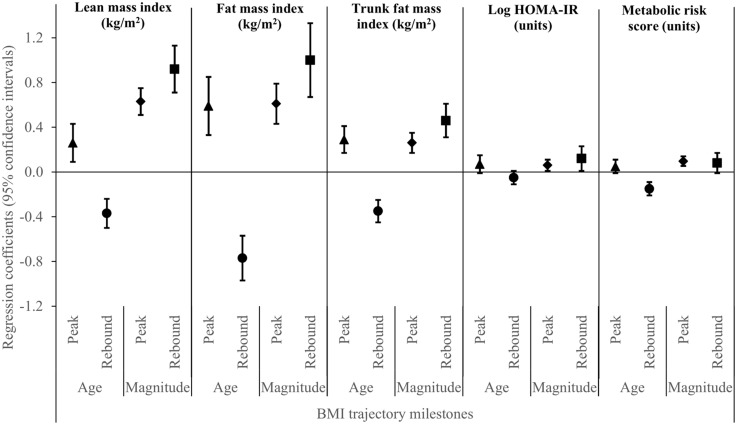
Results: After adjusting for potential confounders, age and magnitude at infancy BMI peak were associated with greater adolescent adiposity, and earlier adiposity rebound was strongly associated with greater adiposity, insulin resistance and metabolic risk score independently of BMI peak. Children with a normal timing of BMI peak plus early rebound had an adverse cardiometabolic profile, characterized by higher fat mass index {β 2.2 kg/m2 [95% confidence interval (CI) 1.6, 2.9]}, trunk fat mass index [1.1 kg/m2 (0.8, 1.5)], insulin resistance [0.2 units (0.04, 0.4)] and metabolic risk score [0.4 units (0.2, 0.5)] compared with children with a normal BMI peak and a normal rebound pattern. Children without a BMI peak (no decline in BMI after the rise in infancy) also had adverse adolescent metabolic profiles.
Conclusions: Early age at BMI rebound is a strong risk factor for cardiometabolic risk, independent of BMI peak. Children with a normal peak-early rebound pattern, or without any BMI decline following infancy, are at greatest risk of adverse cardiometabolic profile in adolescence. Routine monitoring of BMI may help to identify children who are at greatest risk of developing an adverse cardiometabolic profile in later life and who may be targeted for preventive interventions.
Keywords: Lifecourse epidemiology; body mass index peak; body mass index rebound; cardiometabolic outcomes; growth trajectories.
© The Author(s) 2019; all rights reserved. Published by Oxford University Press on behalf of the International Epidemiological Association.
Figures
References
-
- Singh AS, Mulder C, Twisk JW, van Mechelen W, Chinapaw MJ. Tracking of childhood overweight into adulthood: a systematic review of the literature. Obes Rev 2008;9:474–88. - PubMed
-
- Naukkarinen J, Rissanen A, Kaprio J, Pietilainen KH. Causes and consequences of obesity: the contribution of recent twin studies. Int J Obes (Lond) 2012;36:1017–24. - PubMed
Publication types
MeSH terms
Grants and funding
LinkOut - more resources
Full Text Sources
Medical
Miscellaneous
