Review
. 2019 Jan 6:59:65-87.
doi: 10.1146/annurev-pharmtox-010716-104727.

Emerging Pharmacological Targets for the Treatment of Nonalcoholic Fatty Liver Disease, Insulin Resistance, and Type 2 Diabetes

Affiliations
Review

Emerging Pharmacological Targets for the Treatment of Nonalcoholic Fatty Liver Disease, Insulin Resistance, and Type 2 Diabetes

Leigh Goedeke et al. Annu Rev Pharmacol Toxicol. .

Abstract

Type 2 diabetes (T2D) is characterized by persistent hyperglycemia despite hyperinsulinemia, affects more than 400 million people worldwide, and is a major cause of morbidity and mortality. Insulin resistance, of which ectopic lipid accumulation in the liver [nonalcoholic fatty liver disease (NAFLD)] and skeletal muscle is the root cause, plays a major role in the development of T2D. Although lifestyle interventions and weight loss are highly effective at reversing NAFLD and T2D, weight loss is difficult to sustain, and newer approaches aimed at treating the root cause of T2D are urgently needed. In this review, we highlight emerging pharmacological strategies aimed at improving insulin sensitivity and T2D by altering hepatic energy balance or inhibiting key enzymes involved in hepatic lipid synthesis. We also summarize recent research suggesting that liver-targeted mitochondrial uncoupling may be an attractive therapeutic approach to treat NAFLD, nonalcoholic steatohepatitis, and T2D.

Keywords: ectopic lipids; insulin resistance; liver-targeted mitochondrial uncoupling; type 2 diabetes.


Figures
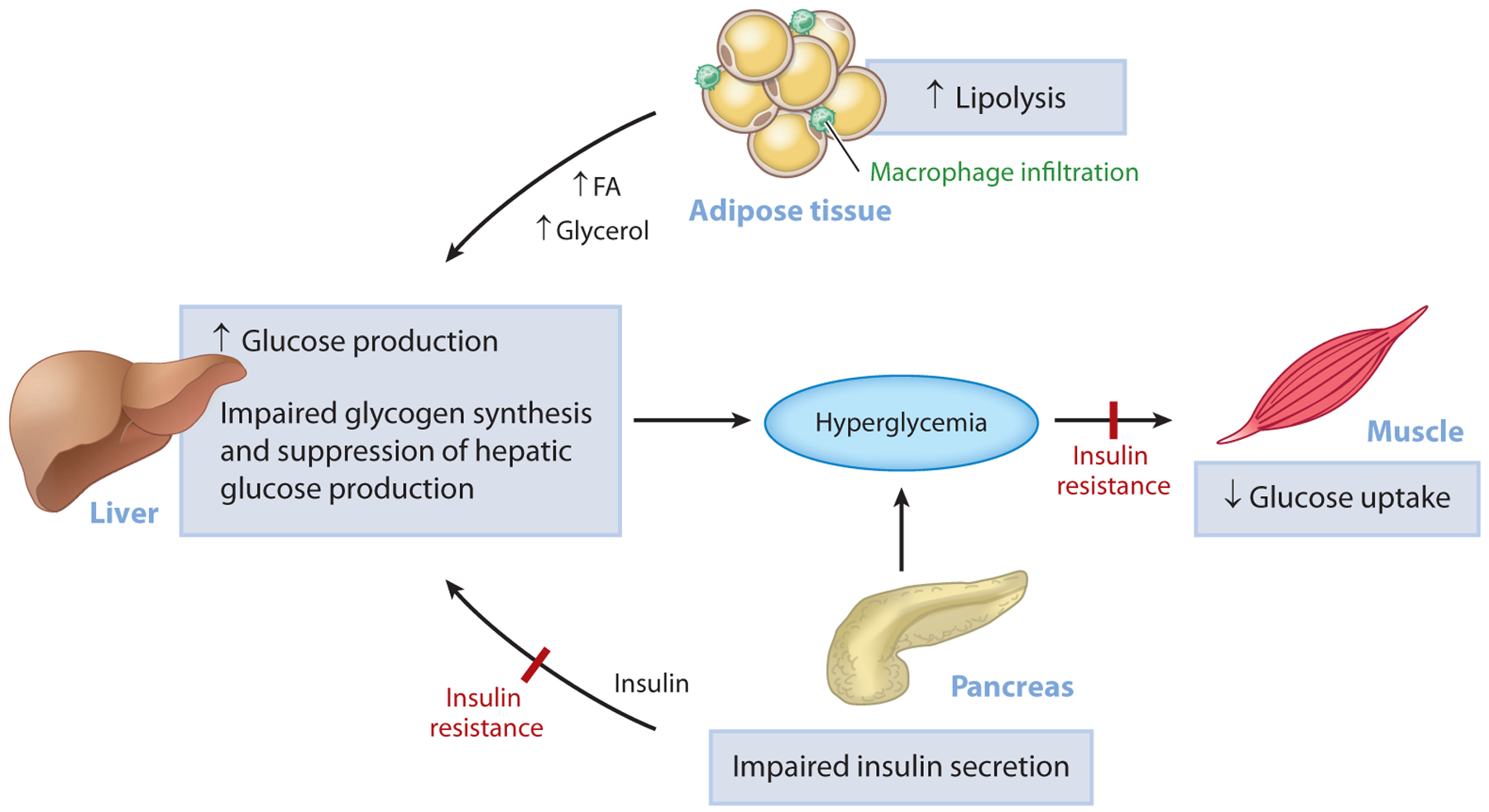
Figure 1
Figure 1
Pathogenesis of hyperglycemia in T2D. Uncontrolled hyperglycemia is a hallmark of T2D and is a major risk factor for long-term microvascular and macrovascular complications. While the progressive loss of pancreatic islet β-cell function is ultimately responsible for the progression from normoglycemia to hyperglycemia, insulin resistance predates β-cell dysfunction and plays a major role in the pathogenesis of T2D. In the muscle, insulin resistance is manifested as impaired glucose uptake following ingestion of a carbohydrate-rich meal and results in postprandial hyperglycemia. In the liver, insulin resistance is characterized by the inability of insulin to stimulate hepatic glycogen synthesis and suppress hepatic glucose production under postprandial conditions. In parallel, inappropriate increases in adipose tissue lipolysis (due to increases in inflammation) can drive hepatic gluconeogenesis through increases in hepatic acetyl-CoA content, allosteric activation of PC, and increased conversion of glycerol to glucose. Initially, the β-cell compensates for alterations in tissue insulin responsiveness by increasing insulin secretion; however, over time, this compensatory mechanism fails and β-cell mass declines, causing a further reduction in insulin secretion, worsening of hyperglycemia, and overt T2D. Abbreviations: FA, fatty acid; PC, pyruvate carboxylase; T2D, type 2 diabetes.
Figure 2
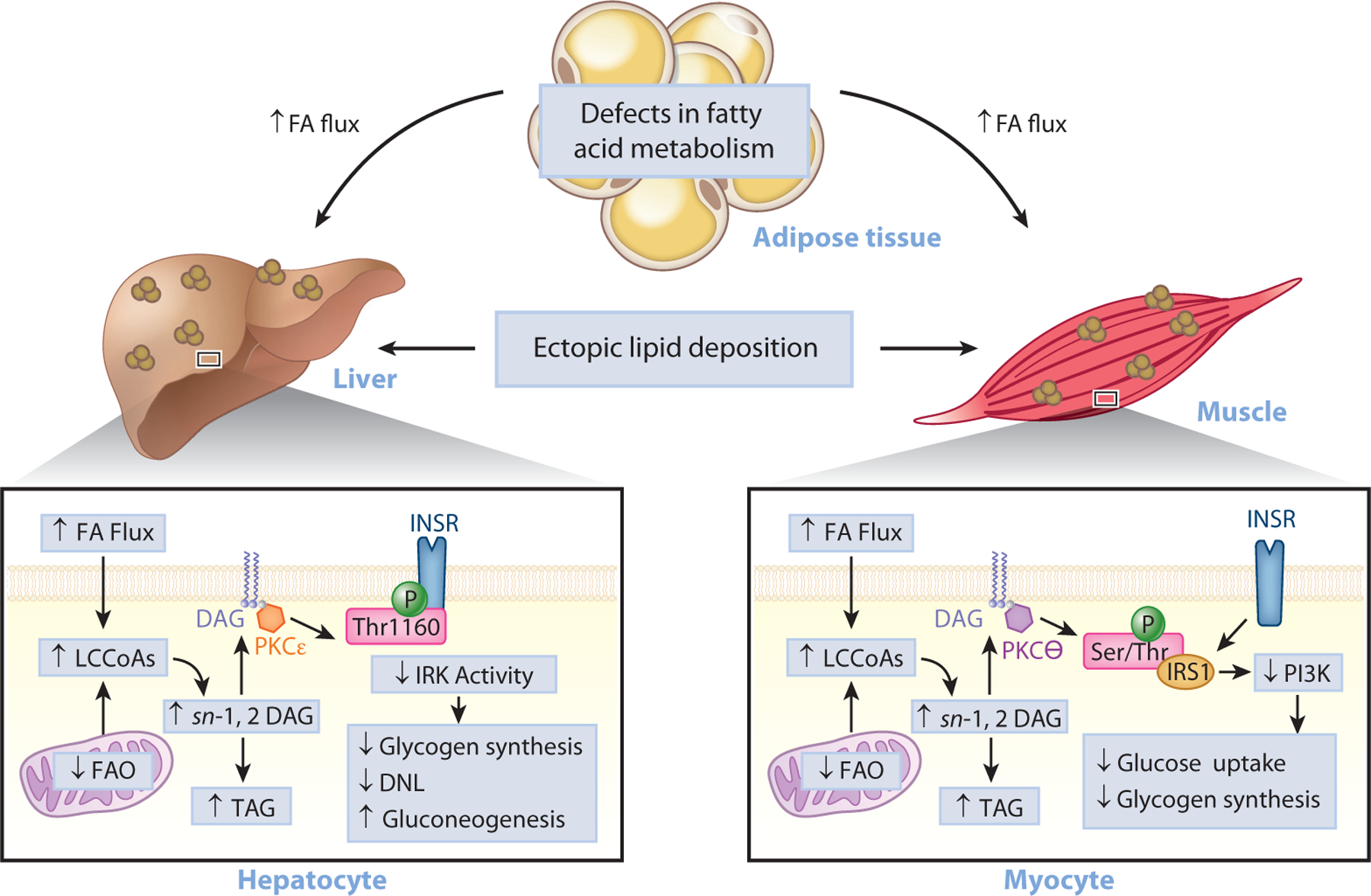
Figure 2
The role of ectopic lipids in insulin resistance. Under conditions of overnutrition or defective adipocyte fatty acid metabolism, lipids can be redistributed from eutopic sites (adipose tissue) to ectopic storage sites (liver and muscle) and lead to impaired insulin signaling, insulin resistance, and T2D. Lipid-induced hepatic insulin resistance may result from activation of the DAG–PKCε axis and the consequent inhibition of INSR signaling through inhibitory phosphorylation of INSR at Thr1160. This leads to impaired insulin stimulation of hepatic glycogen synthesis, impaired transcriptional upregulation of de novo lipogenic genes, and impaired transcriptional downregulation of gluconeogenic genes. Skeletal muscle insulin resistance, caused by increases in intramyocellular ectopic lipid, impairs insulin-stimulated glucose transport and glycogen synthesis through the activation of the DAG–PKCθ axis and the consequent inhibition of the PI3K pathway through inhibitory phosphorylation of IRS1. Abbreviations: DAG, diacylglycerol; FA, fatty acid; FAO, fatty acid oxidation; INSR, insulin receptor; IRK, insulin receptor kinase; IRS1, insulin receptor substrate 1; LCCoA, long-chain CoA; PI3K, phosphoinositide 3-kinase; PKC, protein kinase C; Ser/Thr, serine/threonine; T2D, type 2 diabetes; TAG, triglyceride; Thr1160, threonine 1160.
Figure 3
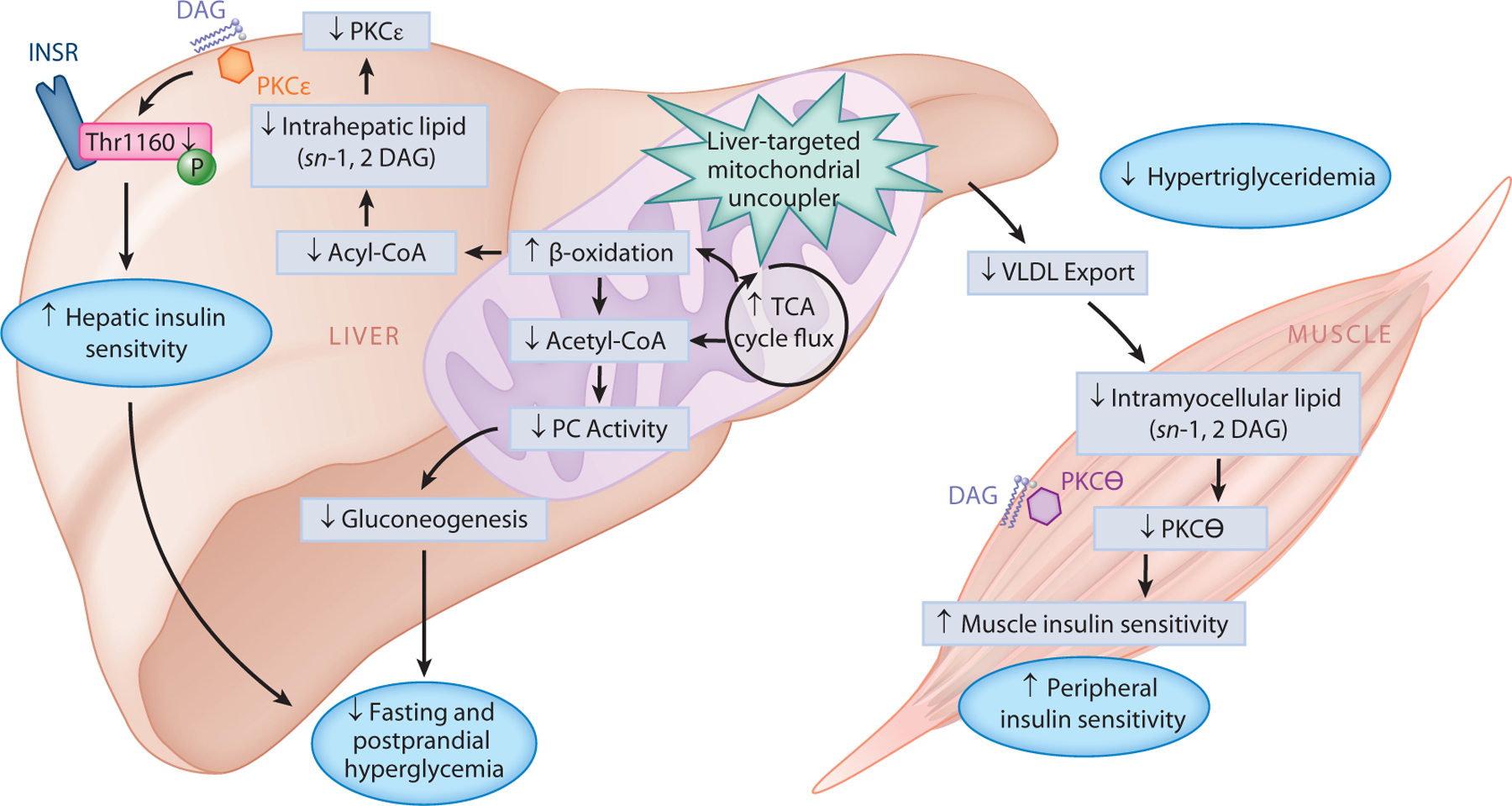
Figure 3
Therapeutic potential of liver-targeted mitochondrial uncouplers for the treatment of T2D. Promoting increased hepatic cellular energy expenditure through the use of liver-targeted mitochondrial uncoupling agents (such as DNP analogs, DNPME, and CRMP) holds therapeutic promise for the treatment of NAFLD, NASH, and T2D. By increasing fat oxidation exclusively in the liver, DNPME and CRMP lower hepatic triglycerides, DAGs, and PKCε translocation, which increases hepatic insulin sensitivity. Liver-targeted mitochondrial uncoupling also increases TCA cycle flux, which reduces hepatic acetyl-CoA content, PC activity, and gluconeogenesis; collectively, this leads to reduced fasting and postprandial hyperglycemia. Moreover, DNPME and CRMP also lower hepatic VLDL export, thereby reducing muscle DAG content, reducing PKCθ activity, and reversing muscle insulin resistance. Overall, these improvements in liver and muscle insulin resistance can reverse diabetes in rodent models of NASH and T2D and suggest that liver-targeted mitochondrial uncoupling agents may be a therapy for the treatment of T2D in humans. Abbreviations: CRMP, controlled-release mitochondrial protonophore; DAG, diacylglycerol; DNP, 2,4-dinitrophenol; DNPME, DNP–methyl ether; INSR, insulin receptor; NAFLD, nonalcoholic fatty liver disease; NASH, nonalcoholic steatohepatitis; PC, pyruvate carboxylase; PKC, protein kinase C; T2D, type 2 diabetes; TCA, tricarboxylic acid; Thr1160, threonine 1160; VLDL, very low-density lipoprotein.

References

    1. Ogurtsova K, da Rocha Fernandes JD, Huang Y, Linnenkamp U, Guariguata L, et al. 2017. IDF Diabetes Atlas: global estimates for the prevalence of diabetes for 2015 and 2040. Diabetes Res. Clin. Pract 128:40–50 - PubMed
    1. DeFronzo RA, Ferrannini E, Groop L, Henry RR, Herman WH, et al. 2015. Type 2 diabetes mellitus. Nat. Rev. Dis. Primers 1:15019. - PubMed
    1. Wang Y, Beydoun MA, Liang L, Caballero B, Kumanyika SK. 2008. Will all Americans become overweight or obese? Estimating the progression and cost of the US obesity epidemic. Obesity 16:2323–30 - PubMed
    1. Boyle JP, Honeycutt AA, Narayan KM, Hoerger TJ, Geiss LS, et al. 2001. Projection of diabetes burden through 2050: impact of changing demography and disease prevalence in the U.S. Diabetes Care 24:1936–40 - PubMed
    1. Finkelstein EA, Trogdon JG, Cohen JW, Dietz W. 2009. Annual medical spending attributable to obesity: payer-and service-specific estimates. Health Aff. 28:w822–31 - PubMed

Publication types

MeSH terms