Review
. 2019 Jan 8;11(1):22.
doi: 10.3390/pharmaceutics11010022.

Current Trends in Cancer Nanotheranostics: Metallic, Polymeric, and Lipid-Based Systems

Affiliations
Review

Current Trends in Cancer Nanotheranostics: Metallic, Polymeric, and Lipid-Based Systems

Catarina Oliveira Silva et al. Pharmaceutics. .

Abstract

Theranostics has emerged in recent years to provide an efficient and safer alternative in cancer management. This review presents an updated description of nanotheranostic formulations under development for skin cancer (including melanoma), head and neck, thyroid, breast, gynecologic, prostate, and colon cancers, brain-related cancer, and hepatocellular carcinoma. With this focus, we appraised the clinical advantages and drawbacks of metallic, polymeric, and lipid-based nanosystems, such as low invasiveness, low toxicity to the surrounding healthy tissues, high precision, deeper tissue penetration, and dosage adjustment in a real-time setting. Particularly recognizing the increased complexity and multimodality in this area, multifunctional hybrid nanoparticles, comprising different nanomaterials and functionalized with targeting moieties and/or anticancer drugs, present the best characteristics for theranostics. Several examples, focusing on their design, composition, imaging and treatment modalities, and in vitro and in vivo characterization, are detailed herein. Briefly, all studies followed a common trend in the design of these theranostics modalities, such as the use of materials and/or drugs that share both inherent imaging (e.g., contrast agents) and therapeutic properties (e.g., heating or production reactive oxygen species). This rationale allows one to apparently overcome the heterogeneity, complexity, and harsh conditions of tumor microenvironments, leading to the development of successful targeted therapies.

Keywords: cancer imaging; cancer treatment; gold nanoparticles; lipid-based nanosystems; nanotheranostics; polymeric nanoparticles.


Conflict of interest statement

The authors declare no conflict of interest.

Figures
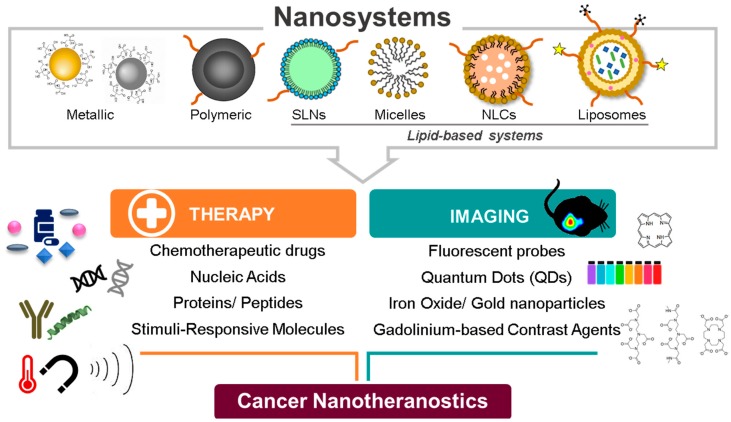
Figure 1
Figure 1
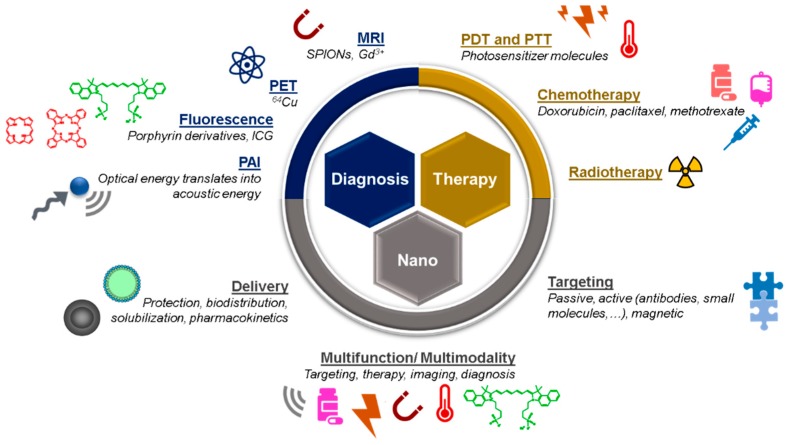
Nanotheranostics: polymeric, metallic, and lipid-based nanosystems for cancer management.
Figure 2
Figure 2
Schematic illustration of triple features in theranostic nanoplatforms, namely nano-sized particle, therapeutic, and diagnostic agents. Adapted with permission from Zhang P, Hu C, Ran W, Meng J, Yin Q, Li Y. Recent progress in light-triggered nanotheranostics for cancer treatment. Theranostics. 2016;6(7):948; copyright 2016 Ivyspring International Publisher [9].
Figure 3
Figure 3
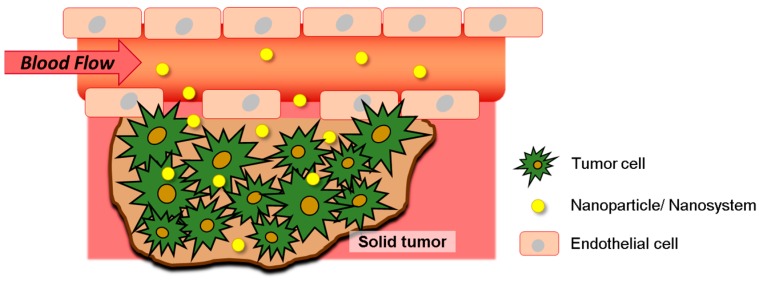
Illustration of the accumulation of nanosystems at tumor sites through an enhanced permeation and retention (EPR) effect.
Figure 4
Figure 4
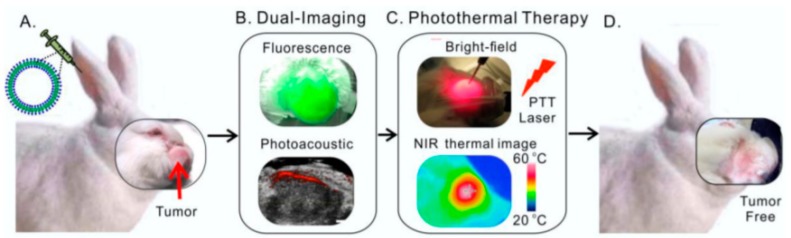
Schematic image of the dual-imaging and PTT effect on head and neck cancer from rabbit. (A) Porphysomes injected intravenously via ear vein of the rabbit; (B) at 24 h post-injection, both fluorescence and photoacoustic imaging were enabled; (C) in vivo photothermal ablation of rabbit tumor by two-step ablations (intra-tumor and transdermal); (D) the tumor was eliminated with no recurrence. Adapted with permission from Muhanna, Jin, Huynh, Chan, Qiu, Jiang, Cui, Burgess, Akens, Chen, and Irish. Phototheranostic porphyrin nanoparticles enable visualization and targeted treatment of head and neck cancer in clinically relevant models. Theranostics. 2015;5(12):1428; copyright 2015 Ivyspring International Publisher [74].
Figure 5
Figure 5
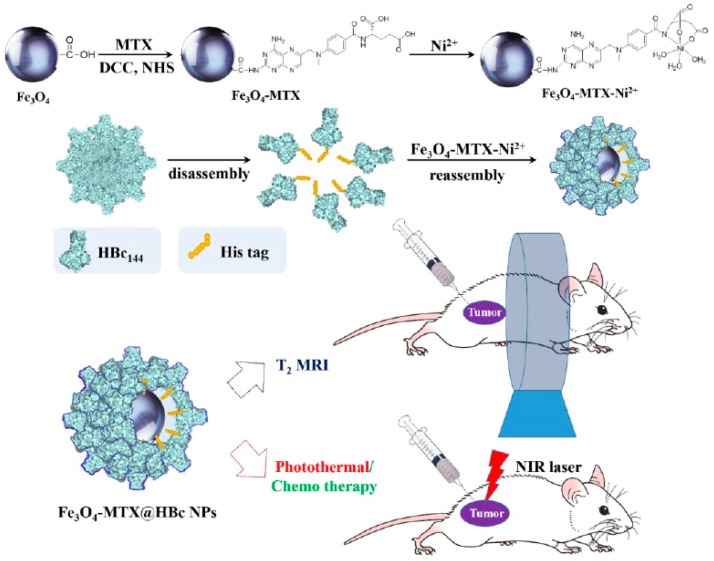
Schematic description of Fe3O4 magnetic nanoparticles conjugated with methotrexate for triple action in imaging (MRI contract agent) and therapeutic (photothermal and chemo therapy). Adapted with permission from Zhang, Shan, Ai, Chen, Zhou, Lv, Zhou, Ye, Ren, and Wang. Construction of Multifunctional Fe3O4-MTX@HBc Nanoparticles for MR Imaging and Photothermal Therapy/Chemotherapy, Nanotheranostics. 2018; 2(1): 87–95. doi: 10.7150/ntno.21942 copyright 2018 Ivyspring International Publisher [94].

References

    1. Bray F., Ferlay J., Soerjomataram I., Siegel R.L., Torre L.A., Jemal A. Global cancer statistics 2018: GLOBOCAN estimates of incidence and mortality worldwide for 36 cancers in 185 countries. CA Cancer J. Clin. 2018 doi: 10.3322/caac.21492. - DOI - PubMed
    1. Nabil G., Bhise K., Sau S., Atef M., El-Banna H.A., Iyer A.K. Nanoengineered delivery systems for cancer imaging and therapy: Recent advances, future directions and patent evaluation. Drug Discov. Today. 2018 doi: 10.1016/j.drudis.2018.08.009. - DOI - PMC - PubMed
    1. Chen Y., Li H., Deng Y., Sun H., Ke X., Ci T. Near-infrared light triggered drug delivery system for higher efficacy of combined chemo-photothermal treatment. Acta Biomater. 2017;51:374–392. doi: 10.1016/j.actbio.2016.12.004. - DOI - PubMed
    1. Lammers T., Kiessling F., Hennink W.E., Storm G. Nanotheranostics and image-guided drug delivery: Current concepts and future directions. Mol. Pharm. 2010;7:1899–1912. doi: 10.1021/mp100228v. - DOI - PubMed
    1. Dreifuss T., Betzer O., Motiei M., Popovtzer R., Barnoy E. The effect of nanoparticle size on theranostic systems: The optimal particle size for imaging is not necessarily optimal for drug delivery. In: Cartwright A.N., Nicolau D.V., Fixler D., editors. Nanoscale Imaging, Sensing, and Actuation for Biomedical Applications XV. Volume 10506. SPIE; Bellingham, WA, USA: 2018. p. 39.

LinkOut - more resources